

More news on this day
Europe’s busiest aviation gateways are straining under a wave of flight cancellations and severe delays, with London Heathrow and Paris Charles de Gaulle repeatedly emerging as epicentres of disruption in recent days.
Get the latest news straight to your inbox!
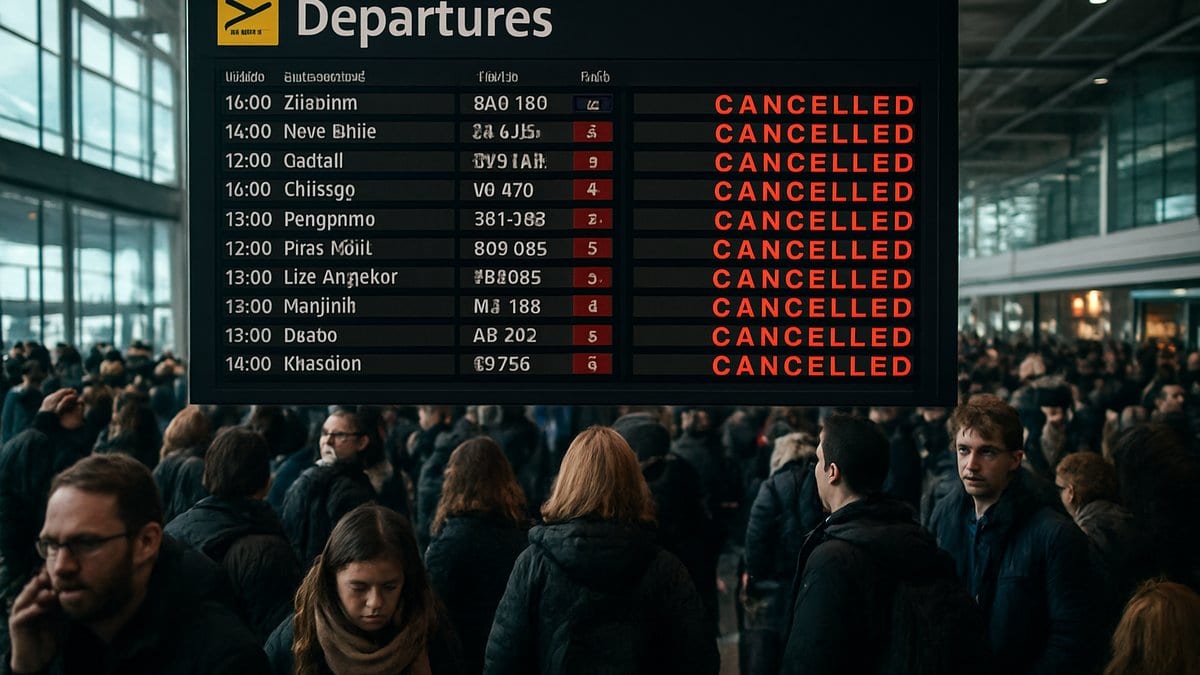
Fresh Data Underscore an Intensifying Pattern of Disruption
Recent operational data and industry reports point to a marked escalation in flight disruption across Europe’s main hubs, with London Heathrow and Paris Charles de Gaulle featuring prominently in a series of cascading breakdowns. On 29 March 2026, monitoring by independent aviation trackers indicated that carriers including Virgin Atlantic, British Airways, SAS and Air France collectively cancelled 16 flights and delayed around 2,000 more across Heathrow, Charles de Gaulle and Zurich, leaving long-haul connections to Asia and the Pacific particularly exposed.
Just a day later, on 30 March, Paris Charles de Gaulle again recorded heavy operational strain, with published coverage describing nearly 400 delayed services and several cancellations affecting major European and transatlantic carriers. Observers noted that the pattern was not confined to a single airline or route but spread across alliances, pointing to broader network stress rather than isolated scheduling issues.
Broader figures for March underline how central Paris and London have become to the unfolding crisis. Travel rights analysts tracking the month’s performance cited approximately 1,838 delayed flights and 90 cancellations on a single day across multiple European countries, with Charles de Gaulle repeatedly listed among the worst affected airports. Separate summaries of March disruption likewise highlighted Heathrow and Charles de Gaulle, alongside Frankfurt, Amsterdam and Barcelona, as the main flashpoints where departure boards have become dominated by red delay indicators.
While Heathrow’s official annual cancellation rate in 2025 remained under 1 percent of scheduled movements, according to Civil Aviation Authority analysis, the current spike in operational incidents is prompting questions about whether headline reliability figures adequately capture the lived experience of travellers during concentrated periods of stress.
Strikes, Staffing and System Tests Converge on Key Gateways
Behind the mounting disruption at Heathrow and Charles de Gaulle lies a complex mix of staffing constraints, air traffic management challenges and system changes that have converged at Europe’s busiest airports. Network operations data published by Eurocontrol for February 2026 note that live trials of a new Target Time Management System at Heathrow generated several thousand minutes of delay, particularly when combined with adverse weather and aerodrome constraints.
In Paris, Eurocontrol’s reporting details a separate technical episode at Charles de Gaulle in February, when a ground radar issue over two days contributed to more than a thousand delay events. These technical challenges have been layered onto a backdrop of recurrent industrial action, including air traffic controller strikes in France and broader labour disputes across the continent, which have repeatedly forced airlines to thin schedules and reroute aircraft through already congested airspace.
Industry observers stress that these chronic factors are colliding with the ongoing effort to rebuild capacity after the pandemic era. Airlines are running tighter crew rosters and higher aircraft utilisation, leaving less slack in the system when weather, equipment or staffing issues arise. Reports from recent disruption days point to crew and aircraft being out of position after earlier cancellations, creating knock-on effects that were still being felt across the Heathrow and Paris networks many hours later.
At the same time, climate driven volatility is sharpening the operational edge. Studies on weather related air traffic management published in recent months highlight that major European hubs such as Heathrow and Charles de Gaulle are increasingly vulnerable to storm systems, low visibility and high winds, which can rapidly erode runway capacity and trigger holding patterns that cascade through airline schedules.
Paris Network Reshuffle Amplifies Pressure on Charles de Gaulle
The timing of Air France’s long planned consolidation of operations in Paris is adding an extra layer of strain. As of 29 March 2026, the carrier has ended all scheduled flights at Paris Orly and shifted both its domestic and international network to Charles de Gaulle. Aviation industry coverage describes the move as a structural simplification for the airline, but the short term impact is a further concentration of traffic at an airport already experiencing frequent control and capacity bottlenecks.
Prior to the consolidation, Orly had acted as a pressure valve for parts of the Paris market, taking a significant share of domestic and regional flying. With these services now folded into Charles de Gaulle, any technical issue, storm cell or staffing shortage at the larger hub has widened consequences, catching travellers who previously might have been insulated by the dual airport system.
Reports from late March show that low cost and full service carriers alike have been forced to cancel or heavily delay departures from Charles de Gaulle as congestion ripples through the terminals. Flight disruption trackers have documented double digit cancellations by major European low cost airlines from Paris and other French airports in March, alongside extended rebooking windows that stretch several days beyond original travel dates.
For passengers, the practical result is that even relatively minor operational hiccups now risk tipping Charles de Gaulle into visible gridlock, with queues forming at check in, security and customer service desks while departure boards cycle through delay notifications.
Heathrow Feels the Shockwaves of a Saturated European Network
Heathrow’s role as a primary intercontinental gateway means that it is not only dealing with its own operational challenges but also absorbing knock on disruption from across Europe. When Paris, Frankfurt or Amsterdam encounter severe delays, connecting passengers and aircraft schedules feeding into Heathrow’s long haul operations are quickly affected, leading to misaligned crews, late inbound aircraft and missed slots.
Recent incident reports highlight how quickly this can escalate. On some of the most disrupted days in March, Heathrow has seen dozens of cancellations combined with several hundred delayed services, particularly across short haul links that connect the London hub to secondary European cities. Travel analysts note that carriers often respond by trimming lightly booked flights and consolidating services, a strategy that can stabilise operations but strands travellers who suddenly find their departures scrubbed from the board.
Historic examples underline Heathrow’s vulnerability to concentrated shocks. A power substation fire near the airport in March 2025 forced a full closure for around 16 hours and led to the cancellation of more than a thousand flights, an episode that still shapes airline contingency planning today. While current disruption has not reached that scale, the memory of abrupt and extended shutdowns informs the caution that airlines and airport managers display when technical anomalies arise.
With Good Friday on 3 April identified by travel forecasters as one of the most disruption prone days of 2026 at UK airports, pressure on Heathrow is set to intensify further as the Easter peak collides with constrained capacity, unsettled weather and an already stretched European network.
Passengers Navigate Rights, Compensation and Growing Uncertainty
For travellers caught in the latest wave of cancellations and delays at Heathrow and Paris, attention is increasingly turning to compensation and rebooking options. Consumer advocates and specialist travel law outlets have spent recent weeks reiterating the protections available under European Union Regulation 261 and its post Brexit counterparts in the United Kingdom, which can provide fixed compensation where cancellations or long delays are considered within airline control.
According to guidance widely circulated by passenger rights groups, travellers departing from EU and UK airports, or flying into the region on EU or UK carriers, may be entitled to between 250 and 600 euros for significant disruption, depending on distance and length of delay. Airlines are also required to provide care, including meals and accommodation, when passengers are forced to wait extended periods because of operational decisions that are not linked to extraordinary circumstances such as extreme weather or airspace closures.
However, reports from March’s disruption indicate that accessing these rights in practice can be challenging. Overstretched ground staff at Heathrow and Charles de Gaulle are often focused on immediate operational needs, leaving passengers to navigate online claim forms after the fact. Low cost carriers in particular have been documented offering travel vouchers and extended rebooking windows instead of upfront cash refunds, solutions that may suit some passengers but not others.
As Europe heads into the main summer travel season, analysts warn that the recent episodes at Heathrow and Paris could be a preview of more turbulent months ahead. With structural capacity limits at key airports, aging air traffic infrastructure and increasingly volatile weather patterns, the margin for error at Europe’s primary gateways is narrowing, and travellers transiting Heathrow and Charles de Gaulle may need to factor persistent disruption risk into their plans for the foreseeable future.