

More news on this day
From self-driving shuttles in Brussels to multi-billion-euro terminal upgrades in Madrid and fully reengineered passenger flows in Amsterdam and Stockholm, a cluster of major European hubs is racing to redefine what travelers can expect from the continent’s airports over the next decade.
Brussels Airport Steps Into the Mobility Future
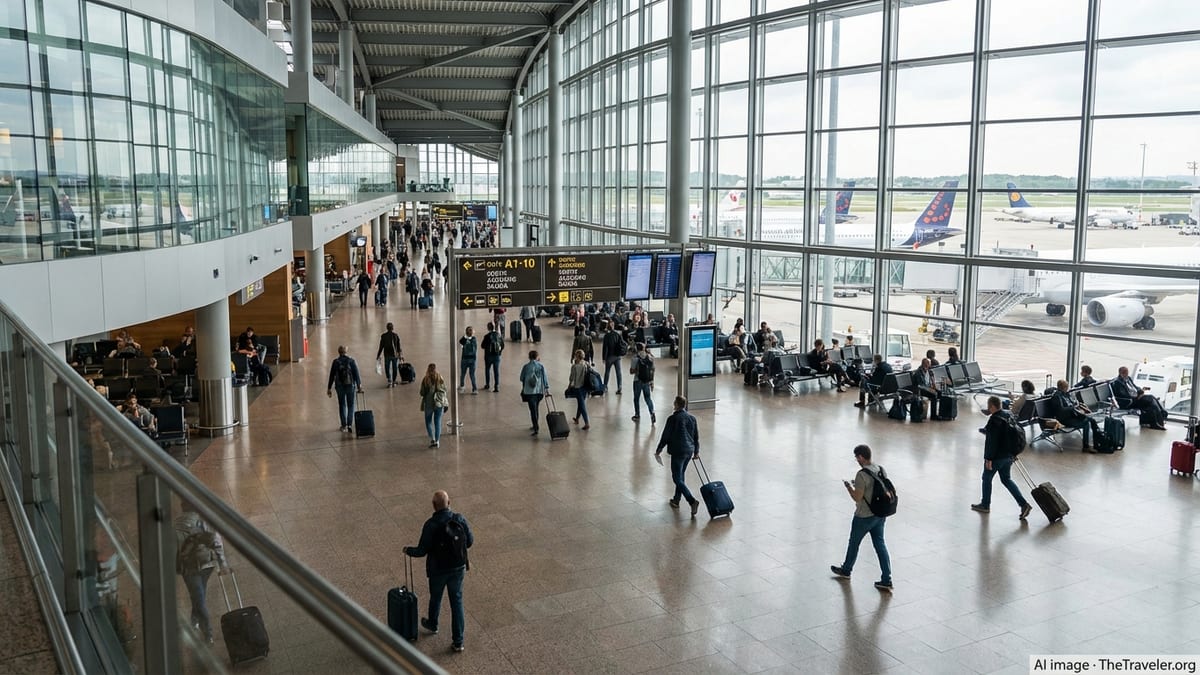
Brussels Airport is repositioning itself as a testbed for what the next generation of European hubs could look like, pairing ambitious terminal improvements with a sweeping rethink of how passengers and staff move to, from and around the site. Under the Hub 3.0 project, the existing terminal complex is being expanded on both arrivals and departures levels to smooth passenger flows and improve connections between the terminal and ground transport, while also adding a new four-star hotel to meet rising demand for rooms at the airport.
The redesign is framed not just as an aviation project but as a regional mobility upgrade. Hub 3.0 aims to tighten the links between Brussels Airport’s terminal and the wider transport ecosystem, improving transfers between rail, bus, tram, bicycle and private car. For passengers, this is expected to translate into shorter transfer times and more predictable connections. For the surrounding communities, the airport operator says the changes should bring a more coherent, less car-dependent mobility network in the northeastern Brussels region.
The infrastructure push comes on top of a decade of investment in the airport’s passenger experience. The Connector building, opened in 2015 between the main terminal and Pier A, replaced an older tunnel with a light-filled structure that centralised security controls, retail and waiting areas. Ten years on, that building is now being treated as a springboard for a more integrated Hub 3.0 layout that better aligns the check-in halls, security platform and pier access with the station, bus stops and road approaches.
At the same time, Brussels Airport is under political and regulatory pressure to grow within its current footprint. Expansion plans involving new piers and runway changes were shelved in 2023, and the airport’s latest environmental permit application focuses on optimising capacity and improving quality rather than adding concrete. That constraint is pushing the operator toward smarter use of existing space, digital tools to squeeze more throughput out of today’s terminal, and partnerships around surface transport to absorb rising passenger numbers without significantly increasing aircraft movements.
Green Testbed: Stargate Turns Brussels Into a Living Lab
Brussels is also at the forefront of Europe’s experiment with cleaner, smarter airport operations, thanks to the EU-funded Stargate programme. Launched in 2021, the five-year initiative channels almost 25 million euros into collaborative trials at Brussels and partner airports, with a focus on electrification, new mobility options and decarbonisation of ground operations. The airport has become a real-time demonstration site for technologies that, if successful, could be replicated at hubs across the continent.
Among the most eye-catching projects is a fully autonomous electric shuttle now operating airside. After initial trials with staff between late 2024 and early 2025, the vehicle entered a second phase connecting the terminal with an employee parking area. For airport planners, the pilot offers insight into how self-driving shuttles could relieve pressure on crowded internal roads and car parks, while cutting emissions associated with staff and passenger transfers.
Stargate also underpins an aggressive push toward electrified ground handling and smart charging. Brussels Airport and its partners are rolling out infrastructure for electric ground support equipment, from baggage tractors to service vehicles, and are trialling systems that manage demand on the grid by charging vehicles when renewable energy output is strongest. In parallel, the airport is experimenting with a green-energy sharing scheme that would allow nearby residents to benefit more directly from the site’s on-site renewable generation.
For travelers, many of these innovations will initially be most visible in subtle ways: quieter ramps, cleaner air around gates and more frequent, low-emission shuttles in landside areas. But as these technologies mature and are rolled out more widely, Brussels could offer a glimpse of how Europe’s airport revolution will marry smoother journeys with stricter climate targets.
Madrid Barajas Prepares a Multi-Billion-Euro Leap
Further south, Spain’s Adolfo Suárez Madrid Barajas Airport is preparing one of the most extensive overhauls in its history, with more than 4 billion euros earmarked for expansion and integration works under the country’s next airport investment plan. The proposals, part of the third Airport Regulation Document for 2027 to 2031, centre on enlarging the flagship Terminal 4 and its satellite building, while physically and operationally unifying the older Terminals 1, 2 and 3 into a single, modernised complex.
The investment is designed to position Madrid as an even stronger intercontinental hub, with the operator projecting traffic could rise to more than 73 million passengers a year by 2031. Enlarged check-in halls, expanded security screening areas and reworked baggage reclaim zones are all planned to absorb that growth while reducing bottlenecks. The project also prioritises better boarding facilities, from additional contact stands to redesigned holding rooms, which are critical for turning around widebody aircraft serving long-haul routes.
Madrid’s plans go beyond the airside interface. The airport is being readied for high-speed rail and improved metro connectivity, confirming a shift toward airport-as-intermodal-hub models also seen at Brussels and Amsterdam. Integrating Spain’s AVE high-speed trains directly into the terminal precinct would make it easier for passengers from across the country to connect to long-haul flights without domestic feeder legs, cutting both travel time and emissions.
Cargo is a key part of the Madrid story. A new state-of-the-art cargo terminal, backed by private logistics investors, is under development with an annual capacity of around 80,000 tonnes and advanced cold-chain facilities. The installation of its handling systems is due to begin in early 2026, with an opening targeted for March that year. The facility is expected to strengthen Madrid’s role as a bridge between Asia and Latin America, providing faster and more reliable handling of pharmaceuticals, perishables and high-value goods.
Amsterdam Schiphol Rebuilds Its Reputation Through Operations
Amsterdam Schiphol, long one of Europe’s busiest and best-connected hubs, is approaching the airport revolution from a different angle. After high-profile disruption in 2022 and 2023 triggered by staffing shortages and long queues, Schiphol’s management has focused on rebuilding resilience and trust through operational reform, labour partnerships and a renewed emphasis on passenger experience.
A central piece of that effort is a reconfiguration of security operations. Schiphol has moved to consolidate its fragmented security contracting model, announcing a new structure in which the airport will create joint ventures with three security providers and hold a minority stake in each. The aim is to shift from short-term, price-driven tenders toward longer-term partnerships that support stable staffing, better training and improved working conditions, which in turn should produce more consistent service at checkpoints.
Airport leaders also point to a broader programme of changes in recent seasons, including centralised recruitment campaigns for security staff, redesigned rest areas and more predictable shifts. These measures, together with process tweaks and technology upgrades, are intended to guard against the kind of long waiting times that dented the hub’s reputation and forced capacity caps during the post-pandemic rebound.
Schiphol’s strategy dovetails with European regulators’ push for more sustainable and socially responsible airports. The hub has committed to reducing its environmental footprint, curbing night flights and phasing out the noisiest aircraft types, while still maintaining its role as a major transfer gateway. For travelers, the end result should be a more orderly, less stressful experience through security and a network that is robust enough to absorb demand without the severe bottlenecks of recent years.
Stockholm Arlanda’s Terminal 5 Becomes a New Flagship
In Scandinavia, Stockholm Arlanda Airport is betting heavily on a transformed Terminal 5 to regain ground in the intense competition among northern European hubs. Over the past few years, the state-owned operator Swedavia has concentrated both investment and passenger flows into a single, enlarged terminal, closing Terminal 4 to regular check-in and security and shifting all such functions to the reworked Terminal 5.
The centrepiece of the transformation is a large, new security checkpoint opened in the summer of 2023. Equipped with advanced scanning technology, the facility allows passengers to keep liquids and large electronics such as laptops in their bags, reducing the need to unpack at the lane. The new platform consolidates previously separate checkpoints into one expansive, light-filled area designed to handle more passengers with shorter average waiting times.
Just beyond security, Arlanda is building a new Marketplace directly linked to the checkpoint. The commercial zone is being phased in, with around 50 new retailers, restaurants and services scheduled to open between late 2023 and the turn of 2024 and 2025. The aim is to replace a patchwork of outlets with a curated, centralised offering that matches passenger expectations at leading European hubs, while also generating revenue that can help keep airport charges competitive.
Behind the scenes, a major architectural and engineering effort has reshaped much of Terminal 5’s frontage and interior. A 330 metre extension has been added in front of the original building to house the new security hall and commercial areas, along with upgraded circulation spaces and wayfinding. Design firms involved in the project highlight the focus on Scandinavian light, clear lines and flexibility, with the goal of creating spaces that can be adapted as passenger needs and security regulations evolve.
Arlanda Consolidates and Plans for the Next Wave of Growth
Arlanda’s restructuring is not limited to new facilities. In late 2025, Swedavia completed the closure of Terminal 4 as a separate check-in and security area, routing all departing passengers through Terminal 5’s new infrastructure. An airside walkway beneath the airport’s central Sky City now links the former terminal to Terminal 5, allowing the two to operate essentially as a single unit while concentrating screening, baggage handling and arrivals in one modernised hub.
The move is intended to simplify the airport’s layout and make it easier for travellers to find their way, while also improving the economics of operating the hub. With all passengers processed through the same checkpoint and core commercial zone, Arlanda can better manage staffing levels and maintain consistent standards. Ground transport providers have also adjusted, with airport buses from central Stockholm stopping directly at Terminal 5 to cut walking distances and streamline transfers.
Despite these changes, Arlanda’s management acknowledges that the airport is still playing catch-up with competitors such as Copenhagen, particularly on long-haul connectivity. Traffic figures for 2024 show Stockholm trailing its Danish rival on both total passengers and intercontinental destinations. To close that gap, Swedavia is courting new airlines, has added several new carriers in the past year and is preparing for a future expansion in the form of a new pier with up to 14 gates, currently planned to begin construction later this decade.
The combination of a more capable Terminal 5 and improved surface access is viewed as critical to Arlanda’s ability to attract and retain long-haul services. With airlines increasingly choosy about where they place scarce widebody aircraft, airport executives hope that a streamlined, modern terminal and shorter, more reliable ground connections will make Stockholm a more compelling alternative for both airlines and passengers.
One Continent, Many Paths to the “Ultimate Airport”
Taken together, the projects under way in Brussels, Madrid, Amsterdam and Stockholm illustrate how Europe’s leading airports are pursuing a shared goal of faster, greener and more predictable journeys, but through strategies tailored to their local constraints. Brussels, operating within tight environmental and capacity limits, is striving to get more out of its existing infrastructure while piloting technologies that could rewrite how airports manage mobility and energy. Madrid is preparing a capacity surge anchored in new terminal space and stronger rail links, betting on its role as a global connector between Europe and the Americas.
Amsterdam is concentrating on organisational reform, using long-term partnerships and labour-focused changes to stabilise operations after a turbulent period. Stockholm is compressing its functions into a single, substantially rebuilt terminal and designing for a future where travel volumes grow but security standards and passenger expectations remain in flux. In every case, digitisation, automation and sustainability sit at the core of the agenda, even if they materialise in different forms at each hub.
For travelers, the European airport revolution will likely be felt most immediately at pinch points that have long defined the flying experience: shorter and less intrusive security checks, smoother transfers between flights and trains, more intuitive terminals and cleaner air at the gate. As these projects reach key milestones over the next five to ten years, the journeys through the likes of Brussels, Madrid, Amsterdam and Stockholm could start to look less like the chore they once were and more like an integrated, if still complex, part of the wider travel experience.