

More news on this day
Thousands of passengers across Europe are facing fresh disruption today as a new wave of delays and cancellations hits key hubs including London Heathrow and Helsinki Vantaa, with knock-on effects rippling through the Netherlands, Spain, the UK and other countries and impacting airlines such as Lufthansa, Swiss and a host of European carriers.
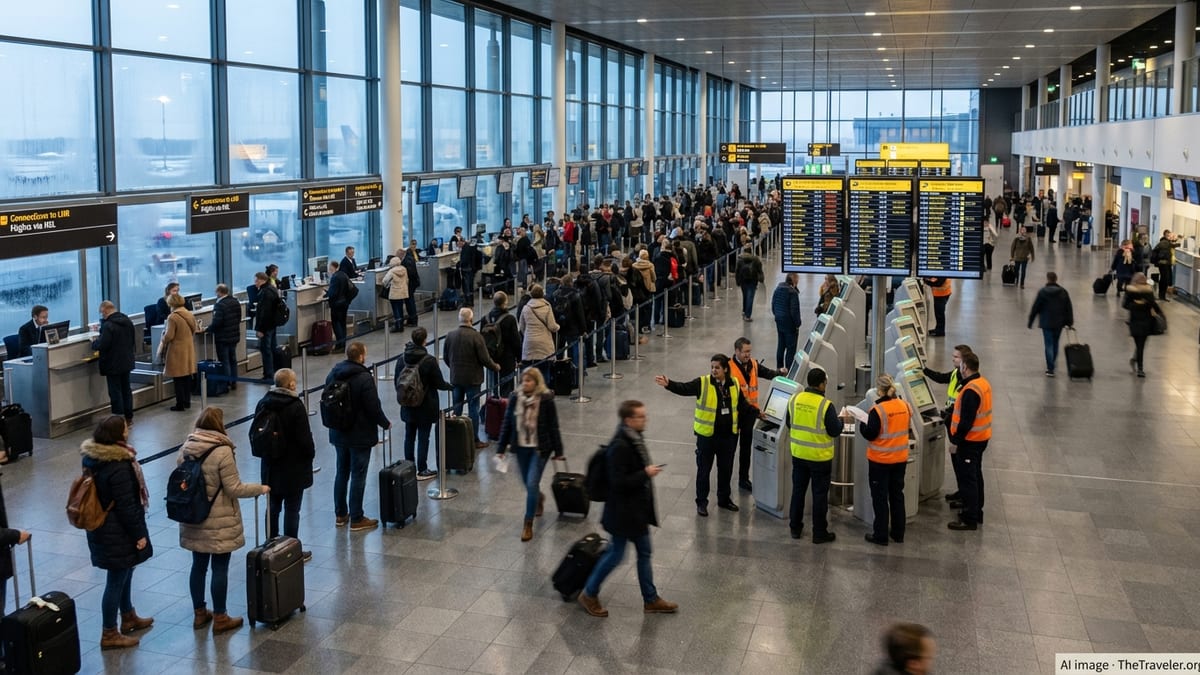
1661 Delays and 57 Cancellations Disrupt European Skies
European air travel entered another turbulent spell as operational data showed 1,661 flights delayed and 57 cancelled across the continent in a single 24 hour window, affecting routes in and out of the Netherlands, Spain, the UK, Italy and the Nordics. The scale of disruption is reminiscent of earlier winter shock days, when sudden weather changes and capacity constraints combined to snarl traffic at some of Europe’s busiest hubs.
While the precise breakdown differs by country, the overall pattern is clear: a high volume of delayed departures at major connecting hubs including London Heathrow, Helsinki Vantaa, Amsterdam Schiphol and Milan’s airports, with regional and secondary airports absorbing the knock-on effects. Airlines have been forced to retime, combine or cancel services as they work through congested departure boards and crew rotation bottlenecks.
For travelers, the figures translate into long queues at security and check in, crowded departure lounges and missed onward connections across the network. Many passengers who had expected routine city breaks or business trips between the UK, the Benelux countries, Spain and Italy have instead found themselves waiting for rebooking or overnight accommodation.
Although the number of outright cancellations is far lower than the volume of delays, aviation analysts note that even a small percentage of flights taken out of the schedule can cause disproportionate disruption on already tight winter timetables, particularly for hub carriers that depend on tightly coordinated banks of arrivals and departures.
Heathrow and UK Airports Under Pressure
London Heathrow remains one of the most severely tested airports whenever Europe’s air traffic network comes under strain, and the latest disruption is no exception. High aircraft movements, congested airspace and winter-weather operating margins have pushed the airport toward its limits, with a significant share of the 1,661 delayed flights touching the UK either as origin, destination or transit point.
Ground handlers and air traffic controllers have been juggling the competing demands of arriving long haul services and short haul European flights that link Heathrow with Amsterdam, Madrid, Barcelona and Milan, among other key destinations. When early morning rotations run late, the delay pattern often propagates across the day, turning what might have been minor timetable slippage into network wide disruption by late afternoon.
Other UK airports, including London Gatwick and Manchester, have also reported elevated delay levels as weather systems and congestion upstream in European airspace translate into late inbound aircraft. With many leisure travelers heading for Spanish resorts and city destinations, even relatively short delays can mean lost hotel nights, missed cruise departures or disrupted rail connections deeper into the continent.
In terminal buildings, passengers have been urged to arrive early, monitor airline apps and be prepared for last minute gate changes. Airport authorities emphasize that safety remains the overriding priority, which sometimes requires accepting lower movement rates during periods of poor visibility, high winds or runway contamination, even when demand is high.
Helsinki Vantaa Feels the Winter Squeeze
In northern Europe, Helsinki Vantaa has emerged as another focal point of the disruption, with winter conditions adding a further layer of complexity. While the airport is well practiced in operating through snow and ice, sudden shifts in visibility, wind and runway conditions can still force crews and controllers to slow operations, resulting in rolling delays that ripple through the schedule.
Recent data from Helsinki shows an elevated share of flights experiencing delays compared with typical winter performance, even as outright cancellations remain relatively limited. That means many passengers are eventually getting to their destinations, but often several hours later than planned, complicating connections to onward European and intercontinental services.
The impact is particularly acute on routes linking Helsinki with major hubs in the Netherlands, the UK and Spain. Finnair and other carriers rely on precise timing to feed morning and evening banks of flights, and any disruption to those carefully calibrated waves can leave travelers stranded between sectors or facing rerouting via alternative hubs such as Frankfurt, Zurich or Amsterdam.
Airport authorities in Finland have highlighted the intense work of de icing teams, snow clearance crews and airside operations staff who are striving to keep runways and taxiways open while maintaining safety margins. However, they acknowledge that when weather conditions swing rapidly, there is often no alternative to reducing the rate of arrivals and departures, a decision that inevitably shows up on passenger facing delay boards.
Lufthansa, Swiss and Other Carriers Battle Knock On Effects
Among the carriers most visibly affected in the current wave of disruption are Lufthansa and Swiss, whose networks crisscross many of the hardest hit airports. Even when their home hubs in Frankfurt, Munich or Zurich are functioning relatively smoothly, delays and cancellations upstream in London, Helsinki, Amsterdam or Milan can cascade into schedule changes across the day.
Flights linking Milan to Zurich, Amsterdam to German hubs and London to both Lufthansa and Swiss home bases have recorded delays that, while sometimes measured in minutes rather than hours, still complicate crew duty times and aircraft rotations. A late arriving aircraft from Heathrow or Helsinki, for example, may leave limited turnaround time before its next sector, forcing operations teams to reshuffle aircraft assignments or, in some cases, trim a rotation altogether.
Other European airlines, including low cost and leisure focused carriers, have likewise been swept up in the turbulence. Their point to point models can sometimes insulate them from hub centered disturbances, but when weather, congestion or airspace restrictions hit multiple regions simultaneously, even simple there and back services can fall behind schedule.
Industry observers note that after several seasons of intense summer disruption, airlines have invested in additional resilience, adding spare aircraft and staff where possible. Yet winter conditions, tight margins and the continued recovery of demand mean operators remain vulnerable to days when several problem factors collide at once, as appears to be the case in the current episode.
Amsterdam, Milan and Other Hubs See Ripple Delays
Amsterdam Schiphol and Milan’s airports, including Malpensa and Linate, are among the continental hubs feeling the secondary effects of disruption originating at London and northern European gateways. As connecting airports that host both local traffic and large volumes of transfer passengers, they are particularly sensitive to irregular operations elsewhere in the network.
At Amsterdam, delays on cross Channel and Nordic routes have translated into longer minimum connection times and a rise in missed onward flights, especially for passengers traveling to Spanish leisure destinations or returning to the UK. Airlines and ground handlers have been attempting to rebook affected travelers on later departures, but tightly loaded winter schedules leave limited spare capacity on popular routes.
Milan, an important node for both business and leisure traffic, has been coping with delayed arrivals from northern Europe feeding into outbound flights across Italy, Spain and central Europe. Even short sector delays can cause passengers to miss rail links from the city’s stations or connections to smaller regional airports not served by direct flights.
Operationally, airports in the Netherlands and Italy have stressed that terminal infrastructure and runways are functioning normally. The main challenge lies in absorbing late incoming aircraft from weather affected regions, sequencing departures to avoid further congestion and coordinating with airlines to manage passenger expectations when slot times shift repeatedly over the course of the day.
Weather, Capacity and Network Complexity Drive the Disruption
Aviation experts point to a familiar but potent mix of factors behind the latest surge in delays and cancellations. Winter weather remains the most visible driver, particularly in northern and central Europe where snow, freezing rain and low visibility routinely challenge operations. Even when airports are well equipped with de icing facilities and snow clearing equipment, sudden deteriorations in conditions can reduce runway capacity and slow ground handling.
Capacity constraints at major hubs such as Heathrow compound the problem. With limited room for schedule flexibility, even modest weather or technical issues can force air traffic flow restrictions, resulting in holding patterns, delayed pushbacks and, in some cases, pre emptive cancellations to protect the overall operation from gridlock.
The growing complexity of airline networks also plays a role. Modern hub and spoke systems, as used by Lufthansa, Swiss and many of their competitors, depend on precise timing to bring together waves of inbound flights for rapid connections. When a single sector in that chain is disrupted, it can break carefully planned connections for hundreds of passengers, necessitating rerouting, hotel accommodation and revised itineraries that further strain resources.
Finally, the continued recovery of demand since the pandemic has left airlines operating with relatively tight spare capacity, particularly in terms of standby crews and aircraft. That makes it harder to absorb a sudden spike in delays like the one associated with the current figure of 1,661 late running flights and 57 cancellations across the European network.
What Travelers in the Netherlands, Spain, the UK and Beyond Can Expect
For travelers in the Netherlands, Spain, the UK and other affected markets, the immediate outlook points to a period of lingering disruption, even if weather conditions begin to stabilize. Delayed aircraft and displaced crews can take several rotations to return to their normal positions in the schedule, meaning that some early morning departures and late evening arrivals in the coming days may still operate off schedule.
Passengers flying from Amsterdam, London, Helsinki or Milan to destinations in Spain such as Madrid, Barcelona or Malaga should build in additional buffer time for onward ground transportation and be prepared for schedule adjustments. Those with tight same day connections may wish to explore earlier departures or more generous layovers where possible.
Industry guidance remains consistent: travelers are advised to check their flight status frequently through airline apps or airport information displays, complete online check in as soon as it opens and keep contact details up to date so that rebooking offers and gate changes can be communicated quickly. When flights are significantly delayed or cancelled, passengers should also familiarize themselves with their rights under European air passenger regulations, which may entitle them to care, rerouting or compensation depending on the circumstances.
While the current spike in disruption is unsettling for many passengers, aviation authorities and airport operators stress that European safety standards remain among the most rigorous in the world. Slower operations during adverse conditions are, they argue, a sign of those standards in action, even if they come at the cost of punctuality and short term convenience for travelers across the continent.