

More news on this day
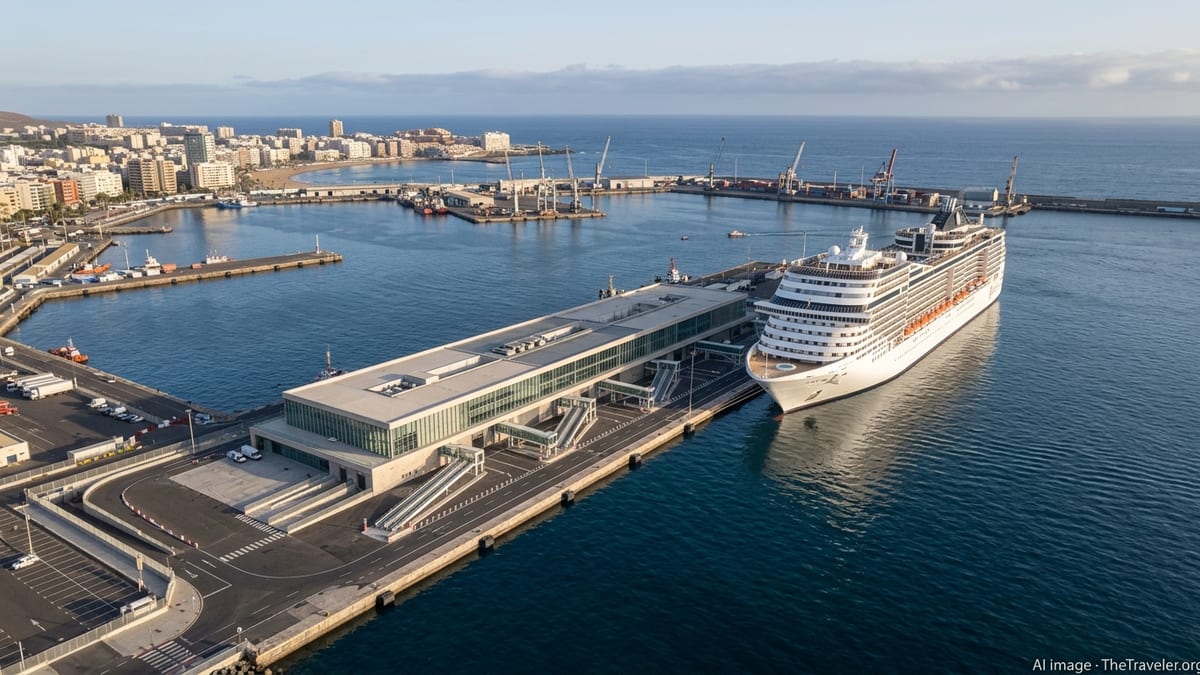
Port of La Luz in Las Palmas de Gran Canaria has unveiled what reports describe as Europe’s biggest cruise terminal, a new hub set to reshape passenger flows and cruise itineraries across the Canary Islands and wider Atlantic routes.
Get the latest news straight to your inbox!
A New Flagship for Europe’s Cruise Infrastructure
The new cruise terminal at Port of La Luz, also known as Las Palmas Cruise Port, is being presented in industry coverage as Europe’s largest dedicated cruise facility by terminal footprint. Publicly available information indicates a surface area of around 14,400 square metres, significantly expanding the port’s capacity to process passengers and handle larger vessels in a single integrated complex.
The facility has been developed within the existing commercial framework of Port of La Luz, already a key Atlantic gateway for cargo, ferries and offshore services. The cruise-specific expansion positions Las Palmas as a year-round turnaround and transit port, moving it further into the first rank of European cruise destinations alongside long-established hubs in Barcelona, Southampton and PortMiami.
Industry briefings describe the terminal as capable of handling the world’s largest cruise ships, aligning its berthing and terminal operations with the newest generation of mega-vessels. This reflects broader investment trends across the Canary Islands, where several ports are upgrading passenger infrastructure to capture growing cruise demand in the eastern Atlantic and winter-sun markets.
The opening also consolidates Las Palmas’ role as a logistical pivot between Europe, Africa and the Americas. With enhanced check-in, security and baggage systems concentrated in a single complex, the port is seeking to streamline operations for cruise lines seeking efficient homeport and partial-homeport options in the region.
Passenger Experience: From Check-in to City Streets
Terminal design details released by the operator and referenced in trade publications point to a layout focused on high passenger throughput and short transfer times. Large, open-plan hall spaces are configured for both transit and homeport operations, with separate flows for embarking and disembarking passengers to reduce congestion and queuing.
The building is reported to integrate check-in counters, security lanes, customs controls and baggage reclaim under one roof, with flexible partitions that allow areas to be reconfigured according to ship size and operational needs. For turnaround calls involving several thousand guests, this modular approach is intended to smooth peak-hour traffic and support tight vessel schedules.
Accessibility has been highlighted as a core feature. The terminal incorporates step-free access, elevators and wide circulation areas, designed to accommodate passengers with reduced mobility and high volumes of wheeled luggage. Signage and wayfinding systems are being promoted as multilingual and intuitive, reflecting the diverse passenger mix expected on Canary Islands itineraries.
Beyond the building itself, the terminal’s location offers relatively direct access into the city of Las Palmas. Public information shows that taxis, local buses and private transfers operate from designated forecourt areas, connecting quickly to the beach district of Las Canteras, the historic quarter of Vegueta and hotel zones that are likely to benefit from pre- and post-cruise stays.
Capacity, Ship Handling and Operational Flexibility
While precise passenger-per-day figures vary across reports, the new Las Palmas Cruise Port terminal is described as a high-capacity facility configured for both single and multiple ship operations. The design is aimed at efficiently processing several thousand passengers during overlapping embarkation and disembarkation windows, a requirement for hosting the latest mega-ships.
The terminal is positioned alongside berths that can accommodate the largest cruise vessels currently in service and those on order, according to cruise industry documentation. This includes ships exceeding 300 metres in length and carrying more than 5,000 passengers, a segment that has driven similar upgrades at competing ports in the Mediterranean and Caribbean.
Operationally, the building is planned to support a mix of transit, homeport and partial-homeport calls. For transit calls, only a segment of the facility may be activated, concentrating on security controls and passenger access to shore excursions. For full turnarounds, the terminal can expand to open additional check-in zones, baggage halls and waiting areas, using its full 14,400 square metre footprint.
This flexibility is significant for cruise lines planning winter-based deployments in the Canary Islands. With improved turnaround capabilities in Las Palmas, itineraries can originate or terminate in the port, rather than relying solely on mainland Spanish gateways or other Atlantic hubs, providing more options for air connections and itinerary design.
Sustainability and Design Features
Published material from the terminal’s developer and operator describes the Las Palmas facility as a “sustainable” terminal, integrating environmental considerations into both construction and operations. References indicate the use of recycled materials in the building structure and finishes, part of a broader effort to reduce the embodied carbon associated with the project.
The terminal reportedly incorporates advanced energy-efficiency measures, including optimized natural lighting, modern insulation standards and low-consumption lighting and climate control systems. These features are in line with a wider trend among new European cruise terminals, which increasingly position themselves as lower-impact infrastructure responding to public and regulatory scrutiny of the cruise sector.
In addition, the operator has highlighted the integration of shore-side systems designed to be compatible with emerging environmental technologies on board ships. Although full shore power availability has not been uniformly detailed across sources, the terminal is being framed as future-ready for cleaner propulsion and emission-reduction solutions as they are rolled out across cruise fleets.
Design choices also emphasize resilience and passenger comfort. Spacious interiors, weather-protected boarding areas and covered walkways address the practical needs of embarking and disembarking in varied Atlantic conditions, while still leveraging the mild climate and natural light that are part of the Canary Islands’ appeal for winter cruising.
What the New Terminal Means for Las Palmas and the Canary Islands
The inauguration of Europe’s biggest cruise terminal at Port of La Luz is expected to have a noticeable impact on Las Palmas and the wider Canary Islands economy. Cruise industry analyses routinely highlight the spending power of both transit and turnaround passengers, who contribute to local businesses through excursions, dining, shopping and hotel stays.
By enhancing its homeport potential, Las Palmas is positioned to attract more visitors who stay overnight before or after their cruise, increasing demand for city hotels, restaurants and cultural attractions. This may benefit not only the urban core, but also surrounding areas on Gran Canaria that feature in shore excursion programs, from volcanic landscapes to coastal villages.
Regionally, the terminal strengthens the Canary Islands’ profile as a strategic cruise hub on Atlantic and repositioning routes, including itineraries linking northern Europe, the Mediterranean, West Africa and the Caribbean. With upgraded facilities in Las Palmas complementing investments in other island ports, cruise lines have more operational certainty when scheduling calls in the archipelago.
At the same time, the growth potential underscored by the new terminal brings renewed focus on managing visitor flows and aligning cruise development with local priorities. Debates around sustainability, city liveability and port-community relations that are already visible in other major cruise destinations are likely to feature in the ongoing evolution of Las Palmas’ cruise strategy, even as the port leverages its new status as home to Europe’s largest cruise terminal.