

More news on this day
Major European cities in Denmark, Germany, Spain, Italy and the Netherlands are repositioning themselves as convenient, low-stress bases for short family breaks, blending walkable centres, upgraded public transport and a growing choice of kid-focused attractions.
Get the latest news straight to your inbox!
Copenhagen and Billund: Denmark’s Family-Friendly Duo
Denmark continues to stand out for families seeking a manageable first European city break, with Copenhagen regularly highlighted by travel publishers as clean, compact and easy to navigate with children. Recent city-break guides for 2025 point to the combination of pedestrian-friendly streets, a dense network of cycle lanes and reliable metro services between the airport and central districts as key reasons parents are choosing the Danish capital for three to four night stays.
Family-focused coverage notes that major attractions cluster within a small area, cutting down on transit time with younger children. Tivoli Gardens, the historic amusement park close to the main railway station, and the National Museum of Denmark, which features interactive displays and a children’s museum space, are frequently cited as core stops on family itineraries. Seasonal opening calendars for Tivoli and other parks show extended hours around school holidays, which tourism boards promote as an opportunity for short-break visitors.
Beyond the capital, Billund in Jutland remains a significant draw thanks to Legoland Billund and the Lego House experience centre. Industry reports describe Legoland as one of Denmark’s most visited attractions, and recent family-travel itineraries often pair a weekend in Copenhagen with two or three nights in Billund, linked by direct domestic flights and intercity trains. This combination gives families an easy mix of culture, theme-park downtime and countryside scenery without long internal journeys.
Tourism material released for the 2025 and 2026 seasons emphasises Denmark’s focus on sustainability and active travel, highlighting car-free city-centre zones, stroller-friendly pavements and widespread English-language signage. These elements, together with family-oriented accommodation such as apartment hotels and multi-room suites, position Denmark as one of northern Europe’s most straightforward options for a first city-focused family trip.
Germany’s Cities: Culture, Parks and Theme Parks in Easy Reach
In Germany, Berlin and Munich are emerging as leading choices for family city breaks, supported by strong rail links, extensive parks and high-profile museums tailored to younger visitors. Travel features published in early 2026 describe Berlin as a good first base, combining accessible history with riverside promenades, street art and dedicated children’s programmes on Museum Island. Shorter, family-oriented tours in the major museums are increasingly promoted in tourism marketing, helping to make complex subjects more approachable for school-age visitors.
Munich is being positioned by hotel groups and destination marketers as one of Europe’s top family city breaks for 2026. Coverage highlights its large urban parks such as the English Garden, playgrounds spread across inner districts and direct S-Bahn links from the airport into the city centre. The city’s reputation for orderly public transport and clear signage is frequently mentioned as a reassurance for parents travelling without a car.
For families willing to travel slightly beyond the major hubs, Germany’s theme-park network is a strong supporting factor. Legoland Deutschland in Bavaria, between Munich and Stuttgart, continues to rank among the country’s most visited theme parks, and packaged rail-and-park offers allow families to combine a cultural stay in Munich with a day or overnight trip to the park. Other regional cities such as Hamburg and Cologne are also promoted for waterfront walks, science centres and easy rail access from neighbouring countries, broadening the range of short-break options.
German tourism analysis for recent seasons shows that international arrivals are increasingly using high-speed trains to move between cities, reducing the need for internal flights. For families, this is marketed as a low-stress way to link two or three urban stops in a single holiday, for example pairing Berlin with Hamburg or Munich with nearby alpine towns.
Spain’s Record Tourism and the Rise of Family City Breaks
Spain’s tourism sector reached new records in 2025, with national statistics confirming more than 96 million foreign visitors and forecasts indicating continued growth into 2026. Within that surge, industry data shows a rising share of trips taken as families, with the European Travel Commission reporting that family travel has become one of the most important segments for urban destinations. Barcelona, Valencia and Seville are repeatedly identified as cities where this shift is particularly visible.
Travel analysis focused on Spain’s main cities notes that Barcelona remains the leading urban destination for international visitors, with strong interest from North American families. High-speed rail links mean that the city can be paired easily with Madrid or Valencia on a multi-stop holiday, but many families are choosing to stay in Barcelona for several days, combining beach time at urban stretches of sand with visits to Park Güell, Montjuïc and the city’s large aquarium.
Valencia is being promoted by Spanish and international tourism organisations as an especially convenient all-round choice for families. Reports highlight the concentration of attractions such as the City of Arts and Sciences, the Oceanogràfic aquarium and landscaped parks in and around the dried Turia riverbed, all connected by tram and bus routes. Travel guidance for the 2025 and 2026 seasons also points to the city’s family-friendly beaches and more relaxed pace compared with Spain’s largest metropolitan areas.
Seville, meanwhile, combines compact historic streets, pedestrianised plazas and a growing calendar of cultural events that include family-friendly performances. Urban tourism research published over the past year notes that nightlife is losing importance as a driver of demand in several Spanish cities, while interest in family tourism and cultural experiences is steadily rising. For short breaks, that shift is translating into more daytime programming, child-focused museum exhibits and extended opening hours for parks and riverfront areas.
Italy’s Classic Cities Adapt for Families
Italy remains one of Europe’s most aspirational destinations for families, and recent coverage suggests that cities including Rome, Florence and Venice are refining their offerings to make short trips with children more manageable. Tourism updates highlight improved crowd-management strategies at major heritage sites, such as advance timed-entry systems, combined tickets and mandatory pre-booking for certain attractions, which help families minimise queuing.
In Rome, travel writers are noting a growing emphasis on open spaces and neighbourhood exploration alongside headline monuments. Publicly available information about municipal parks, including Villa Borghese with its boating lake and playgrounds, is increasingly featured in family-focused itineraries. Metro and bus networks link these green spaces with central districts, allowing parents to break up sightseeing with downtime in shaded gardens.
Florence and nearby Tuscan towns are promoted as suitable for slightly older children, with compact historic centres and pedestrian bridges such as the Ponte Vecchio providing low-traffic walking routes. Tourism messaging for the 2025 and 2026 seasons often recommends visiting outside peak midday hours, using early mornings and late afternoons for major sights and reserving lunchtime for longer breaks away from crowds.
Italy’s long-distance rail network, including frequent high-speed services between Rome, Florence, Bologna, Milan and Venice, underpins many short-break plans. Travel planners describe these trains as a practical alternative to domestic flights for families, with generous luggage space and the option to bring strollers on board. This connectivity allows visitors to treat a city break as part of a longer itinerary, for example spending several days in Rome before continuing to the coast or lakes.
Amsterdam and Dutch Cities Prioritise Simple Logistics
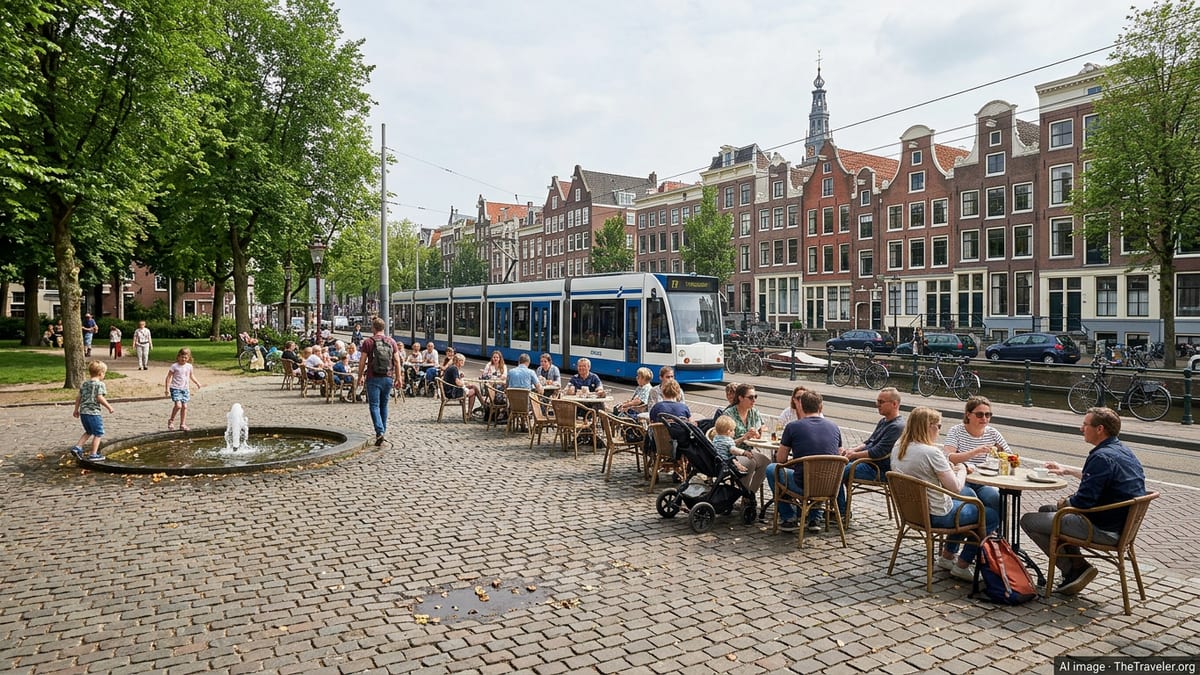
In the Netherlands, Amsterdam continues to lead international arrivals, but recent travel coverage shows a clear focus on managing tourism while preserving liveability. For families, that has translated into guidance on quieter neighbourhoods, recommendations to explore parks and waterfront areas, and encouragement to visit during shoulder seasons. The city’s extensive tram, metro and bus system, along with straightforward rail links from the airport, keeps transfers short and predictable for visitors with young children.
Amsterdam’s museums have expanded their programming for younger audiences, with major institutions offering family trails, audio guides for children and hands-on science exhibits. The city’s network of playgrounds, canalside paths and nearby urban beaches also features prominently in current family itineraries. Authorities have tightened rules around disruptive nightlife and certain types of visitor behaviour in the historic centre, and travel analysts suggest that these measures are gradually shifting the city’s image away from party tourism toward more balanced city breaks.
Other Dutch cities such as Utrecht, Rotterdam and The Hague are gaining attention as alternatives or add-ons to Amsterdam. Rail operators publicise frequent services that link these destinations in under an hour, making it easy for families to base themselves in one location and take day trips without renting a car. Utrecht’s medieval centre and canals, Rotterdam’s modern architecture and maritime attractions, and The Hague’s proximity to North Sea beaches are all cited as assets for short stays.
Across the Netherlands, the emphasis on cycling infrastructure remains a distinctive advantage. For visiting families, rental cargo bikes and child seats are widely available, and many hotels now provide bike storage or on-site rentals. Combined with relatively flat terrain and clearly marked routes, these features contribute to the perception of Dutch cities as some of Europe’s simplest and most practical options for easy-going family breaks.