

More news on this day
For travelers who see the journey as part of the adventure, a new kind of bucket list is emerging in Europe: destinations where the airport approach is as memorable as the getaway itself, with Madeira, Innsbruck and Courchevel standing out for landings that combine complex terrain, demanding winds and spectacular scenery.
Get the latest news straight to your inbox!
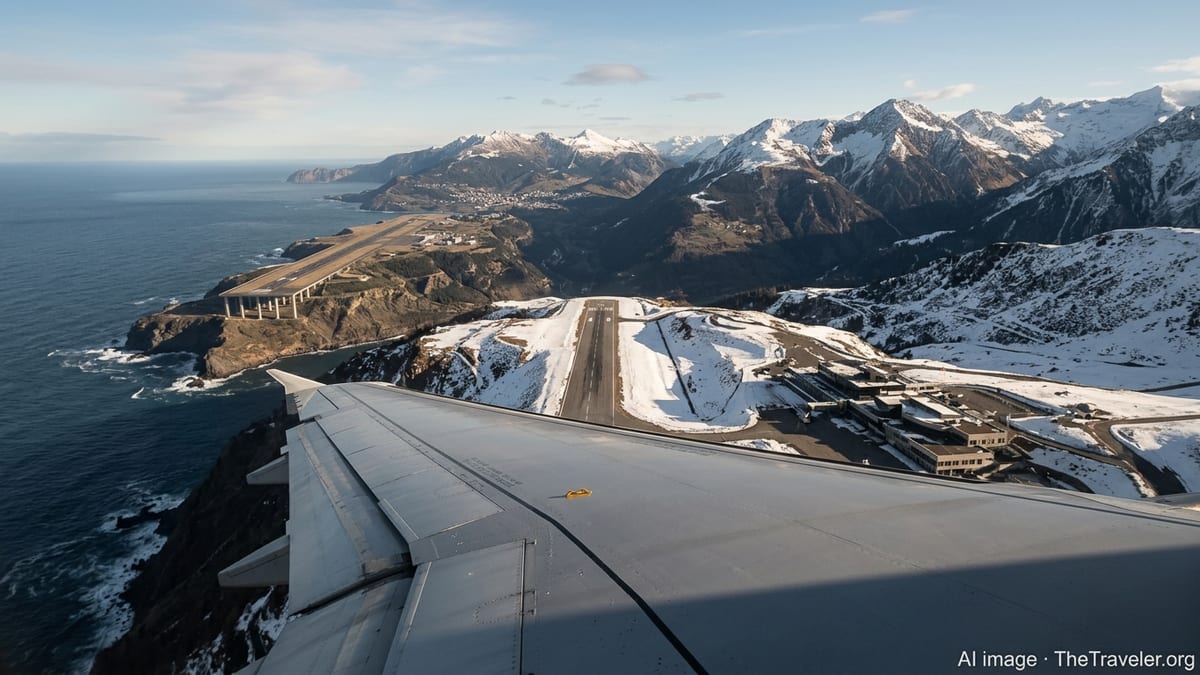
Madeira: Atlantic Crosswinds and a Runway on Stilts
Serving the Portuguese island of Madeira, Cristiano Ronaldo International Airport sits between steep hills and the Atlantic, with one end of the runway edging close to cliffs and the sea. Publicly available airport information notes that a standard straight-in, precision approach is not possible on one of its principal runways because of the surrounding terrain, forcing aircraft to follow specially designed curved procedures before lining up to land.
The runway itself has been extended out over the ocean on a forest of concrete columns, a striking piece of engineering that allows modern jets to operate where natural flat land is scarce. Aviation training materials and specialist magazines describe Madeira as a “Category C” aerodrome, meaning crews require specific briefing and, for many operators, dedicated training before flying the approach in regular service.
Wind is a defining feature of arrivals here. Reports from pilots and spotters indicate that strong and rapidly shifting crosswinds, localized turbulence and wind shear are common, especially on approaches that require a tight turn toward the runway at low altitude. Video footage shared widely online shows airliners arriving with noticeable sideways drift before straightening at the last moment, underscoring why the airport regularly appears in rankings of the world’s most challenging landings.
For passengers, the experience can be equal parts unsettling and unforgettable. As the aircraft banks over the ocean and lines up with the elevated runway, the combination of sudden views of the coastline, the forest of pillars below and the sensation of gusty air makes arrival in Madeira a genuine aviation spectacle, particularly on windy days.
Innsbruck: Threading a Valley in the Heart of the Alps
Innsbruck Airport in western Austria offers a very different, but equally dramatic, kind of challenge. Nestled in a narrow Alpine valley, the airport sits close to the city center with snow-capped peaks rising sharply on both sides. According to airport documentation and aviation safety material, the surrounding terrain restricts the use of conventional straight-in instrument landing procedures, requiring specially designed routes that curve along the valley before pilots make a visual transition to final approach.
The Alps create complex local weather effects, including strong downslope winds and rapidly changing visibility. Guidance for pilots highlights these phenomena as key factors in the airport’s classification as a more complex field, with additional operational requirements compared with standard European airports. During periods of Föhn winds, for example, aircraft may experience turbulence and variable airspeed on final, even in otherwise clear conditions.
For aviation enthusiasts, Innsbruck has become a plane-spotting destination in its own right. Travel and hobbyist reports describe aircraft appearing suddenly between mountain ridges, turning over the city and aligning with the runway against a backdrop of jagged peaks and winter ski slopes. The combination of tight valley walls, proximity to urban neighborhoods and the visual transition from instrument procedures creates a landing profile that is widely discussed in pilot forums and simulation communities.
Despite its reputation, Innsbruck is a busy gateway to major ski resorts and summer hiking areas, with commercial airlines operating scheduled services under carefully defined procedures. For passengers, the payoff for a slightly more turbulent approach is a rare opportunity to see the Alps from an angle usually reserved for cockpit crews, as the aircraft threads its way down the valley toward touchdown.
Courchevel: Europe’s Extreme Mountain Altiport
If Madeira and Innsbruck are demanding, Courchevel Altiport in the French Alps is in a category of its own. Set at roughly 2,000 meters above sea level, this small mountain airfield serves one of France’s best-known ski resorts and is widely cited in specialist aviation coverage as one of Europe’s most extreme runways. The single strip is only about 537 meters long, with an extraordinary gradient of around 18.5 to 18.6 percent, making it both one of the shortest and steepest paved runways in Europe.
The runway’s slope effectively turns it into a ramp. Landings are made uphill, using the gradient to help slow the aircraft, while takeoffs are made downhill, with the slope helping aircraft accelerate toward the valley. Aviation organizations and pilot training accounts emphasize that there is no practical option for a go-around once a landing is committed, because high terrain rises near the upper end of the strip and the lower end drops away sharply into the mountains.
Publicly available information indicates that Courchevel is restricted to daylight operations in good weather, with no instrument landing system or runway lighting. Only certain types of smaller aircraft with suitable short-field performance are permitted, and operators typically require pilots to complete dedicated mountain and altiport training, sometimes including supervised flights, before they can land there.
For visitors arriving by air, the experience is intensely immersive. The final approach often involves flying through tight valleys with ski slopes, chalets and chairlifts visible on nearby hillsides, before the aircraft pitches up to meet the sloping runway. For those on the ground, the airfield has become a viewing attraction, with aviation magazines and travel features frequently highlighting the spectacle of aircraft appearing from the valley and clawing their way up the incline before parking on the plateau above.
From Fear to Bucket List: Why These Landings Attract Travelers
Collectively, Madeira, Innsbruck and Courchevel illustrate how geography, weather and engineering can combine to turn an ordinary part of travel into an event in its own right. While all three locations are subject to strict operational rules and safety oversight, their approaches are complex enough that many airlines treat them as special cases, with extra training or qualification requirements for crews.
Travel trends coverage suggests that this reputation is increasingly part of the appeal. Online travel forums and social media are filled with personal accounts, cockpit videos and simulator re-creations of these approaches, turning them into aspirational experiences for aviation-curious travelers. For some, booking a seat on a winter flight into Innsbruck or a gusty arrival at Madeira is as much of a goal as skiing the nearby slopes or hiking the island’s volcanic ridges.
At the same time, these airports play vital roles as gateways to remote or mountainous regions that would be difficult to serve otherwise. The engineering solutions that make them possible, from Madeira’s elevated runway extension to Courchevel’s steep altiport design, showcase how airport infrastructure can adapt to extreme settings while still integrating into regular commercial networks.
For travelers looking to elevate their next European trip, keeping an eye on the route as well as the destination may be the key. Choosing an itinerary that includes one of these approaches turns the final minutes of flight into a vivid encounter with some of the continent’s most dramatic landscapes, framed by the unique demands of high-skill aviation.