

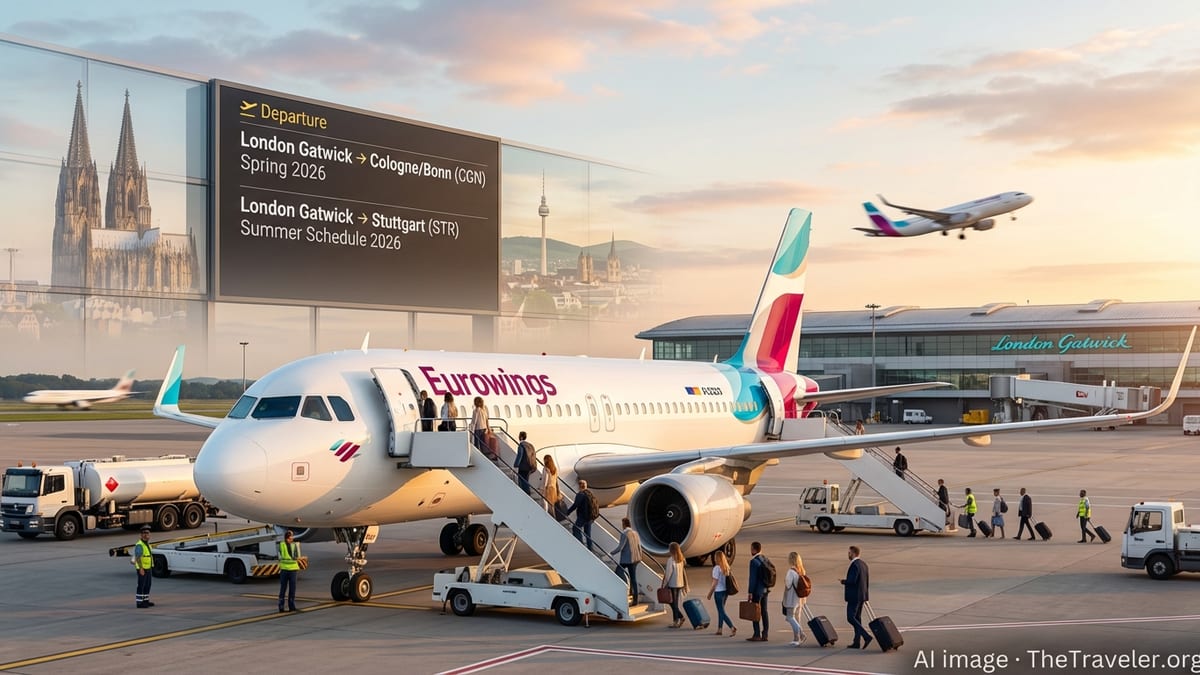
Eurowings is set to deepen air links between the United Kingdom and Germany in 2026 with the launch of new services from London Gatwick to Cologne Bonn and Stuttgart, adding fresh capacity into two of Germany’s key cultural and business hubs in time for the busy spring and summer travel season.
The move strengthens Gatwick’s continental network and gives British and German travellers an additional low-cost option at a time when tourism flows between the two countries are climbing back to record levels.
More News
- Super Bowl LX Turns San Francisco Bay Area Into Weeklong Festival for Travelers
- Waldorf Astoria to Anchor New Ski-In, Ski-Out East Village at Deer Valley, Opening 2028
- Germany Issues Targeted Minneapolis Travel Warning After Second Fatal Federal Protest Shooting
New Eurowings Routes from Gatwick Take Off in Spring 2026
German low-cost carrier Eurowings will begin operating from London Gatwick Airport at the start of the 2026 summer schedule, adding two new links into its network. Flights from Gatwick to Cologne Bonn are due to start on 29 March 2026, followed by a Gatwick to Stuttgart route from 12 April. Both launches fall at the beginning of the peak European leisure travel season, positioning the services to capture strong spring and early summer demand.
The new Cologne route will debut with 13 weekly services, operating twice daily on most days of the week and a slightly reduced schedule on Saturdays. Stuttgart will initially be served six times per week with no Saturday operation. All flights are scheduled to be operated by Eurowings’ Airbus A320 aircraft, offering a familiar single-aisle cabin product to both business and leisure travellers.
The expansion at Gatwick forms part of a wider reshaping of Eurowings’ London strategy, as the carrier balances its existing operations at Heathrow with new capacity at the UK’s second-busiest airport by passenger numbers. For Gatwick, the routes add to a growing roster of European short-haul carriers that have been building back schedules and opening new city pairs since international travel fully reopened.
Restoring Direct Links to Cologne and Stuttgart from South London
The decision to launch Cologne Bonn and Stuttgart from Gatwick restores non-stop options from south London to two German cities that have seen fluctuating service in recent years. Cologne was previously served from Gatwick by easyJet until 2022, and British Airways also briefly operated the route between 2018 and 2020 before focusing its Cologne services at Heathrow. Stuttgart has had periods of limited or no direct connectivity from Gatwick, pushing travellers toward Heathrow or connecting itineraries.
By re-establishing these links, Eurowings is targeting a mix of pent-up point-to-point demand and connecting traffic within its German and European network via Cologne and Stuttgart. Cologne Bonn Airport is one of Eurowings’ key bases, offering onward connections across Germany, central and eastern Europe, as well as to leisure destinations around the Mediterranean. Stuttgart, meanwhile, serves one of Germany’s most affluent industrial regions, home to major automotive and engineering brands and a strong base of small and medium-sized enterprises.
For travellers based in south London, Surrey, Sussex and Kent, Gatwick’s role as a more convenient departure point compared with Heathrow is likely to be a major draw, particularly for short city-break or visiting-friends-and-relatives trips. The dense Cologne schedule, with up to two flights on most days, also opens up more flexibility for long weekend itineraries and short-notice business travel.
Boost for UK German Tourism as Volumes Climb
The new services land at a time when tourism between the UK and Germany is rebounding strongly and, in some segments, reaching record levels. Official UK statistics show that visitors from Germany have reasserted their place among the country’s top inbound markets, with around 3.3 million visits in 2024 and record spending of more than £2 billion, underlining Germany’s importance to Britain’s tourism economy. Analysts expect German visitor numbers and spend to continue edging higher through 2025 and into 2026 despite economic headwinds in Europe.
On the outbound side, UK residents’ overseas trips have also surged, passing pre-pandemic levels in 2024, with Germany among the top European destinations for both leisure and city-break travel. Overall, overseas residents made more than 42 million visits to the UK in 2024, while UK travellers made nearly 95 million trips abroad, reflecting broad-based appetite for international travel after several years of disruption.
Tourism bodies on both sides of the Channel are looking to air connectivity as a crucial lever to sustain this recovery. Germany remains one of the largest outbound travel markets in the world, with more than 100 million international trips a year and high average spending per visitor. For Britain, improved regional and low-cost connectivity is seen as central to supporting growth in inbound tourism beyond London and to offset policy-related pressures, including higher travel taxes and reduced public marketing budgets.
Cologne and Stuttgart: Twin Gateways for Culture, Business and Events
Cologne and Stuttgart are both positioned to benefit from the new links as they promote themselves aggressively to British and international visitors. Cologne combines a UNESCO-listed cathedral and historic old town with a powerful events calendar built around trade fairs, exhibitions and cultural festivals. The city’s renowned Christmas markets, art fairs and carnival season have long been magnets for British tourists, and a robust schedule of flights from Gatwick could make short, spur-of-the-moment trips easier to plan.
Stuttgart, capital of Baden Württemberg, offers a different draw. It is a global center of the automotive industry, home to the headquarters and museums of brands such as Mercedes Benz and Porsche, and hosts a dense calendar of trade fairs and conferences that attract business travellers from across Europe and beyond. At the same time, the region has been marketing itself more intensively as a leisure destination, highlighting vineyards, hiking trails and an increasingly sophisticated food and wine scene.
Both cities are also well connected by rail to other parts of Germany, giving British visitors arriving via Eurowings an additional set of options. From Cologne, high speed and regional trains link swiftly to Bonn, Düsseldorf, the Ruhr area and even Brussels and Amsterdam. From Stuttgart, visitors can connect to the Black Forest, Lake Constance and other parts of southern Germany, as well as into Switzerland and Austria. Travel planners note that the new flights could therefore support multi city itineraries that combine big city culture with countryside stays.
London Gatwick Strengthens Its European Network
For London Gatwick, the addition of Eurowings helps diversify its airline mix and deepen its presence in the crucial German market. After the pandemic, Gatwick’s recovery has been led by low cost and leisure carriers, but airport management has also sought to attract more full service and hybrid operators to broaden the route network and reduce dependence on any single airline group.
Germany represents a key focus within that strategy. The country is both a major source of inbound visitors to the UK and an important destination for British holidaymakers and business travellers. By bringing in Eurowings, Gatwick not only gains frequent service to two new German cities but also strengthens its ties to Lufthansa Group’s low cost arm at a time when alliances and partnerships are reshaping short haul competition in Europe.
Industry observers note that increased capacity on Gatwick Germany routes may add some competitive pressure to rival airports around London, especially Heathrow, where slots remain constrained and fares can be higher. At the same time, the move may stimulate overall demand, as more frequent, conveniently timed and competitively priced flights typically encourage new trips that would not otherwise have been taken.
Implications for Fares, Competition and Connectivity
The arrival of Eurowings at Gatwick with double daily Cologne flights and near daily Stuttgart services is expected to have implications across pricing, competition and connectivity for UK German travel. On heavily traded city pairs such as London Cologne, which have seen a succession of operators over the last decade, the return of a dedicated low cost carrier at Gatwick could put downward pressure on average fares, especially outside peak holiday periods.
Travel agents report that British and German travellers are increasingly price sensitive, but remain willing to spend more overall on travel experiences. That combination tends to favor carriers that can offer relatively low base fares with paid add ons such as extra baggage, seat selection and lounge access. Eurowings’ A320 operation from Gatwick fits this model and is expected to appeal to both budget conscious leisure passengers and small business travellers seeking flexibility without the cost of a full service ticket.
From a connectivity standpoint, the new flights strengthen the web of air links underpinning tourism, conferences, trade fairs and cultural exchanges between the UK and Germany. Tourism researchers and chambers of commerce have long argued that direct air services support not only visitor numbers but also investment flows, educational links and people to people exchange, particularly when routes are sustained over multiple seasons and marketed jointly by airports, airlines and destination partners.
Prospects for 2026 and the Wider European Travel Market
Eurowings’ Gatwick expansion comes amid a broader upswing in European tourism, with the European Union recording more than 3 billion nights spent in tourist accommodation in 2024, its strongest year on record. Germany ranks among the top destinations within that total, and British travellers continue to play a key role in driving hotel and short stay occupancy in major German cities.
Forecasts for 2025 and 2026 point to further growth in international travel to and from the UK, although at a more moderate pace than the post reopening surge. VisitBritain expects inbound visitor spending to set new records, driven in part by high profile cultural and sporting events, as well as strong demand for city breaks and experience led travel. Against this backdrop, new point to point routes like Gatwick Cologne and Gatwick Stuttgart are viewed as essential infrastructure to translate macro level demand into actual trips.
Looking ahead to spring and summer 2026, tourism officials in both Britain and Germany will be closely watching booking patterns on the new Eurowings services, particularly during key travel peaks such as Easter, school holidays and the shoulder seasons. Strong load factors could encourage additional frequencies or even new UK German city pairs, while underperformance might lead to schedule adjustments. For now, the move is being interpreted as a vote of confidence in the resilience of cross channel tourism and in the role of secondary airports such as Gatwick and Cologne Bonn in sustaining it.
FAQ
Q1. When will Eurowings launch its new London Gatwick to Cologne and Stuttgart flights?
The Gatwick to Cologne Bonn route is scheduled to start on 29 March 2026, coinciding with the launch of the summer timetable, while Gatwick to Stuttgart is planned to begin on 12 April 2026.
Q2. How often will Eurowings fly from Gatwick to Cologne and Stuttgart?
Eurowings intends to operate 13 weekly flights between Gatwick and Cologne, with two flights on most days and a slightly reduced schedule on Saturdays, and six weekly flights between Gatwick and Stuttgart, with no Saturday service initially.
Q3. What type of aircraft will Eurowings use on the new Gatwick routes?
The airline is planning to deploy Airbus A320 aircraft on both the Gatwick Cologne and Gatwick Stuttgart routes, offering a standard short haul cabin with a mix of fare options and buy on board services.
Q4. Why are these new routes important for UK German tourism?
They restore and expand direct air links between south London and two major German cities at a time when visitor numbers between the UK and Germany are growing, making it easier for tourists, business travellers and those visiting friends and relatives to plan convenient, competitively priced trips.
Q5. How do the new flights benefit travellers in the London and South East region?
For many residents of south London, Surrey, Sussex and Kent, Gatwick is easier to reach than Heathrow, so having direct flights from Gatwick to Cologne and Stuttgart cuts journey times, broadens schedule choice and can reduce overall travel costs.
Q6. What attractions are likely to draw British visitors to Cologne and Stuttgart?
Cologne offers its famous cathedral, riverside old town, Christmas markets and a busy calendar of cultural events, while Stuttgart combines major automotive museums and trade fairs with vineyards, nearby countryside and a growing food and wine scene.
Q7. Will the new Eurowings services affect fares between London and Germany?
Industry analysts expect the extra capacity, particularly on London Cologne, to encourage stronger competition and potentially lower average fares outside holiday peaks, although prices will still vary significantly by date, demand and how far in advance tickets are booked.
Q8. Can passengers connect from Cologne or Stuttgart to other destinations with Eurowings?
Yes, both Cologne Bonn and Stuttgart are integrated into the Eurowings and wider Lufthansa Group network, so passengers arriving from Gatwick will have access to a range of onward flights within Germany, across Europe and to selected leisure destinations.
Q9. Are the new routes aimed more at leisure or business travellers?
The schedules and aircraft type are designed to appeal to both segments, supporting city breaks, cultural tourism and visiting friends and relatives, as well as business trips linked to Cologne’s trade fairs and Stuttgart’s industrial and automotive sectors.
Q10. Could Eurowings add more UK German routes from Gatwick in future?
Future expansion will depend on the performance of the Cologne and Stuttgart services and broader market conditions, but aviation analysts suggest that strong bookings and sustained demand could encourage Eurowings to consider additional German destinations or higher frequencies from Gatwick over time.