

More news on this day
EVA Air is set to launch a new nonstop route between Taipei and Washington, D.C. on June 26, 2026, a strategic addition that tightens business, political and tourism ties across the Pacific while giving travelers a rare direct link between Taiwan and the United States capital region.
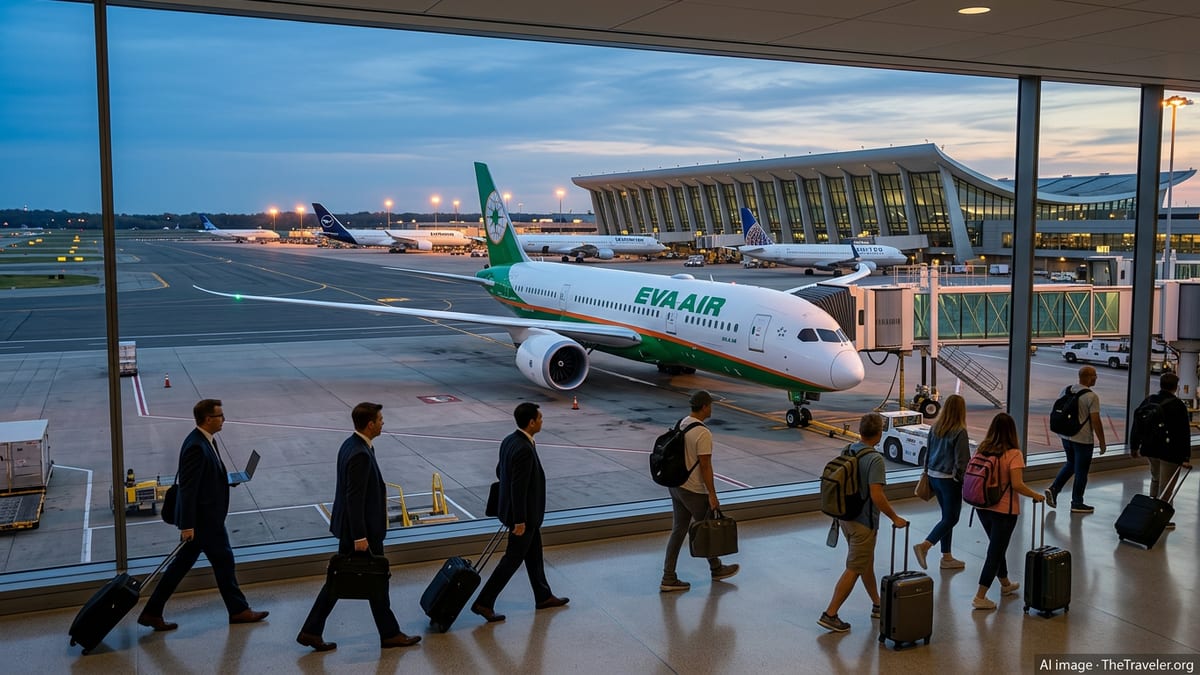
New Nonstop Bridge Between Taipei and the U.S. Capital
The new service will connect Taiwan Taoyuan International Airport and Washington Dulles International Airport with four weekly flights, marking EVA Air’s first direct route to the Washington metropolitan area. According to the airline’s announcement, the route will be operated with Boeing 787-9 aircraft configured with Royal Laurel business, premium economy and economy cabins, underscoring the carrier’s focus on both corporate and leisure segments.
Washington will become EVA Air’s tenth North American destination, further consolidating its position as one of the most active transpacific carriers serving Asia from the United States. The airline has gradually built a substantial footprint across major U.S. gateways, and the addition of Washington Dulles extends that network to a city that is central to government, international organizations and global corporate decision making.
EVA Air officials describe the route as a natural next step in the carrier’s North America expansion strategy. With Taipei as a growing regional hub, the nonstop link to the U.S. capital is expected to appeal to travelers not only between Taiwan and Washington but also to those connecting onward across Asia.
Timetable Tailored to Business, Government and Transit Demand
The Taipei–Washington route is scheduled to operate four times weekly, with departures timed to offer same-day or next-day onward connections across EVA Air’s Asian network. From Taipei, passengers will be able to connect to key business and leisure destinations including Tokyo, Seoul, Singapore, Bangkok and major cities in mainland China and Southeast Asia, all within coordinated banked flight waves.
For Washington-based travelers, the schedule into and out of Dulles is designed to align with the working day, providing arrival and departure times that make it easier for government officials, corporate travelers and NGO staff to integrate long-haul travel into tight meeting agendas. By reducing the need for time-consuming connections via West Coast hubs, the airline is aiming to capture travelers who value efficiency and predictability as much as inflight comfort.
Travel industry analysts note that the four-times-weekly pattern strikes a balance between market testing and meaningful capacity. It gives corporate travel planners and frequent flyers a reliable spread of options across the week, while allowing the carrier to ramp up or adjust frequencies as demand grows from both sides of the Pacific.
Boost for Business, Diplomacy and the Knowledge Economy
The launch of nonstop Taipei–Washington flights carries significance beyond convenience. The route is expected to support expanding economic ties in sectors such as semiconductors, advanced manufacturing, clean energy and information technology, where Taiwan and the United States are deepening cooperation. Direct air links typically encourage more frequent face-to-face engagement, which can accelerate deal-making, project oversight and cross-border collaboration.
Diplomatic and policy communities in both cities are also likely to benefit. With Washington hosting federal agencies, international institutions and think tanks, and Taipei serving as a key democratic partner and technology hub in East Asia, the direct connection lowers barriers for delegations, policy dialogues and multilateral meetings that previously required at least one en route transfer.
Universities and research institutes are another anticipated winner. The greater Washington region is home to a dense cluster of higher-education and research organizations, while Taiwan’s universities and science parks attract international scholars and students. The new route is poised to make academic exchanges, conferences and joint research initiatives more straightforward and time-efficient.
New Options for Leisure Travelers and Asia-Bound Tourists
Leisure travelers are expected to take advantage of the simplified journey as well. For U.S. tourists, Taipei is positioning itself as a gateway to East and Southeast Asia, combining its own attractions with easy onward access to island getaways, cultural capitals and culinary hotspots across the region. EVA Air’s network structure allows passengers originating in Washington to reach destinations across Asia with a single stop in Taipei, avoiding multiple connections.
The route also opens a direct path for Taiwanese and other Asian travelers heading to the U.S. capital to explore its museums, monuments and historic neighborhoods, or to connect elsewhere in the Mid-Atlantic. From Washington Dulles, domestic links place Philadelphia, New York, Boston and other East Coast cities within easy reach, enhancing the appeal of multi-city itineraries that pair Asia with classic U.S. cultural and historical experiences.
Tour operators on both sides are expected to develop packages that leverage the new nonstop service, combining city breaks in Taipei and Washington with regional add-ons. As transpacific tourism continues to recover and evolve, the convenience of a single long-haul sector between the two cities could prove a differentiator for travelers comparing options that once required at least one stop in another U.S. or Asian hub.
EVA Air Strengthens Its Transpacific Competitive Edge
The Washington launch highlights EVA Air’s ambitions to compete aggressively in the premium transpacific market. The Boeing 787-9 aircraft allocated to the route will feature the carrier’s latest-generation cabins, including lie-flat business-class seats and an upgraded premium economy section, products that have helped the airline build a loyal following among frequent flyers and aviation enthusiasts.
By expanding its North American map beyond traditional West Coast gateways to include key interior and East Coast hubs, the airline is building a network that supports both point-to-point demand and connecting flows. Washington joins cities such as Los Angeles, San Francisco, Seattle, Chicago, Dallas and New York in a lattice of routes that feed into EVA Air’s Taipei hub, giving the carrier more flexibility to respond to shifting demand patterns.
Industry observers say the move also fits into a broader pattern of growing air connectivity between the United States and key Asian technology and manufacturing centers. As supply chains become more regionally integrated and business ties deepen, airlines that can offer reliable, comfortable and efficient nonstop links are likely to be well positioned. For EVA Air, the June 26 debut of its Taipei–Washington service marks a high-profile step in that direction.