

More news on this day
EVA Air is set to reshape transpacific travel this summer with the launch of nonstop flights between Taipei and Washington, D.C. on June 26, 2026, a strategic expansion that strengthens U.S.-Taiwan connectivity while showcasing the airline’s latest premium cabins and far-reaching partnership network.
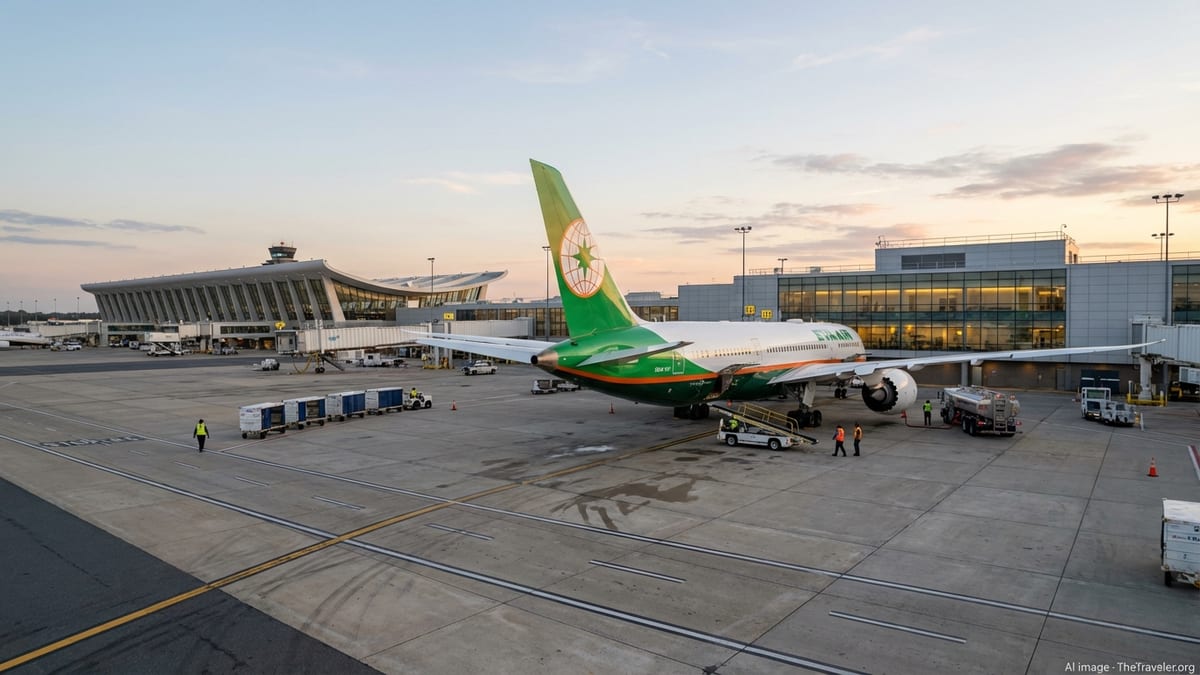
A Milestone Route Linking Taipei and the U.S. Capital
EVA Air confirmed that it will begin nonstop service between Taiwan Taoyuan International Airport and Washington Dulles International Airport on June 26, 2026, operating four weekly round trips. The new link will be the first-ever nonstop connection between Taiwan and the U.S. capital region, cutting travel times and eliminating the need for time-consuming connections through West Coast hubs.
The Taipei–Washington route will operate under flight numbers BR04 from Taipei and BR03 from Washington, D.C., using Boeing 787-9 aircraft configured in three cabins. According to the airline’s published schedule, BR04 is slated to depart Taipei in the evening and arrive at Dulles late the same night, while the return BR03 will leave shortly after midnight and reach Taiwan early the following morning, local time. Final timings remain subject to timetable adjustments as the launch date approaches.
For EVA Air, the new service raises its North American network to 10 gateways, including major cities such as Los Angeles, San Francisco, Seattle, Chicago, New York, Houston, Dallas-Fort Worth, Vancouver and Toronto. With the addition of Washington, D.C., the carrier positions itself as the airline with both the largest number of destinations and the densest flight network linking Taiwan and North America.
The move underscores the importance of the U.S. market for Taiwan’s flagship private carrier and reflects the growing demand for direct, premium long-haul services that connect Asia’s high-tech powerhouse with the United States’ political and economic centers.
Strategic Timing Amid Deepening U.S.-Taiwan Ties
The launch of the Taipei–Washington nonstop route comes at a moment of accelerating economic and political engagement between the United States and Taiwan. The island is a critical node in global technology supply chains, particularly as the world’s leading producer of advanced semiconductor chips used in everything from smartphones to data centers and artificial intelligence infrastructure.
In recent months, major U.S. technology companies have announced new or expanded investments in Taiwan, while U.S. and Taiwanese officials have advanced talks on trade facilitation, tariff reduction and regulatory cooperation. These developments are expected to increase the volume of government delegations, business travelers, and technical specialists moving between Taipei and the U.S. capital corridor.
Direct air service is widely viewed as a key enabling factor for deepening bilateral ties. By eliminating layovers in West Coast or Asian hubs, EVA Air’s new route reduces total journey times and logistical complexity for officials, corporate executives, researchers and NGO representatives who routinely travel between Taipei and Washington for consultations, negotiations and conferences.
Travel analysts note that the route’s four-times-weekly frequency is calibrated to capture both business and premium leisure demand while allowing EVA Air to scale up if bookings outperform expectations. The schedule also dovetails with the airline’s broader North American network, supporting convenient same-day and next-day connections beyond the capital region.
Premium Comfort: EVA Air’s Fourth-Generation Premium Economy
EVA Air will deploy its Boeing 787-9 fleet on the Taipei–Washington sector, each aircraft outfitted with Royal Laurel Class, a new-generation Premium Economy cabin and standard Economy Class. The configuration is intentionally designed to appeal to a wide mix of travelers, from senior officials and corporate leaders to long-haul leisure passengers seeking added comfort without the cost of business class.
The airline has highlighted its fourth-generation Premium Economy as a particular differentiator on this route. The cabin offers some of the industry’s most generous seat pitch in its class, expanded recline and enhanced leg and foot support, repositioning Premium Economy from an “upgraded economy” product toward what EVA Air describes as a “business-class-like” experience for mid-range budgets.
Onboard, Premium Economy passengers can expect wider seats than in standard economy, larger personal entertainment screens and upgraded catering compared with the main cabin. EVA Air’s longstanding emphasis on cabin design and service presentation, including curated Asian and Western menus and a reputation for attentive onboard service, is likely to resonate with Washington-bound travelers who face flight times of around 14 hours.
In Royal Laurel Class, EVA Air’s long-haul business product, passengers will find fully lie-flat seats, direct aisle access and a suite-style configuration that prioritizes privacy. Combined with the quiet, fuel-efficient Boeing 787-9, the airline is positioning the new route as a premium, rest-friendly option suitable for arrival straight into high-level meetings in Washington or Taipei.
Seamless Connections Across North America and Asia
Beyond the point-to-point market between Taiwan and the U.S. capital, EVA Air is counting on extensive connecting traffic to support the new service. From its hub at Taiwan Taoyuan International Airport, the airline offers links to major cities across East, Southeast and South Asia, as well as Oceania, enabling travelers from Washington to connect onward to destinations such as Tokyo, Osaka, Seoul, Bangkok, Ho Chi Minh City, Singapore and Manila on single-carrier or through-ticket itineraries.
On the other side of the Pacific, the carrier’s membership in Star Alliance and its partnerships with North American airlines expand itinerary options into the U.S. domestic network and Latin America. EVA Air cooperates with Star Alliance partners including Air Canada, United Airlines, Avianca and Copa Airlines, along with codeshare and interline arrangements with Alaska Airlines, JetBlue, Hawaiian Airlines, Sun Country Airlines, Southwest Airlines and WestJet.
These relationships allow a traveler departing Washington, D.C. to check bags through to over 200 destinations across the Americas via a mix of EVA Air and partner-operated segments. Passengers originating in secondary and tertiary U.S. cities can also route via Washington Dulles to Taipei and beyond, instead of relying solely on West Coast gateways.
Industry observers suggest that this connectivity will help disperse traffic more evenly across North American entry points, easing congestion at traditional hubs and offering U.S. and Canadian travelers additional choice when planning trips to Asia for leisure, study, family visits or business ventures.
Economic Windfall for the Capital Region
Airport officials in Washington have welcomed EVA Air’s decision to choose Dulles as its gateway, projecting a meaningful economic boost for the broader National Capital Region. Preliminary estimates from the Metropolitan Washington Airports Authority suggest that the new nonstop route could generate more than 60 million dollars in annual economic impact through visitor spending, business travel, airport operations and associated services.
Each long-haul departure typically supports a network of local jobs, from airport staff and ground handlers to catering, maintenance, hospitality and tourism operators. With passengers likely to include high-spending business travelers and affluent leisure visitors from Taiwan and across Asia, local hotels, restaurants, conference centers and transport providers stand to benefit.
The flight also enhances Washington’s position as an international gateway, enabling the city to compete more effectively with East Coast peers such as New York and Boston for conferences, headquarters decisions and diplomatic events with an Asia-Pacific focus. For multinational corporations and global institutions based in the capital region, the ability to fly nonstop to Taipei simplifies travel planning and may encourage more frequent face-to-face engagement with partners across Asia.
Tourism boards and travel organizers on both sides of the Pacific are already promoting itineraries that combine Washington, D.C. with other East Coast cities. EVA Air, working with travel agencies in Taiwan, has launched a multi-city tour product that pairs the capital with destinations such as Baltimore, Philadelphia, the Amish countryside, Atlantic City and New York City, aiming to offer an efficient and curated East Coast experience to first-time visitors.
New Options for Leisure, Culture and Education Travel
While corporate and governmental travelers are a key target for the new route, EVA Air also expects strong interest from leisure and educational segments. Washington, D.C. remains one of the most visited cities in the United States, thanks to its concentration of monuments, memorials, historic neighborhoods and world-renowned Smithsonian museums, most of which offer free admission.
For Taiwanese travelers, a nonstop flight cuts down on transit time and jet lag, making shorter vacations in the capital region more attractive. The route is also well positioned to serve Taiwanese students enrolled in universities along the Eastern Seaboard, including in Washington, Maryland, Virginia and neighboring states reachable by train or car from Dulles.
Conversely, travelers from the United States will gain a more convenient path to Taipei, which serves as a gateway to Taiwan’s cultural, culinary and nature experiences. The island has been actively promoting tourism focused on night markets, hiking, cycling, hot springs and indigenous culture, and a direct link from Washington is likely to raise its profile among East Coast travelers who might previously have favored other Asian hubs due to route availability.
Travel agents say that EVA Air’s premium-focused offering, particularly its enhanced Premium Economy, may appeal to older leisure travelers and families seeking greater comfort without the cost of business class, especially on itineraries that combine Taiwan with further connections into Japan, Korea or Southeast Asia.
Competitive Landscape and Market Implications
Before EVA Air’s announcement, travelers between Taipei and the Washington region typically relied on one-stop itineraries via West Coast gateways such as San Francisco, Los Angeles or Seattle, or through other Asian and European hubs. Airlines including United, as well as several Asian carriers, have long carried connecting passengers between Taiwan and the U.S. capital through code-share and alliance arrangements.
The introduction of nonstop service is expected to intensify competition for high-yield corporate and government traffic, particularly in premium cabins. EVA Air’s reputation for service quality and its focus on an elevated Premium Economy product may pressure rival airlines to refine their own long-haul offerings or adjust pricing on one-stop itineraries serving the Taiwan–Washington market.
At the same time, the overall pie is likely to grow. Nonstop routes typically stimulate new demand by making trips that were previously viewed as too long or complex more appealing. Analysts anticipate that the convenience of a direct flight will encourage incremental travel both from the U.S. to Taiwan and onward into Asia, and from Taiwan into the U.S. capital corridor.
Given the relatively limited number of nonstop East Coast links to secondary Asian hubs, EVA Air’s move reinforces Washington Dulles’s role as a key point of entry for transpacific traffic and could encourage additional Asian airlines to evaluate the region for future service expansions.
What Travelers Should Know Before Booking
With tickets already available for purchase, EVA Air is positioning the Taipei–Washington route as a compelling new option for trips starting in late June 2026 and beyond. Prospective passengers are being encouraged to pay close attention to departure and arrival times, particularly the late-night and early-morning slots that are typical for transpacific operations at both Taoyuan and Dulles.
Travelers eyeing Premium Economy or Royal Laurel Class are likely to see the new service priced at a premium during peak periods such as summer holidays and year-end, reflecting strong demand from both business and leisure segments in the route’s first season. Shoulder-period departures, including midweek dates, may offer more competitive fares and greater award-seat availability for frequent flyers.
Airport authorities on both sides are advising passengers to arrive early for the inaugural flights, anticipating heightened media interest and celebratory events around the first departures on June 26. In Taipei, the route joins an expanding list of long-haul services, so travelers connecting from other Asian cities should allow sufficient time for transfer formalities and security checks at Taoyuan.
As the inaugural date approaches, schedule refinements and possible frequency adjustments remain possible based on operational considerations and booking trends. However, for now, EVA Air’s commitment to launching nonstop Taipei–Washington service in June 2026 is being widely interpreted as a vote of confidence in the resilience of transpacific travel demand and in the strategic value of closer air links between Taiwan and the United States.