

Windansea Beach in La Jolla is one of Southern California’s most storied stretches of coastline, famous for its powerful surf, sculpted sandstone, and the humble thatched shack that has become a symbol of San Diego beach culture. Beautiful, compact, and at times unforgiving, it is a spot that rewards visitors who arrive prepared. Here is everything you need to know before you go.
Getting Oriented: Where You Are and What to Expect
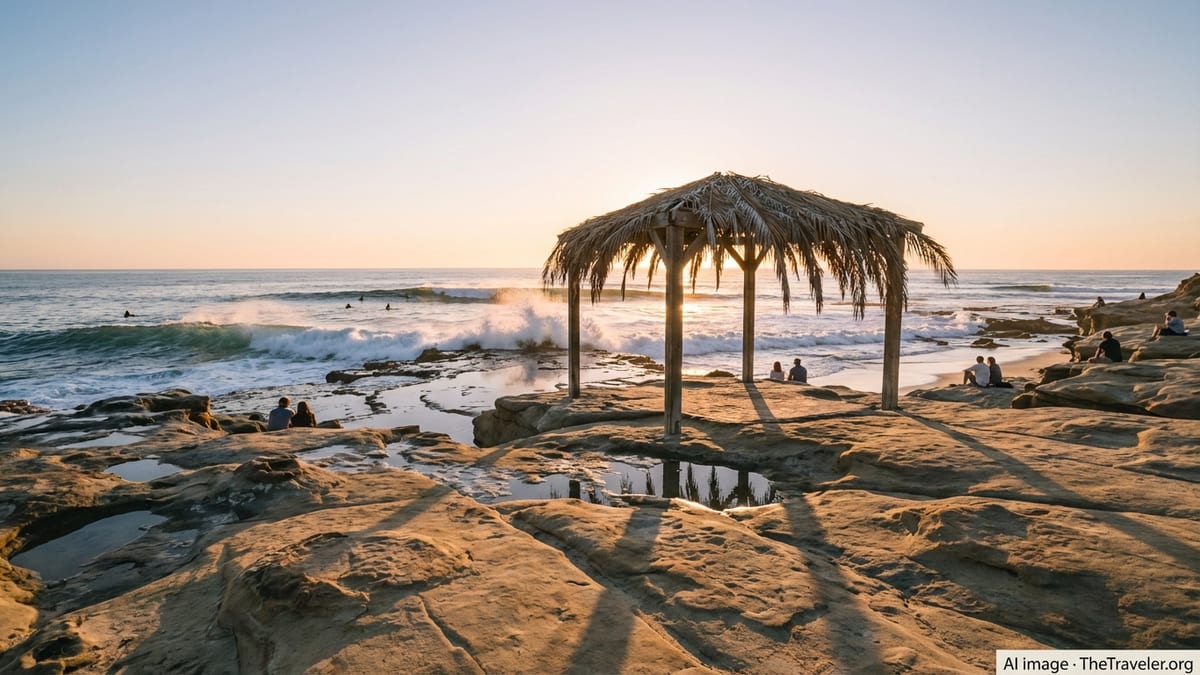
Windansea Beach sits along Neptune Place in the La Jolla neighborhood of San Diego, a short drive north of downtown and just south of La Jolla’s village center. Rather than a long wide strand, you will find a narrower ribbon of sand broken up by sandstone shelves and rock outcrops that create little coves. The setting feels intimate and distinctly local, with homes perched above the bluff and the iconic palm-frond Surf Shack framing views of the Pacific.
This is a beach known first for its scenery and surf rather than for family-friendly swimming. Underwater reefs help shape the waves that have drawn skilled surfers here since at least the 1930s, and those same features can create strong currents and abrupt drop-offs. On many days you will see experienced surfers lining up just offshore, while sunbathers settle on the warm rocks and photographers wait for the golden light that makes sunset at Windansea so memorable.
The beach itself is relatively compact, especially at high tide when the water pushes up against the rocks and seawalls. On summer afternoons and during holiday weekends it can feel crowded despite its small size, yet the rocky partitions also give it a series of semi-secluded pockets. First-time visitors are often surprised by how wild the waves can look compared with calmer beaches elsewhere in San Diego, so it helps to arrive with a realistic sense of the conditions.
Because Windansea backs onto residential streets rather than a boardwalk or commercial strip, there are few services in the immediate area. You will want to plan ahead for food, restrooms, and other basics. For those willing to make that small effort, the reward is a classic Southern California beach that still feels like a neighborhood secret, even though its image has appeared in surf magazines and travel spreads for decades.
Beach Conditions, Safety, and When to Visit
Windansea’s beauty comes with some real hazards, and understanding them is essential. The shoreline here is known for a pronounced shore break, where waves pitch and break hard right at the water’s edge. That can knock even strong swimmers off their feet and slam them into the sand or submerged rocks. Combined with rip currents that form near the reefs and along deeper channels, this makes the water best suited to experienced swimmers and surfers who are comfortable in powerful surf.
The City of San Diego notes that much of the beach experiences moderate to severe shore break, and advises swimmers to enter and exit carefully to avoid injury. Lifeguards are typically on duty during the busier seasons, roughly from mid-morning to late afternoon, but coverage can be reduced or absent in winter. Even when lifeguards are present, they are clear that this is not an ideal place for small children to play in the waves. If you are visiting with kids, many locals recommend treating Windansea as a viewing and sunbathing spot and saving actual swimming for more forgiving beaches nearby.
Rip currents are another critical factor. At Windansea and neighboring Marine Street and Sea Lane beaches, local safety groups emphasize that some of the seemingly calmer gaps between breaking waves are actually channels where water is flowing strongly offshore. If you do go in and feel yourself being pulled out, the advice is to stay calm, avoid fighting directly against the current, and swim parallel to the beach until you are out of the rip before angling back to shore. For many visitors, especially those not used to ocean swimming, remaining in the shallows or enjoying the scene from the sand is the wisest choice.
In terms of timing, summer and early fall usually bring the warmest water and the largest crowds, especially on weekends and during school holidays. Winter often delivers some of the most impressive surf, attracting dedicated surfers and photographers, while cooler air and water temperatures keep casual beachgoers away. Mornings can be cool and sometimes overcast with coastal marine layer skies that often burn off by midday. Sunsets are a highlight nearly year-round, and many locals arrive in the late afternoon specifically to watch the sun drop into the Pacific.
Access, Parking, and Facilities
Access to Windansea Beach is via neighborhood streets that lead west from La Jolla Boulevard to Neptune Place, which runs along the bluff above the sand. There are several concrete staircases and sloping paths down to the beach cut between the homes and sea walls. Surfers often descend carrying boards down narrow entrances that can feel crowded at busy times. The Surf Shack and a small viewing area sit near the foot of Bonair Street, which is where many visitors first see the water.
Parking is limited and is one of the main practical challenges of a visit. There is a very small city lot along Neptune Place with spaces for only a handful of cars. Local residents note that these spaces often fill early on sunny days and can turn over quickly but unpredictably. Beyond that, parking is almost entirely on residential streets, subject to standard San Diego parking regulations and posted time limits. It is wise to allow extra time to circle for a spot, and to park carefully without blocking driveways or crosswalks. Since there is no dedicated overflow lot, carpooling or using a rideshare service is often the more relaxed option in peak season.
Visitors should also be prepared for the absence of typical beach facilities. Windansea does not have public restrooms, showers, or changing rooms right at the sand. There are no food stands, rental kiosks, or beach gear shops directly on the beachfront. Many regulars plan ahead by using facilities elsewhere before arriving and packing any food, water, and sun protection they will need. This lack of infrastructure is one reason the beach maintains a quieter, more residential character compared with larger, more developed strands.
For those relying on public transportation, bus routes along La Jolla Boulevard provide reasonably close access, with a short walk downhill to Neptune Place. Sidewalks are in good condition, but the final approach to the sand involves stairs or uneven rock and sand, which can be challenging for visitors with mobility limitations. Because the beach is relatively narrow at high tide and the terrain is irregular, it is not among the most accessible stretches of coastline in the region.
Surf Culture, History, and the Famous Shack
Windansea Beach occupies a special place in California surf history. Long before it was a popular spot with photographers and sunset watchers, it was one of the proving grounds for early surfers experimenting with new board designs and tackling powerful reef breaks. By the mid-twentieth century, it had developed a reputation for heavy, consistent surf that attracted some of the best wave riders in Southern California. For decades, the local surf crew was known for both their skill and a certain intensity about protecting their home break.
The beach’s name itself reflects its environment. Originally called Neptune Beach, it later took the Windansea name from a nearby hotel whose owner reportedly held a contest to rename the property. A local resident suggested “Windansea,” evoking the wind and sea that define the area’s often blustery, wave-lashed character. That old hotel is gone, lost to a fire in the 1940s, but the name stuck, and with it the identity of the beach as a place where ocean, weather, and surf culture come together.
The low palm-frond shelter known as the Surf Shack is Windansea’s most recognizable landmark. First built in the 1940s by returning World War II surfers as a shaded place to stash boards and gather between sessions, it has been repaired and rebuilt several times after storm damage. The City of San Diego recognized the shack as a historic landmark in the late 1990s, noting it as one of the oldest continuously used surf shelters of its kind on the West Coast. Today it stands as a simple but powerful symbol of the neighborhood’s connection to the ocean and remains a favorite backdrop for photos and small gatherings.
Stories from Windansea’s wilder decades still circulate among longtime residents. Accounts describe legendary luaus, spirited parties under the shack’s thatched roof, and a sometimes rowdy reputation that contrasted with La Jolla’s otherwise quiet, upscale image. Over the years, however, the scene has mellowed. While beach get-togethers and sunset hangs are still common, you are more likely to encounter a mix of families, couples, photographers, and visiting surfers from around the world than the hard-partying crews of the past.
Swimming, Sunbathing, and How to Enjoy the Beach Safely
For many visitors, the best way to experience Windansea is from the sand and rocks rather than in the surf. The sandstone shelves that line much of the beach provide natural platforms for sunbathing and offer excellent vantage points for watching waves and surfers. Their gently undulating shapes, streaked with shades of beige and gold, are a major part of the beach’s visual appeal. When the tide is low, shallow pools may form among the rocks where children can look for small marine life under close adult supervision and away from the main impact zone of the waves.
Swimming here requires caution and realistic self-assessment. Even on days that look relatively calm from the bluff, sets can arrive with surprising force. The combination of steep beach face, shore break, and hidden rocks means that visitors intent on getting in the water should move slowly, avoid diving headfirst, and pay very close attention to what lifeguards are advising. Some locals limit themselves to quick dips in the shallower edges of the shore break, exiting promptly when a larger set approaches, while others skip swimming entirely and enjoy the waterline at ankle depth.
Traditional beachgoing activities like picnicking, reading, and relaxing in the sun fit Windansea perfectly, provided you bring what you need. With no shade aside from the shack, sun protection is crucial. A hat, high-SPF sunscreen, and plenty of water are essential, especially in summer afternoons when reflected light off the sand and rocks can intensify exposure. Towels and lightweight blankets work well on the sand, while some visitors bring thin pads to make the harder rock surfaces more comfortable for longer lounging.
If you prefer a quieter experience, aim for weekday mornings outside of peak holiday periods. The combination of softer light, cooler temperatures, and fewer people often shows the beach at its most peaceful. Even then, tides play a large role in how much sand is available. At very high tides, the water may reach right up to the rocks, limiting walking space. Checking a tide chart before visiting can help you time your arrival for when there is more exposed beach to explore.
Rules, Regulations, and Respecting the Neighborhood
Windansea Beach falls under City of San Diego beach regulations, which emphasize both safety and neighborhood quality of life. Alcohol is prohibited on the sand and in the adjacent parking areas. Glass containers, smoking, littering, and any disturbing levels of amplified noise are also banned. Camping and overnight sleeping on the beach or in vehicles nearby are not allowed. These rules are enforced to varying degrees depending on season and time of day, but visitors should assume they apply at all times and plan accordingly.
Dogs are not permitted on the beach at Windansea under current city rules, a policy meant to protect both wildlife and human visitors on this relatively tight stretch of sand. If you are traveling with a pet, you will need to choose another area of the coast that specifically allows dogs during designated hours. Enforcement can involve fines, so it is worth respecting the restriction rather than attempting a quick visit with a dog on the sand.
Because the beach is woven so closely into a residential neighborhood, visitor behavior has a direct impact on people who live nearby. That means parking legally, keeping voices down late in the evening, and packing out all trash. The lack of on-site bins in some access points makes it especially important to bring a small bag for your own waste. Locals and volunteer groups regularly organize cleanups to protect the fragile sandstone formations and nearby marine environment, and visitors can support that effort simply by leaving the beach cleaner than they found it.
Climbing on unstable bluff sections or scrambling along wet, algae-covered rocks near the waterline is strongly discouraged. Erosion and heavy surf combine to undercut sections of the coast, which can collapse without warning. Heeding warning signs and staying behind any posted barriers is not only safer but also helps preserve the natural features that make the area so photogenic in the first place.
Photography, Sunsets, and Making the Most of Your Visit
Windansea Beach is beloved by photographers for good reason. The combination of low sandstone terraces, textured rock pools, and the simple geometry of the Surf Shack against the sky creates endless compositions. Late afternoon into sunset is the prime window for photography, when the sun sinks toward the horizon and paints the rocks and shack with soft golden and pink tones. On some evenings, the entire western sky glows, and locals will pause whatever they are doing to watch the display from the shoreline or bluff.
If you are interested in taking photos, aim to arrive with enough time to explore angles before the light peaks. Shooting from the sandstone shelves closer to the water gives a low, immersive perspective framed by waves and foreground textures, while standing back along Neptune Place or the higher sections of rock captures wider scenes with the shack, surfers, and coastline all in view. As always, keep safety in mind, and resist the temptation to step onto wet, darkened rock surfaces that can be extremely slippery when coated in algae or spray.
For visitors who simply want to soak up the atmosphere, sunset is also a social time. Small groups gather quietly on the rocks, couples bring picnic baskets, and surfers squeeze in one last session before the light fades. On especially clear days in winter, you may catch sight of the offshore islands on the horizon. Even on overcast evenings, the rhythmic crash of waves against the reef and the silhouette of the shack give the scene a moody, cinematic quality.
To make the most of a visit, consider pairing time at Windansea with a broader exploration of La Jolla. Spend a few hours enjoying the beach, then head into the village for a meal, or start your day with coffee nearby and arrive at the sand as the morning fog lifts. Because the beach itself lacks commercial services, building in time elsewhere for food, restrooms, and shopping keeps your time at Windansea focused on what it does best: powerful surf, striking scenery, and a distinct sense of place.
The Takeaway
Windansea Beach is not the classic wide, gentle, fully serviced strand that many travelers picture when they imagine San Diego. Instead, it is a compact, ruggedly beautiful pocket of coastline that has shaped and been shaped by surf culture for generations. Powerful reef breaks, sculpted sandstone, and the enduring Surf Shack give it a character that feels both timeless and distinctly local.
Visiting here rewards preparation. You will need to manage without restrooms or concessions, navigate limited parking, and treat the water with respect. In return, you gain access to some of the city’s most dramatic coastal scenery, an authentic window into its surf history, and sunsets that regularly stop locals in their tracks. Whether you come to watch the waves, photograph the shack, or simply sit on the warm rocks and listen to the ocean, Windansea offers a concentrated dose of what makes the Southern California coast so compelling.
FAQ
Q1. Is Windansea Beach safe for swimming?
Swimming at Windansea is best left to confident, experienced ocean swimmers. The beach is known for strong shore break, rip currents, and hidden rocks, which can be hazardous. Many visitors choose to stay in very shallow water or simply enjoy the scene from the sand.
Q2. Are there lifeguards at Windansea Beach?
Seasonal lifeguards are typically on duty during busier times of year, generally from mid-morning to late afternoon in the warmer months. Coverage can be reduced or absent in winter, so never rely solely on lifeguards for safety and always assess conditions yourself.
Q3. Are there restrooms or showers at Windansea Beach?
No. There are no public restrooms, showers, or changing facilities at Windansea Beach itself. Visitors should plan ahead, use facilities elsewhere before arriving, and be prepared to spend time at the beach without those amenities.
Q4. Is Windansea Beach good for families with young children?
Windansea is beautiful but not ideal for small children who want to play in the surf, due to strong waves and currents. Families often come for short visits to enjoy the views, sit on the rocks, and watch surfers, then head to more sheltered nearby beaches for swimming.
Q5. Can I bring my dog to Windansea Beach?
Dogs are not allowed on the beach at Windansea under current city regulations. If you are traveling with a pet, you will need to choose another San Diego beach that specifically allows dogs during certain hours.
Q6. Is alcohol allowed on Windansea Beach?
No. Alcohol is prohibited on the sand and in the parking areas at Windansea Beach. Glass containers and smoking are also banned, and violations can result in fines.
Q7. What is the best time of day to visit Windansea Beach?
Late afternoon into sunset is especially popular for the warm light and views, but it can be crowded. For a quieter experience, consider weekday mornings outside of major holidays, when the beach is usually less busy and light is softer.
Q8. How difficult is it to find parking near Windansea Beach?
Parking can be challenging. The small beachfront lot has very limited spaces, and street parking in the surrounding neighborhood fills quickly on sunny days. Allow extra time to look for a legal spot, and consider walking from a bit farther away or using rideshare services.
Q9. Can beginners surf at Windansea Beach?
Windansea is generally considered a spot for experienced surfers. The reef break, powerful waves, and crowded lineups can be intimidating and dangerous for beginners. Newer surfers are usually better off learning at more forgiving breaks nearby before attempting Windansea.
Q10. Why is the Surf Shack at Windansea Beach famous?
The palm-frond Surf Shack was originally built by local surfers in the 1940s as a simple shelter and gathering spot. It has since become a recognized historic landmark and an emblem of La Jolla’s surf culture, often featured in photographs and stories about the beach.