

More news on this day
Ex-Tropical Cyclone Narelle, which has already carved a destructive path across northern Australia, is now forecast to swing unusually far south toward Western Australia, with new guidance indicating a burst of heavy rain, squally winds and a heightened risk of flooding for Perth and parts of the southwest in the coming days.
Get the latest news straight to your inbox!
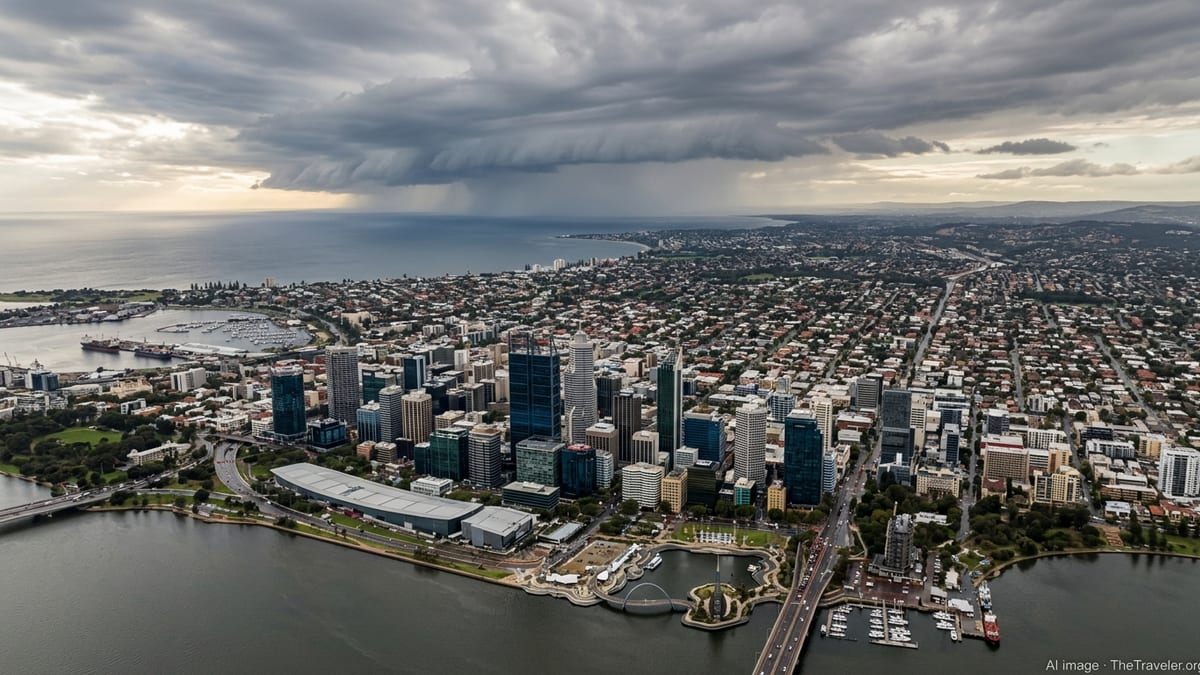
Storm System Regroups After Crossing the Continent
Publicly available tracking data shows that Narelle first formed in mid-March over the warm waters of the Coral Sea, rapidly intensifying into one of the strongest cyclones of the 2025–26 Australian season before striking Far North Queensland. The system then weakened over land as it crossed Cape York Peninsula, but retained a deep moisture plume as it moved west across the Top End.
After emerging over the Gulf of Carpentaria and the waters off northern Australia, Narelle fluctuated between tropical cyclone and tropical low status while spreading heavy rain through remote parts of Queensland and the Northern Territory. Emergency summaries and media coverage from those regions describe widespread power outages, blocked roads and pockets of severe flooding, although major population centres avoided the worst-case outcomes.
Meteorological analyses now classify the system as an ex-tropical cyclone as it shifts into the interior of Western Australia. Despite the loss of a warm-core cyclone structure, forecasters note that its broad circulation, deep tropical moisture and interaction with existing frontal features are combining to set up an unusual southward sweep toward the state’s densely populated southwest corner.
The evolving pattern has drawn particular attention because only a small number of former cyclones have maintained enough structure and moisture to significantly affect Perth and nearby coastal districts, making Narelle’s projected track a relatively rare event for late March.
Rare Southward Shift Raises Concerns for Perth
Updated model guidance and forecast discussions indicate that Narelle’s remnants are likely to curve toward the west coast and then track south along or just inland from the shoreline, feeding a band of rain and embedded thunderstorms into the Perth metropolitan area and adjacent regions. This southward deflection is being linked to a combination of steering winds around subtropical high pressure to the east and an approaching mid-latitude trough from the Indian Ocean.
Such a configuration is uncommon but not unprecedented for Western Australia. Historical case studies highlight previous ex-tropical cyclones that have drifted toward the southwest, bringing unusual bursts of humidity, heavy falls and strong winds to areas more accustomed to dry, settled conditions at this time of year. In several past events, localized flooding and short-lived transport disruption were reported despite the systems no longer meeting cyclone intensity thresholds.
In the current situation, forecast charts shared by weather agencies and independent analysts suggest that the heaviest rain band associated with Narelle could line up near the west coast as the system passes offshore or grazes inland. While there is still uncertainty around its exact position and speed, the consensus points to a marked increase in cloud, showers and potentially intense bursts of rain for Perth and the wider southwest over the upcoming weekend.
Enthusiastic local commentary in Perth is already focusing on the prospect of substantial rainfall after a run of hot, dry conditions, but forecasters are emphasizing that even a “rain event” driven by a decaying cyclone can carry hazards, particularly if downpours arrive in a short window of time.
Heavy Rain and Flood Risk: What the Models Show
Forecast rainfall maps for Western Australia indicate that ex-Cyclone Narelle could deliver a swath of moderate to locally heavy totals from the Gascoyne coast southward into the South West and Great Southern districts. Some high-resolution models are flagging pockets of intense accumulation near and south of the track, where tropical moisture is expected to collide with cooler air and topographic features inland from the coast.
For the Perth metropolitan area, the latest projections suggest the potential for multiple rounds of showers and rain, with short but vigorous bursts possible as the system’s core or associated trough moves through. While some scenarios show more modest totals if Narelle weakens rapidly over land, others indicate a risk of localized flash flooding in low-lying suburbs, underpasses and drainage-prone roadways, especially if heavier bands stall over the city.
Hydrological risk assessments produced for Western Australia in recent years have stressed that ex-tropical cyclones can deliver intense rainfall well away from their landfall point. In similar storm setups, the heaviest falls have often occurred to the south of the circulation center, where moisture-laden air is lifted along convergence zones and frontal boundaries. That pattern is again being watched closely as Narelle’s track clarifies.
Given the inherent uncertainty in predicting the exact placement of the most intense rain bands, weather services are encouraging close monitoring of short-term forecasts and radar imagery as the system approaches. Even relatively small shifts in Narelle’s path could mean the difference between a soaking but manageable spell of rain and more disruptive, flood-producing downpours for particular districts.
Travel and Transport Impacts Across Western Australia
For travelers, the timing of ex-Cyclone Narelle’s approach coincides with a busy period for movements in and out of Perth, as visitors transit between the capital, coastal holiday towns and inland attractions. Aviation observers note that low cloud, poor visibility and gusty winds often lead to delays and occasional cancellations when ex-tropical systems influence the southwest, particularly if heavier showers cluster near the main flight paths.
On the roads, previous events of this type have produced slick surfaces, localized water over carriageways and reduced visibility, raising the risk of accidents on major routes such as the Mitchell and Kwinana freeways and key regional highways. Outback tracks and unsealed roads across the Gascoyne, Pilbara fringes and Wheatbelt can become impassable for periods if heavy rain redevelops over areas already softened by earlier showers linked to Narelle’s passage.
Rail and port operations along the west coast may also need to adapt to changing conditions, particularly where strong crosswinds, heavy rain or minor flooding affect access roads and loading facilities. In some past ex-cyclone events, operators have temporarily adjusted schedules or reduced speeds on certain lines as a precaution while the most active weather passes through.
Tourism businesses in Perth and the southwest are closely watching updates, balancing the potential for short-term disruption with the longer-term benefit of significant rainfall for parks, wine regions and coastal landscapes heading into autumn. Many operators highlight that, outside brief periods of intense weather, ex-cyclone rain events can produce dramatic skies and lush scenery that appeal to visitors once conditions stabilize.
Preparedness Messages as the System Nears the Southwest
Publicly available emergency management guidance for Western Australia consistently emphasizes basic preparedness whenever ex-tropical systems move into the region. For households and travelers in the Perth area, this typically includes checking that gutters and drains are clear, securing loose outdoor items that could be blown about by gusty winds, and allowing extra time for journeys during periods of heavy rain.
Rural communities and travelers in more remote parts of the state are encouraged by official guidance to pay particular attention to flood-prone creeks, causeways and low-lying roads, where rapidly rising water can cut access with little warning. Previous ex-cyclone events have shown that even areas far from the coast can experience sudden flooding when deep moisture bands interact with local terrain.
Information from recent cyclone and flood responses across northern Australia also underscores the importance of up-to-date information from meteorological services and state emergency agencies. As Narelle’s remnants continue their unusual journey southward, forecast products are being updated frequently to reflect new data from satellites, radar and surface observations.
With ex-Cyclone Narelle transitioning into a complex rain-bearing system rather than a wind-focused tropical cyclone, specialists describe this as a classic “watch and adapt” situation for Western Australia. The coming days will determine whether Perth experiences a notable, flood-inducing deluge or a more modest but still welcome burst of late-season rainfall as the storm’s long path across the continent nears its end.