

More news on this day
As airlines ramp up ultra-long-haul routes linking the UK, United States and Australia, sleep doctors and aviation fatigue experts are urging travelers to treat in-flight rest less like a luxury and more like a critical part of long-distance trip planning.
Why Long-Haul Sleep Matters More Than Ever
From London to Los Angeles or Sydney to New York, typical flight times now stretch well past 10 hours, with some nonstops nudging 17 to 19 hours. Sleep and circadian specialists say that on sectors of this length, the quality and timing of in-flight rest can determine not only how refreshed travelers feel on arrival, but also how safely they navigate jet lag, ground transport and the first 24 hours in a new time zone.
Research in aviation and sleep medicine has repeatedly linked disrupted circadian rhythms to worse mood, slower reaction times and impaired decision-making. For aircrew, this has become a major safety topic, but experts note that the same biological rules apply to passengers dozing upright in economy. The longer the duty or travel day and the more time zones crossed, the more crucial it becomes to plan when and how you will sleep.
With North Atlantic and transpacific traffic rebounding and more UK, US and Australian travelers booking complex itineraries through multiple hubs, specialists say that a casual, “sleep if it happens” attitude is no longer enough. Instead, they recommend treating sleep as a strategic resource and building a realistic rest plan before you board.
Plan Your Body Clock Before You Fly
Sleep physicians interviewed in recent months have emphasized that the work of sleeping well on a plane begins several days before departure. For eastbound flights, such as New York to London or Los Angeles to Sydney, many now advise gradually shifting bedtime earlier by 30 to 60 minutes per night in the three days before travel. Westbound fliers, for example from London to San Francisco, are often told to do the opposite and push bedtime slightly later.
Circadian experts say this slow “pre-shift” of sleep, combined with targeted exposure to light, helps reduce the shock of jumping across eight to twelve time zones in a single day. Bright morning light in the direction of travel and dimmer evenings at home are frequently recommended as low-tech tools that nudge the body clock toward destination time before takeoff.
Several sleep specialists also highlight the role of carefully timed melatonin, taken in small doses rather than the high-strength tablets widely sold in US pharmacies. They stress, however, that melatonin is a body clock signal, not a sedative, and that timing matters more than quantity. Used haphazardly, they warn, it can push the circadian rhythm in the wrong direction and prolong jet lag rather than shortening it.
Across the UK, US and Australia, clinicians are increasingly advising travelers to discuss any regular use of sleep aids with a doctor before flying. In particular, those with underlying conditions such as sleep apnoea, heart disease or mental health disorders are urged to seek tailored medical advice rather than copying friends’ pill regimens on overnight flights.
Make the Aircraft Cabin Work for Your Sleep
Once on board, fatigue researchers say the priority is to control as many elements of the environment as possible within the constraints of the cabin. That starts with choosing a flight that aligns with your natural sleep window where practical. Night departures that place the main sleep period during local nighttime at departure or destination tend to be more forgiving for most travelers than mid-afternoon takeoffs that require trying to sleep in broad daylight according to the body clock.
Seat selection remains a powerful factor for those in economy cabins. Window seats are widely preferred by sleep experts, primarily because they allow travelers to rest against the fuselage and avoid being disturbed by seatmates climbing out to the aisle. Being closer to the wing can slightly reduce noise and vibration, though the benefit is modest compared with using earplugs or active noise-cancelling headphones.
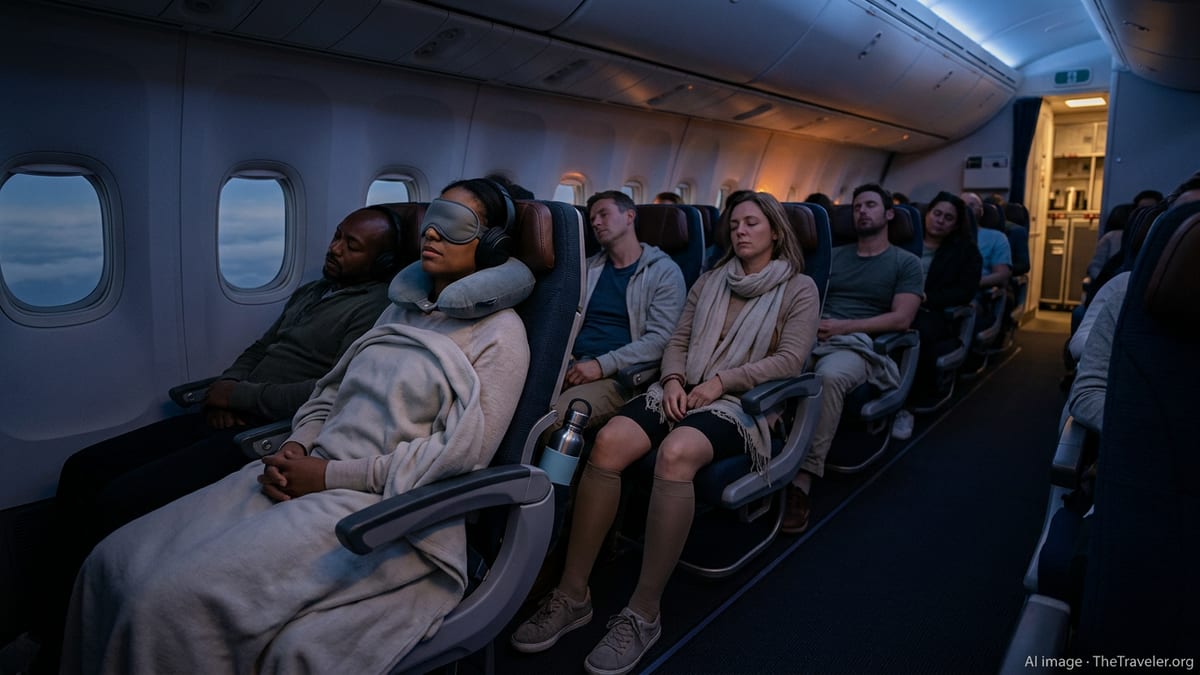
Cabin lighting and visual cues also matter. Eye masks, which block residual light from reading lamps and galleys, have been repeatedly recommended by sleep clinicians as a low-cost intervention that improves both the chance of falling asleep and the depth of sleep obtained. Pairing an eye mask with a neck-supporting travel pillow and a light personal blanket or scarf helps recreate a familiar bedtime sensation amid the constraints of an upright seat.
Experts caution that travelers should not expect to sleep a solid eight hours in economy. Instead, they encourage aiming for two or three consolidated blocks of 60 to 90 minutes, roughly matching natural sleep cycles. Even if total sleep time is shorter than at home, they note that structured, relatively uninterrupted blocks of rest can blunt the worst of jet lag and next-day fatigue.
Rethink Alcohol, Caffeine and Sleeping Pills
Despite the popularity of a pre-flight glass of wine, sleep doctors across the UK, US and Australia are increasingly direct in their warnings about alcohol at altitude. They point out that cabin humidity is low and pressurization is roughly equivalent to high altitude, amplifying the dehydrating and sedating effects of alcohol. While a drink may help some passengers nod off more quickly, it fragments sleep, increases nighttime awakenings and can intensify jet lag on arrival.
Caffeine, meanwhile, remains a double-edged tool. Aviation fatigue specialists suggest that travelers time their last tea or coffee at least six hours before they intend to sleep on board. Caffeine taken earlier in the duty or travel day can sharpen alertness during airport transfers and boarding, but doses too close to the planned sleep window may leave passengers wired just when they hope to drift off.
The question of prescription sleep medication is drawing renewed scrutiny as long-haul routes proliferate. Sleep physicians point out that sedative medications can leave residual grogginess just as passengers are navigating immigration, driving rental cars or making connecting flights in unfamiliar airports. They also highlight rare but serious risks when such drugs are mixed with alcohol or used for the first time in flight, far from immediate medical help.
Current guidance from many specialists is conservative: only use prescription sleep aids that have been previously trialed on the ground, avoid combining them with alcohol and be cautious on flights under about ten hours, where the drug may not fully wear off by landing. Over-the-counter antihistamines, often used as makeshift sleeping pills, are similarly discouraged due to their unpredictable and sometimes prolonged sedating effects.
Arrival Day: Locking In Your New Time Zone
Experts say the final piece of long-haul sleep strategy begins when wheels touch down. After eastbound overnight flights from the US to Europe or from Australia to Asia, many travelers are tempted to nap immediately upon reaching their hotel. Sleep researchers instead advise holding out until at least early evening local time, then going to bed at a normal hour in the new time zone.
Targeted light exposure plays a key role in this first day plan. Bright outdoor light in the late morning or afternoon at destination is widely recommended to anchor the circadian clock in its new setting. A short walk in daylight, even in overcast northern European or North American winters, can be more effective than staying indoors under artificial lighting.
Moderate movement and meals timed to local hours are another focus. Clinicians say that light exercise such as walking, stretching or a gentle hotel-gym session can improve nighttime sleep quality without overstimulating a tired body. Eating at local mealtimes rather than snacking continuously from the airport onwards helps align the gut’s daily rhythm with the new clock time, which some studies suggest may reduce the duration of jet lag.
For UK, US and Australian travelers who regularly shuttle across hemispheres, specialists add one more piece of advice: expect adaptation to take several days, and avoid scheduling high-stakes meetings or long drives on the first day after a major time-zone jump. Approaching long-haul travel as a multi-day adjustment, rather than a single overnight ordeal, they argue, is the most reliable route to better sleep in the sky and a safer, more productive trip on the ground.