

More news on this day
Explora Journeys has taken a decisive step in its rapid fleet expansion, marking three major shipbuilding milestones on the same day at Fincantieri’s Sestri Ponente shipyard in Genoa, Italy, and underscoring its push toward a six-vessel ultra-luxury fleet by 2028.
Get the latest news straight to your inbox!
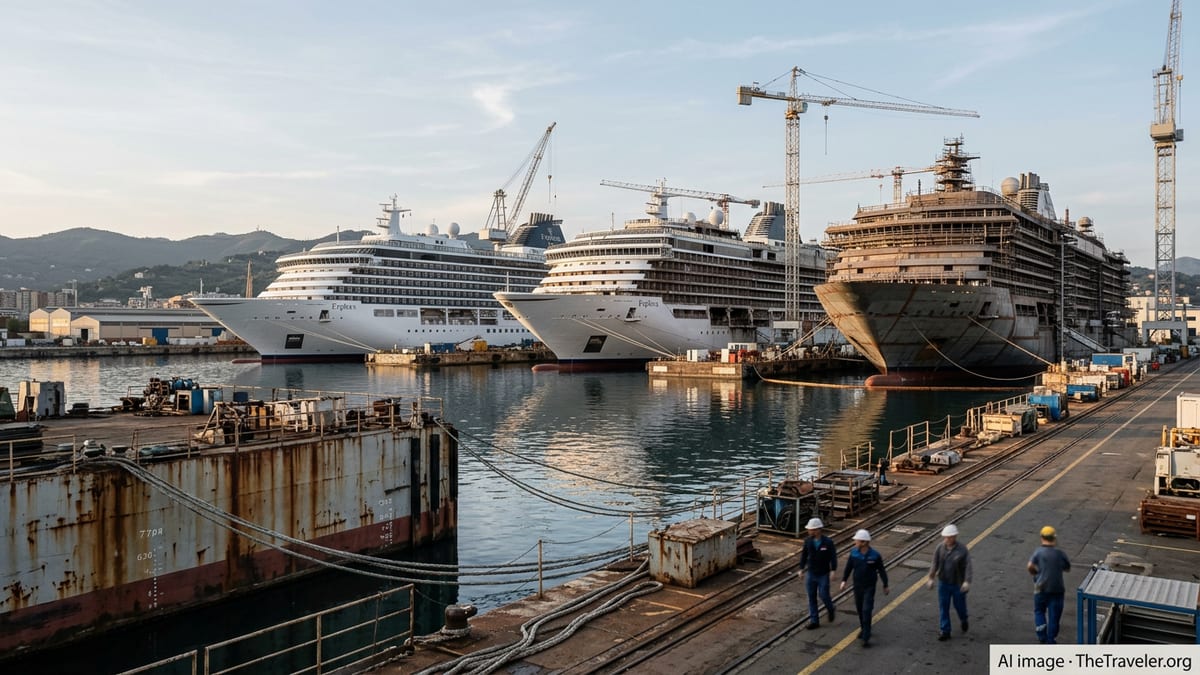
Triple Ceremony Underscores Accelerated Growth
The latest event at Fincantieri’s Genoa yard brought together senior leaders from Explora Journeys, the cruise division of MSC Group, and Italian shipbuilder Fincantieri to celebrate a tightly choreographed sequence of milestones. In a single ceremony, the brand marked the technical launch of EXPLORA IV, the coin ceremony for EXPLORA V, and the steel cutting for EXPLORA VI, three critical stages that collectively signal the next phase of the company’s growth.
The technical launch, often referred to as the float out, saw EXPLORA IV touch water for the first time as construction moves from the building dock to outfitting. At the same time, the traditional maritime coin ceremony for EXPLORA V formally blessed the ship and its future crew, while the first steel cut for EXPLORA VI officially began work on the line’s sixth vessel. Holding these steps concurrently highlights how aggressively Explora Journeys is compressing its development timeline.
Executives framed the day as more than a symbolic moment, describing it as proof that the brand’s ambitious schedule is firmly on track. With two ships already in service and four now in various stages of construction in Genoa, the company reiterated that all six ultra-luxury vessels are planned to be operating by 2028, positioning Explora Journeys as one of the fastest-growing new entrants in the high-end ocean travel segment.
Where Each New Ship Stands Now
The spotlight at the shipyard is now firmly on EXPLORA III, IV, V and VI, each at a different point in the construction pipeline. EXPLORA III, the next ship due to join the fleet, is in advanced build and is scheduled for delivery in July 2026, when it will debut on a Mediterranean preview voyage before its official naming ceremony in Barcelona. That timeline will give the line three operating ships within the next year and a half.
EXPLORA IV, which has just completed its float out, will spend the coming months alongside the outfitting quay in Genoa as interior spaces, guest accommodations and technical systems are finished and tested. Once complete, the ship is expected to join the fleet in 2027, mirroring the ultra-luxury positioning and spacious, residential-style design language that has defined the first two vessels.
Behind EXPLORA IV, construction of EXPLORA V and EXPLORA VI is now formally under way. The coin ceremony for EXPLORA V confirms that its keel is in place and major blocks are being assembled, while the steel cutting for EXPLORA VI marks the very start of physical construction. Both ships are planned to follow in quick succession, with EXPLORA V and EXPLORA VI scheduled to enter service in 2027 and 2028 respectively, completing the six-ship program.
For travelers and the trade, the compressed delivery schedule means Explora Journeys will transition within just a few years from a newcomer with a single ship to a fleet that can support simultaneous programs across multiple regions, from the Mediterranean and Northern Europe to the Caribbean and beyond.
Investment, Italian Shipbuilding and Economic Impact
The triple milestone also underscored the scale of MSC Group’s commitment to Explora Journeys and to Italy’s maritime industry. The six-ship program represents an investment of around 3.5 billion euros in the Explora Journeys fleet alone, part of a broader multi-billion-euro partnership between MSC and Fincantieri that has already delivered several large cruise ships for the group’s contemporary brand.
Italian officials and local dignitaries attending the Genoa ceremony highlighted the cascading economic benefits of the project. The fleet construction is supporting thousands of direct and indirect jobs at Fincantieri’s Sestri Ponente site and along the wider Italian supply chain, from advanced marine engineering firms to interior design studios and specialized craftsmen responsible for bespoke finishes and furnishings.
For Fincantieri, the project reinforces its role as a leading builder in the ultra-luxury and premium cruise segments, as shipyards compete for a smaller number of high-value, highly customized orders. For Genoa and the Ligurian region, the continued investment strengthens the city’s historic position as a strategic center of Mediterranean shipbuilding and maritime innovation.
Executives from both MSC Group and Fincantieri described the collaboration as a long-term industrial partnership that goes beyond traditional buyer-supplier dynamics, with teams working closely together on design evolution, technology integration and operational efficiencies across all six ships.
Sustainability Technologies at the Heart of the Design
While the ceremony was about construction progress, a recurring theme was environmental performance. EXPLORA III will be the first ship in the series built with liquefied natural gas capability, and the next-generation EXPLORA IV, V and VI are set to continue that evolution, using LNG-ready designs that can also accommodate lower-carbon alternatives such as bio-LNG and synthetic LNG as they become commercially viable.
The future ships will incorporate a package of technologies aimed at cutting emissions and improving efficiency, including shore power connectivity for zero-emission operations in ports that offer cold ironing, advanced waste heat recovery systems and optimized hull and propulsion designs to reduce fuel consumption. Selective catalytic reduction systems will be used to lower nitrogen oxide emissions, and fuel cell installations are being developed to convert LNG into hydrogen on board for specific applications.
These steps fit within MSC Group’s wider decarbonization roadmap, which targets net-zero greenhouse gas emissions from its cruise operations in the coming decades. For Explora Journeys, the environmental focus is positioned as a core part of its luxury proposition, with the brand seeking to appeal to guests who expect both elevated comfort and a demonstrably lower impact style of ocean travel.
Industry analysts note that while LNG is not a long-term solution on its own, it does significantly reduce certain emissions compared with conventional marine fuels and provides a bridge to future fuels and propulsion systems, including green hydrogen and other e-fuels that could be integrated into later refits or future newbuilds.
What This Means for Luxury Cruise Travelers
The rapid expansion of the Explora Journeys fleet is set to reshape the choice of ultra-luxury ocean itineraries by the second half of this decade. With six ships planned to be in service by 2028, the brand will be able to offer a broader geographic spread of routes, more seasonal depth and a higher number of longer, immersive journeys that connect multiple regions in a single voyage.
For guests, the next wave of ships will build on the residential-style design, generous space ratios and high crew-to-guest service levels already seen on EXPLORA I and EXPLORA II. The additional capacity is expected to bring more themed sailings, extended world and grand journeys and an expanded calendar of destination-rich Mediterranean, Northern European, Caribbean and transoceanic voyages.
Travel advisors watching the brand’s trajectory say the back-to-back triple milestones send a clear message that Explora Journeys is not a niche experiment but a fully committed, long-term entrant in the top tier of ocean luxury. As more hardware comes online and itineraries are announced, the line is likely to compete more directly with established luxury and upper-premium players, offering a fresh option for travelers seeking a contemporary, design-forward take on high-end cruising.
For now, the activity at the Fincantieri shipyard in Genoa offers a tangible sign of what is still to come, as three future vessels take shape side by side and Explora Journeys accelerates toward becoming a six-ship fleet within just a few years.