

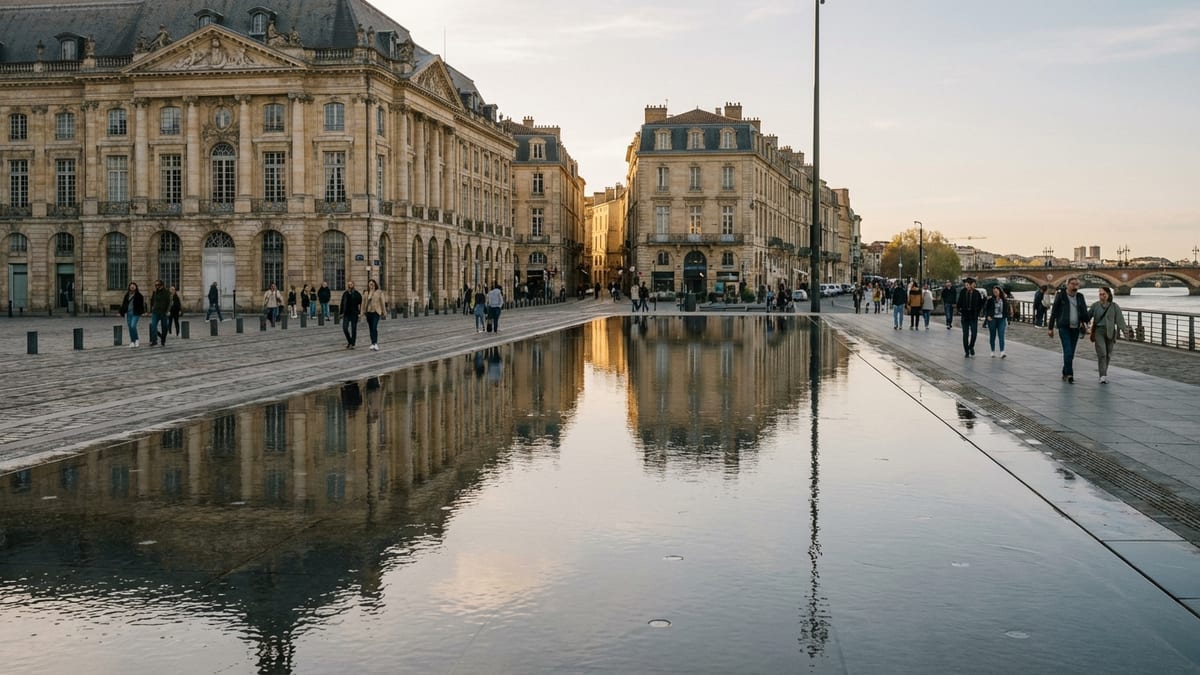
Riverside Bordeaux is often love at first sight, and nowhere is that feeling stronger than in the walkable old town between Place de la Bourse and the Saint Pierre quarter. This compact route stitches together grand 18th century facades, medieval lanes, graceful churches and squares full of café terraces. It is an ideal half day introduction to the city’s history, food and wine, best explored at a strolling pace with plenty of pauses for a glass of Bordeaux or a canelé pastry.
How to Use This Walking Guide
This guide follows a simple route that starts at Place de la Bourse by the Garonne river and finishes in the Saint Pierre quarter, the historic heart of old Bordeaux. It is designed as a flexible self guided walk covering a distance of roughly two kilometers, easily manageable in two or three hours with time for photos and a café stop. You can linger in museums and churches or simply enjoy the streetscape outdoors depending on your interests and the weather.
The description assumes you arrive at Place de la Bourse by tram or on foot along the riverfront, then loop into the warren of streets behind the square. From there you will weave through key sights such as the Miroir d’Eau, Place du Parlement, the Grosse Cloche gate and the church of Saint Pierre before ending at Place Saint Pierre. The walk can be done in reverse, but starting at the river gives the most dramatic first impression.
Most of this route runs through pedestrian streets or low traffic lanes, so it feels relaxed even at busy times. Cobbles and old paving stones are ubiquitous, however, so comfortable walking shoes are important. If you are traveling with young children or anyone with limited mobility, allow extra time, especially in narrow alleys around Saint Pierre where outdoor terraces can make the passage quite tight.
Arriving at Place de la Bourse and the Garonne Riverfront
Place de la Bourse is the formal front door to Bordeaux’s old town, a sweeping classical square framed by honey colored 18th century buildings. Facing the Garonne on the left bank, it was built in the mid 1700s as a symbol of the city’s commercial power. Today it remains the most photographed place in Bordeaux, by day when the stone glows warm gold and at night when the facades are perfectly lit. The central pavilion houses the Palais de la Bourse, still used for events and exhibitions.
The square is easy to reach on public transport. The Place de la Bourse tram stop on Bordeaux’s network sits a short walk away, with lines including A and C running frequently through the day. The city bus system also serves the area, and large interchanges such as Quinconces are within ten minutes’ walk. Taxis and rideshares can drop you at the quayside or on nearby Cours du Chapeau Rouge, while underground parking at Bourse Jean Jaurès serves visitors arriving by car.
From the tram stop, walk toward the river and you will emerge onto the vast open space that stretches between the buildings and the Garonne. Turn to take in the full curve of the facades and notice the small sculptural details: masks, coats of arms, wrought iron balconies. Bordeaux’s historic center is a UNESCO World Heritage Site, and this square encapsulates the harmonious urban design that earned the city that status. Unlike some European old towns that unfold gradually, here the spectacle is immediate.
The Miroir d’Eau and the Quays of the Garonne
Cross the tram lines and you will reach the Miroir d’Eau, a shallow granite basin that has become Bordeaux’s contemporary icon. Opened in 2006 as part of the redevelopment of the riverfront, it is the largest reflecting pool of its kind in the world, covering more than 3,000 square meters with a film of water just a couple of centimeters deep. In warm weather children splash while photographers wait for the breeze to still so the classical facades reflect perfectly in the mirror like surface.
The water feature normally operates from late spring through autumn, typically between morning and late evening with a repeating cycle of filling, mirror effect and mist. In winter the basin is usually dry for maintenance and to avoid ice. If you are visiting outside the warmest months, check locally whether the water is running, but even without water the open space offers some of the best views back to the square and across to the right bank and the Pont de Pierre stone bridge upstream.
Take a short stroll along the quays before heading into the old town. The Garonne embankment here is part of a long riverside promenade that runs north and south from Place de la Bourse. Landscaped lawns, bike lanes and play areas line the route, with benches ideally placed for watching the slow moving river traffic and the sweep of Bordeaux’s facades. River cruise boats often moor nearby, and at high tide the brown water flows fast, reminding you that this was once a working port and gateway for wine shipments across Europe.
For this walking route, a good approach is to walk ten minutes south along the river to appreciate the skyline, then return to Place de la Bourse to enter the old town streets behind the square. This helps you orient yourself: the river is always to the east, and the old town spreads inland to the west in a fairly narrow strip between the Garonne and broader boulevards further out.
From Place de la Bourse to Place du Parlement
From the edge of Place de la Bourse, turn your back on the river and slip into the lanes that run westward. The change of atmosphere is immediate. Within a few steps the grand formality of the square softens into a network of human scale streets lined with wine bars, bistros and small boutiques. The old town here survived both war and 20th century redevelopment better than in many French cities, so the streets still follow their medieval patterns even where facades have been cleaned and restored.
One of the most pleasant routes to the Saint Pierre quarter is to aim for Place du Parlement, a few minutes’ walk inland. The square dates from the 18th century and is framed by harmonious stone buildings similar in style to Place de la Bourse, but on a more intimate scale. At its center stands an ornate fountain that is especially photogenic when the surrounding café terraces are busy on summer evenings. This is a good place to pause for lunch: many menus feature regional dishes such as entrecôte steak, duck confit and platters of local cheeses.
Between the two squares, wander wherever the narrowest streets attract you. Side lanes such as Rue du Pas Saint Georges and smaller cross streets reveal independent wine shops and pâtisseries selling Bordeaux specialties like canelés, the small caramelized cakes flavored with rum and vanilla. Look up to spot sculpted keystones above doors and wrought iron signs that hint at earlier trades. Some street names still recall guilds and professions, a thread that becomes stronger as you approach Place Saint Pierre.
Exploring the Saint Pierre Quarter
Continue westward and slightly south from Place du Parlement and you will find yourself in the heart of the Saint Pierre quarter. This district roughly stretches between Rue Sainte Catherine, Bordeaux’s main pedestrian shopping spine, and the Garonne riverfront, and is what many locals mean when they speak of the “old town.” Its charm lies in its scale: lanes are narrow, often cobbled, and the buildings rarely rise above five stories. Small squares open unexpectedly, lined with restaurants whose tables spill into the open air from spring to autumn.
Place Saint Pierre itself stands on the site of Bordeaux’s ancient harbor, which in Roman and medieval times reached much further inland than the modern quays. Today you see only the outline of former warehouses in the layout of the streets, but plaques and occasional archaeological displays recall the area’s trading past. The square is quieter than its popularity might suggest, buffered from traffic and large crowds by the tangle of pedestrian streets around it. In the late afternoon, when the light turns amber on the stone, it feels like an outdoor living room for the neighborhood.
As you wander, notice how many streets bear the names of traditional crafts. Around Place Saint Pierre you find Rue des Argentiers for silversmiths, Rue des Bahutiers for chest makers and Rue des Trois Chandeliers for chandelier makers. These names echo the time when the area was packed with workshops supplying goods to merchants and sailors. Today those same premises host wine bars, small contemporary galleries and intimate bistros, but the sense of continuity between trade and hospitality remains strong.
It is worth stepping away from the main restaurant filled squares to explore quieter corners. You can reach Rue Saint James and the Grosse Cloche gate in under ten minutes’ walk to the southwest, or cut north to Cours Alsace Lorraine, a broad avenue that marks the outer edge of the oldest streets. Use the spire of nearby churches as landmarks if you lose your bearings. Getting mildly lost here is part of the pleasure, and you are never far from the river or a tram stop back to your hotel.
Église Saint Pierre and Sacred Bordeaux
Dominating Place Saint Pierre is the parish church of Saint Pierre, whose current Gothic structure largely dates from the 14th and 15th centuries. It was built at a time when Bordeaux prospered under English rule and later as part of the French kingdom, and its architecture reflects both maritime connections and local devotion. The facade is compact but richly ornamented, with statues peering from niches and a portal that frames the square beyond when seen from inside.
Step through the door and the noise from café terraces drops away. The interior is typically dim and cool, with stained glass filtering soft colored light onto the stone. Side chapels contain paintings and carved altarpieces that survived wars and revolutions, and memorials recall former parishioners tied to the port and its trades. Take a few minutes to sit in a pew and look up at the ribbed vaulting above, a reminder that Bordeaux’s religious heritage is as strong as its commercial story.
For visitors interested in sacred architecture, the Saint Pierre church is part of a broader network of historic churches within walking distance. To the southwest lies the great Saint André cathedral with its separate bell tower, and to the south Rue Saint James leads toward the Grosse Cloche, once part of the old city walls and still crowned by a small belfry. Even if you stay focused on the Saint Pierre area, it is worth noting how church spires punctuate the skyline and help orient you as you move through the alleys.
Photography is generally allowed inside Saint Pierre but be considerate during services, weddings or organ rehearsals. Modest dress is appreciated, and in high season this can be a welcome spot to take a quiet break from the heat and crowds outside. If you enjoy organ music, check local listings or notices at the church entrance for occasional recitals and evening concerts that make full use of the building’s acoustics.
Cafés, Wine Bars and Evening Atmosphere
One of the chief pleasures of this walking route is the chance to linger over food and drink in atmospheric surroundings. Around Place du Parlement and Place Saint Pierre you will find a concentration of restaurants serving everything from traditional French cuisine to modern bistro dishes and lighter Mediterranean inspired plates. Menus are typically posted outside and many places offer a fixed price lunch, which can be a budget friendly way to sample local specialties.
Wine bars are an essential part of the Bordeaux experience. In the Saint Pierre quarter, many bars specialize in by the glass tastings, allowing you to compare wines from different appellations without committing to a whole bottle. Staff are usually happy to recommend pairings and explain labels, and it is common to find short lists of organic or natural wines alongside more classic châteaux. Pair your glass with local charcuterie or cheeses for a simple but satisfying pause between sightseeing stops.
As evening falls, the quarter’s mood shifts from daytime sightseeing to a more local, social rhythm. Terraces fill with residents meeting friends after work, tourists linger over late dinners and musicians may perform in corners of the main squares or under the arches of old buildings. Lighting is soft rather than harsh, and many streets are lit by lantern style fixtures that complement the stone facades. Compared with larger French cities, the atmosphere is relaxed rather than frenetic, but tables at popular spots can book out at weekends, so reservations are wise if you have a particular restaurant in mind.
If you prefer a quieter evening, consider an early dinner in the Saint Pierre area followed by a final stroll back to the Miroir d’Eau. At night, when the water is operating in season, the reflections of Place de la Bourse are especially striking, and the tram lines gliding past add a cinematic quality to the scene. From there it is easy to catch a tram back toward the train station or hotel districts further out.
Practical Tips for Walking Bordeaux Old Town
The historic center of Bordeaux is compact, but a little planning makes a walking tour more comfortable. Mornings and late afternoons are generally the best times to explore, especially from late spring to early autumn when midday sun can be strong and the reflecting pool at the Miroir d’Eau generates extra heat. If you are visiting in high summer, start your walk soon after breakfast to enjoy quieter streets and cooler temperatures, then return to the riverfront in the evening.
Comfortable footwear is essential. Even though distances are short, many streets are cobbled or paved with uneven stones that can be tiring in thin soled shoes. The old town is mostly flat, but narrow alleys and occasional steps, especially around the remnants of former gates and walls, can pose minor obstacles. Accessibility is improving, with more ramps and level crossings, but visitors using wheelchairs or strollers may prefer to stick to broader streets such as Cours Alsace Lorraine and routes parallel to the river while choosing specific squares and churches to enter.
Public transport provides a useful framework for this walking route. The city’s tram lines intersect near Place de la Bourse and along Cours Alsace Lorraine, making it easy to start or end your walk at a convenient stop. Trams typically run every few minutes during the day on main lines, with reduced frequency early in the morning and late at night. Tickets can be purchased from machines at stops and validated before boarding. Buses add further flexibility, but for the core of the old town, walking remains the most pleasant way to get around.
Safety is generally good in the historic center, particularly in busy areas like Place du Parlement and Place Saint Pierre. As in any popular destination, keep an eye on bags and pocketable valuables in crowded trams or around major photo spots such as the Miroir d’Eau. Tap water is safe to drink, and public fountains and restrooms are scattered through parks and transport hubs. A small reusable bottle and a foldable umbrella or light waterproof jacket are useful in a city where Atlantic weather can shift quickly.
The Takeaway
Walking from Place de la Bourse to the Saint Pierre quarter is one of the most rewarding ways to encounter Bordeaux. The route links the city’s grand classical face on the Garonne with the intimate medieval lanes, squares and churches that reveal its deeper layers of history. Along the way you experience signature sights such as the Miroir d’Eau, sample the café and wine bar culture that defines daily life here, and sense how the old harbor district has adapted from trade and craftsmanship to hospitality and culture.
Because the distances are short and the terrain is mostly flat, this walk suits a wide range of visitors, from first time travelers to France to seasoned city break enthusiasts. You can compress it into a couple of hours or stretch it over a leisurely day filled with museum visits, tastings and detours to nearby landmarks. Either way, the combination of riverfront views, golden stone architecture and lively yet human scale streets makes this part of Bordeaux a place many travelers find themselves returning to more than once during their stay.
FAQ
Q1: How long does it take to walk from Place de la Bourse to Place Saint Pierre?
At a relaxed pace with brief photo stops, you can walk from Place de la Bourse to Place Saint Pierre in around 15 to 20 minutes, but most visitors allow two to three hours to explore side streets, visit the church and enjoy a drink or meal.
Q2: Is the walking route suitable for children and strollers?
The route is generally family friendly and mostly flat, but many streets are cobbled and can be bumpy for strollers. Take it slowly in narrow lanes and around café terraces, and consider using slightly wider streets if you need more space.
Q3: When is the best time of day to see the Miroir d’Eau?
Early morning offers quieter reflections and softer light, while late afternoon and evening provide dramatic photos with the facades lit and the sky changing color. In warm months, evenings are especially atmospheric when locals gather by the water.
Q4: Does the reflecting pool operate all year round?
No. The Miroir d’Eau typically operates from late spring through autumn and is usually turned off in winter for maintenance and to prevent ice. Schedules can vary slightly by year, so check locally if it is a key part of your visit.
Q5: Are there guided walking tours in the Saint Pierre quarter?
Yes. Several local companies and independent guides offer scheduled and private walking tours focused on the historic center, many of which include Place de la Bourse, the Saint Pierre church and surrounding streets as core stops.
Q6: Can I visit the interior of Église Saint Pierre?
In general, the church is open daily for visitors outside of service times, although exact hours may vary by season and parish activities. Entry is usually free, with an optional donation box near the entrance.
Q7: Is it safe to walk the old town at night?
The central areas around Place de la Bourse, Place du Parlement and Place Saint Pierre are usually lively and feel safe in the evening, with many restaurants and bars open. As always, stay aware of your surroundings and stick to well lit streets late at night.
Q8: What should I wear for this walking route?
Comfortable, flat shoes are important because of cobbles and uneven paving. In summer, light clothing, a hat and sunscreen help with strong sun, while in cooler months a layered outfit and a compact rain jacket are wise due to changeable Atlantic weather.
Q9: Are there vegetarian or vegan food options in the Saint Pierre area?
Yes. While Bordeaux is known for meat and regional specialties, the Saint Pierre quarter has an increasing number of restaurants and cafés offering vegetarian and some vegan dishes, especially in contemporary bistros and international cuisine spots.
Q10: How can I combine this walk with other Bordeaux sights in one day?
A popular plan is to start with this riverfront and Saint Pierre walk in the morning, pause for lunch in the old town, then continue on foot or by tram to visit Saint André cathedral, Rue Sainte Catherine for shopping or the Chartrons district for wine and antique browsing in the afternoon.