

More news on this day
High on the rocky slopes of Mount Kakavos on the Greek island of Lemnos, the tiny open-air chapel of Panagia Kakaviotissa offers one of the Aegean’s most dramatic combinations of landscape, history and lived tradition.
Get the latest news straight to your inbox!
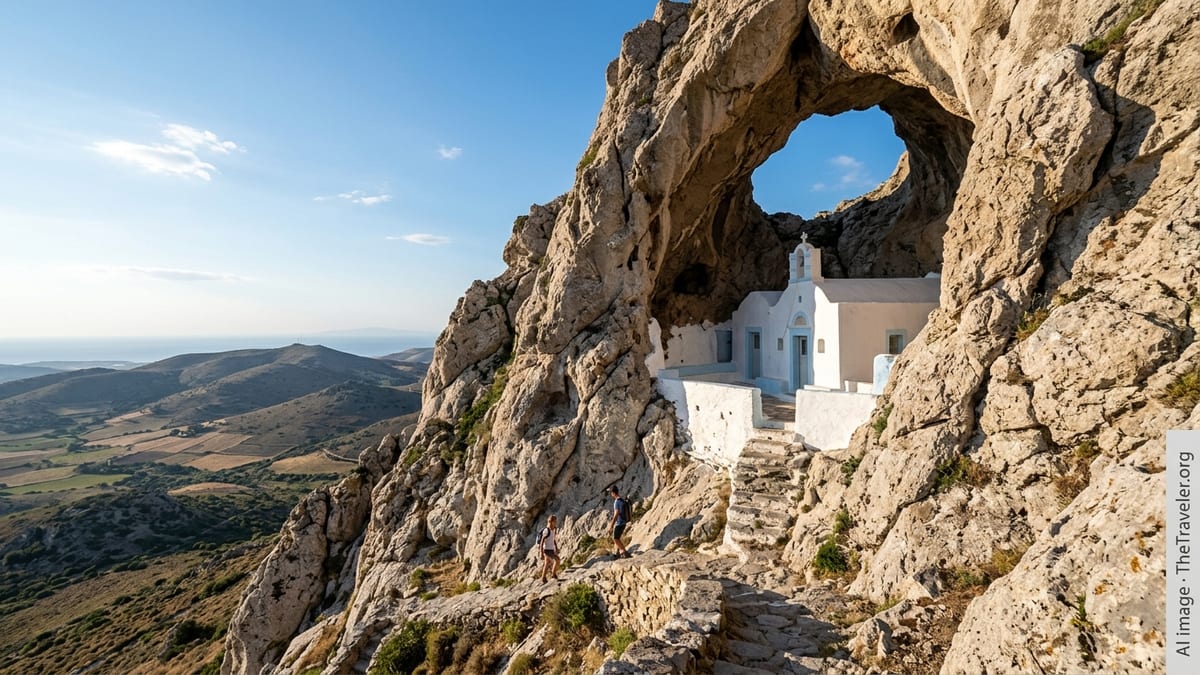
A Remote Cliffside Sanctuary Above the Aegean
Panagia Kakaviotissa sits in a natural rocky hollow at around 260 meters above sea level, overlooking the central and southern stretches of Lemnos. The whitewashed chapel, framed by jagged cliffs, is widely described in travel coverage as one of Greece’s most distinctive places of worship because it has no conventional roof. Instead, visitors stand beneath an irregular opening in the rock, with the sky serving as the church’s canopy and sunlight pouring directly onto the icons.
The sanctuary is reached from a trailhead a short drive from the port town of Myrina, with most recent guides describing the hike as moderate rather than technical. The final approach involves stone steps and narrow paths that wind through low scrub and limestone outcrops, gradually revealing wider views of the island’s rolling interior and coastlines. For many visitors, the gradual transition from farmland and olive groves to bare rock adds to the sense of pilgrimage, even on a casual visit.
Travel writers note that the site remains relatively quiet compared with better known chapels in the Cyclades, despite becoming more visible on social media in recent years. Outside major religious feast days, those who time their visit for early morning or late afternoon often find only a handful of other hikers at the summit. The absence of built-up tourist infrastructure at the site, apart from simple benches and information signs in some seasons, reinforces the feeling of being in a secluded, almost hidden sanctuary.
Centuries of History Carved Into the Rock
Historical references compiled in recent cultural studies of Lemnos indicate that Panagia Kakaviotissa traces its origins to the early 15th century, when monks from a monastery in Myrina are believed to have retreated to the slopes of Mount Kakavos. The choice of the natural cave-like hollow offered both protection and a vantage point over surrounding routes. The current small chapel, with its plain white walls and blue-painted details, stands where earlier hermits are thought to have established a more rudimentary place of worship.
Accounts in regional heritage publications describe Panagia Kakaviotissa as part of a wider network of small, often isolated chapels scattered across Lemnos. Many of these were linked to local agricultural life, serving as landmarks, refuges in times of danger, or focal points for seasonal celebrations. In this context, the roofless design appears less as an architectural novelty and more as a practical response to the contours of the rock, which already offered partial shelter while allowing smoke and light to escape.
The site’s religious life remains active, particularly around Orthodox Easter, when local tradition includes a well-attended service at the chapel. Publicly available reports and visitor accounts describe villagers and Lemnians returning from elsewhere in Greece and abroad to take part in processions that carry icons up the mountain path. Even outside these key dates, the small interior is carefully maintained, with fresh paintwork, candles, and offerings reflecting ongoing community attachment.
Panoramic Views and the Best Times to Visit
For travelers, Panagia Kakaviotissa is as much about the sweeping Aegean panorama as it is about devotion. From the ledge in front of the chapel, clear days bring views across the undulating hills of Lemnos, with flashes of the sea visible between promontories. The play of light on the surrounding rock and chapel walls changes hourly, with the open "roof" in the cave acting like a natural spotlight that shifts as the sun arcs overhead.
Travel guides and recent visitor reports consistently recommend timing trips for the cooler hours of the day, particularly in late spring and early autumn. Morning visits often provide softer light on the interior of the chapel and quieter paths, while late afternoon hikes can coincide with golden-hour views over the island and, on some days, vivid sunsets. Summer mid-day heat can be intense on the exposed trail and at the rocky summit, making water, hats and sturdy footwear essential.
Weather conditions can transform the experience. On very clear days, the horizon appears sharply defined, while occasional haze softens the outlines of distant hills and coastlines. Strong winds, common in the northern Aegean, can whip across the ridge, reinforcing the sense of exposure but also providing relief from the heat. Visitors are often encouraged in recent travel writing to check local forecasts and avoid attempting the hike during unstable weather, when the rocky surfaces can become slippery.
Practical Access, Respectful Etiquette and Safety
Publicly available tourism information describes access to Panagia Kakaviotissa as straightforward for independent travelers with a rental car or taxi from Myrina. A signposted road leads to a small parking area, from which the main trail begins. The walk typically takes 20 to 40 minutes each way, depending on fitness levels and how often visitors pause to photograph the landscape. There are no ticket booths or formal opening hours at the chapel, but daylight is the safest and most practical time for a visit.
Although the hike is classed as moderate, the uneven terrain requires attention. Parts of the trail cross loose gravel, and the final section climbs steeper stone steps without handrails. Recent hiking accounts advise closed shoes with good grip and caution when descending, especially if light is fading. Families with children often attempt the route, but close supervision is recommended near the exposed edges around the chapel.
Once inside the rock hollow, visitors are encouraged by local customs to treat the space as an active place of worship rather than a viewpoint alone. Modest dress, quiet voices and careful handling of candles and offerings are widely described as appropriate etiquette. Photography is generally accepted, but many guides advise avoiding flash near icons and being discreet if worshippers are present. Leaving litter, carving into rocks or moving religious items is strongly discouraged and at odds with the site’s protected status and community expectations.
A Growing Presence in Lemnos’ Tourism Story
In recent years Panagia Kakaviotissa has featured more prominently in promotional material and independent travel coverage about Lemnos, often cited as a signature image for the island. Photos of the roofless chapel framed by blue sky or stars have circulated widely, drawing the attention of travelers who might previously have overlooked this quieter corner of the northern Aegean in favor of better-known destinations in the Cyclades or Dodecanese.
Regional development studies note that Lemnos is positioning itself as a destination where traditional agriculture, nature and low-density tourism coexist. In that narrative, Panagia Kakaviotissa serves as a compelling symbol: an ancient yet living sanctuary that showcases both the raw geology of the island and the endurance of its religious and cultural practices. Its relatively modest visitor numbers, compared with mass-tourism hotspots, currently help preserve the contemplative atmosphere that many travelers highlight as a key part of the experience.
As awareness grows, local and national bodies continue to emphasize responsible visitation, encouraging those who make the climb to appreciate both the physical beauty of the site and its sacred character. For travelers seeking an encounter with the Aegean that balances dramatic views and authentic local tradition, Panagia Kakaviotissa is emerging as one of Lemnos’ most memorable stops.