

More news on this day
Stretching along the south slope of Athens’ Acropolis between two of the city’s most storied theaters, the Stoa of Eumenes is drawing renewed attention from travelers seeking a deeper look at how ancient Athenians moved, gathered, and sheltered themselves in the shadow of the Parthenon.
Get the latest news straight to your inbox!
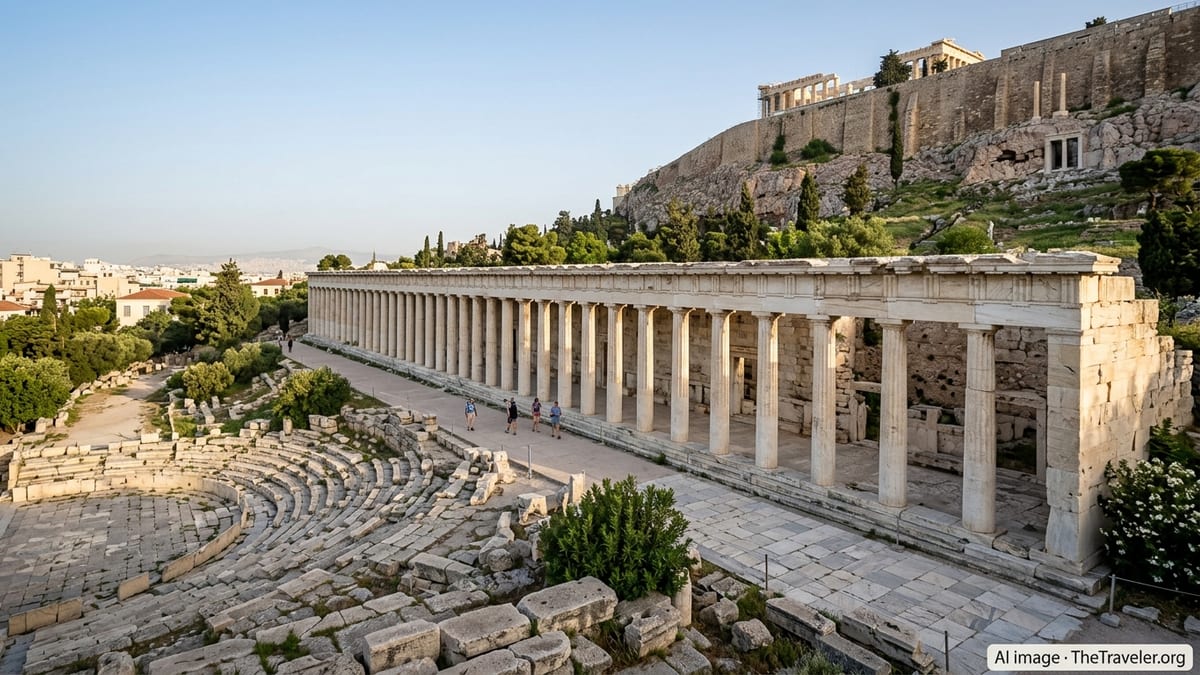
A Hellenistic Landmark Framing the Acropolis South Slope
The Stoa of Eumenes runs along the southern flank of the Acropolis, forming an elegant colonnaded backdrop between the Theater of Dionysus below and the later Odeon of Herodes Atticus above. Publicly available archaeological summaries describe it as a Hellenistic gallery more than 150 meters long, creating a covered walkway that once guided visitors around the sacred rock while protecting them from sun and rain.
The structure takes its name from Eumenes II of Pergamon, the powerful ruler who offered the stoa to Athens in the second century BC. In keeping with the diplomatic culture of the era, the building functioned as both practical infrastructure and political gift, visually tying the prestige of Pergamon to the ceremonial landscape of the Athenian citadel.
Today, travelers approaching the south slope encounter the surviving lower colonnade, fragments of the upper level, and the restored line of the ancient floor. While not as immediately recognizable as the Parthenon above, the stoa’s long, rhythmic façade helps frame the approach to the Acropolis and gives a sense of the bustling, theater-lined hillside that once greeted festival crowds.
Recent educational material produced for visitors to the Acropolis sites highlights the Stoa of Eumenes as one of the key waypoints on the south slope, underscoring how this zone functioned as both a cultural quarter and a circulation route encircling the sacred hill.
Architecture That Bridged City, Sanctuary, and Theater
The Stoa of Eumenes was built as a two-storey colonnade, with an open ground-floor arcade and an upper level that likely offered shaded views across the southern districts of Athens. Archaeological descriptions note that the design drew on the refined stoa architecture of Pergamon, adapted to the steep topography of the Acropolis slope.
The lower level employed a mix of Doric and Ionic elements, while the upper storey probably featured lighter columns and generous windows or openings. Inside, visitors walked along a deep, column-lined corridor that acted as a sheltered promenade, with masonry at the rear tying the stoa into the rising hillside. The structure also absorbed an earlier stretch of the Peripatos, the ancient path that traced the Acropolis perimeter.
By visually linking the Theater of Dionysus with the later Odeon of Herodes Atticus, the stoa created a continuous architectural sequence along the south slope. Festival-goers attending dramatic performances would have passed beneath its shade, moving between stages and shrines while remaining connected to the overarching silhouette of the Acropolis above.
Comparisons in specialist studies between the Stoa of Eumenes and the better-known Stoa of Attalos in the nearby Agora underline its importance as part of a broader Hellenistic wave of colonnaded architecture that reshaped Athens’ civic and sacred spaces.
Ongoing Study and Theoretical Restoration Efforts
The Stoa of Eumenes has been the focus of renewed scholarly interest in recent years, as researchers reexamine its original form and role in the Acropolis landscape. A detailed study on theoretical restoration, published in an archaeological journal, outlines how surviving foundations, column fragments, and ancient descriptions can be combined to propose a more complete reconstruction on paper.
These studies emphasize that any modern intervention on the ground remains cautious and limited. Conservation teams working across the Acropolis complex generally prioritize stabilizing existing masonry, clarifying the ancient ground levels, and presenting structural lines without extensive modern rebuilding. For the Stoa of Eumenes, this has meant selectively resetting columns and consolidating walls to make the building’s scale legible without recreating its full height.
Public information released by the Greek restoration service for the Acropolis also frames the stoa as part of a broader narrative about how visitors approached the sanctuary over time. By highlighting its function in bilingual guides and educational material, curators are drawing attention to an element that once risked being overshadowed by the hilltop temples themselves.
For travelers, the result is a site where the work of archaeologists and conservators is visible in carefully placed marble blocks, filled joints, and restored walking surfaces. The stoa reads less as an isolated monument and more as a case study in how modern Athens interprets, protects, and presents its multi-layered classical topography.
Experiencing the South Slope on Today’s Acropolis Visit
For visitors planning an Acropolis itinerary, the Stoa of Eumenes forms part of the broader south slope archaeological area, which includes the Theater of Dionysus, sanctuaries, and the monumental Roman-period Odeon of Herodes Atticus. Publicly available visitor information notes that access to the slopes is typically bundled with entry to the main Acropolis site, with time-slot ticketing used to manage crowd flow at peak periods.
Recent travel reports describe an emphasis on directing visitors along marked paths that protect the fragile archaeology while still allowing close views of the stoa’s surviving colonnades. Signage and interpretive boards outline the history of the south slope, helping independent travelers understand how structures like the Stoa of Eumenes related to ancient processions, performances, and everyday movement around the hill.
Conditions on the slopes can be demanding in summer, with limited shade and uneven stone surfaces. Travel commentary and official guidance alike consistently recommend sturdy footwear, sun protection, and water, particularly for those planning to combine the south slope with a full ascent to the Parthenon plateau.
For a fuller understanding of the building and its decorative details, many visitors pair a walk along the Stoa of Eumenes with time at the nearby Acropolis Museum, where sculptural fragments and architectural elements from the slopes are displayed in a controlled setting.
A Subtle Yet Essential Stop for Architecture Enthusiasts
Although it lacks the instant recognition of the Parthenon or the visual drama of the Propylaea, the Stoa of Eumenes is increasingly highlighted in guidebooks and digital resources as a must-see for travelers interested in ancient urban design. Its position along the south slope offers oblique views of the Acropolis above and the city spreading out below, allowing visitors to imagine how Athenians once moved through a landscape of sacred theaters, stoas, and shrines.
Architecture enthusiasts can use the preserved line of columns and foundations to read the stoa’s rhythm and proportions, mentally restoring its upper storey and imagining the interplay of shadow, sound, and movement on a festival day. The building’s generous length and alignment with key monuments make it a natural vantage point for photography that captures both ancient stone and contemporary Athens.
As restoration milestones elsewhere on the Acropolis, such as the removal of long-standing scaffolding around the Parthenon, refocus global attention on the hill, the quieter south slope and its Hellenistic stoa are poised to gain a higher profile. For travelers willing to look beyond the skyline icons, the Stoa of Eumenes offers a grounded, architectural way to experience how the Acropolis functioned not just as a sacred summit, but as a lived-in, carefully choreographed urban edge.