

More news on this day
Severe late‑season storms across the North Atlantic are exposing a fragile link in global aviation, as remote island airports struggle with freezing conditions, emergency diversions and mounting numbers of stranded passengers from North America, Europe and the Pacific.
Get the latest news straight to your inbox!
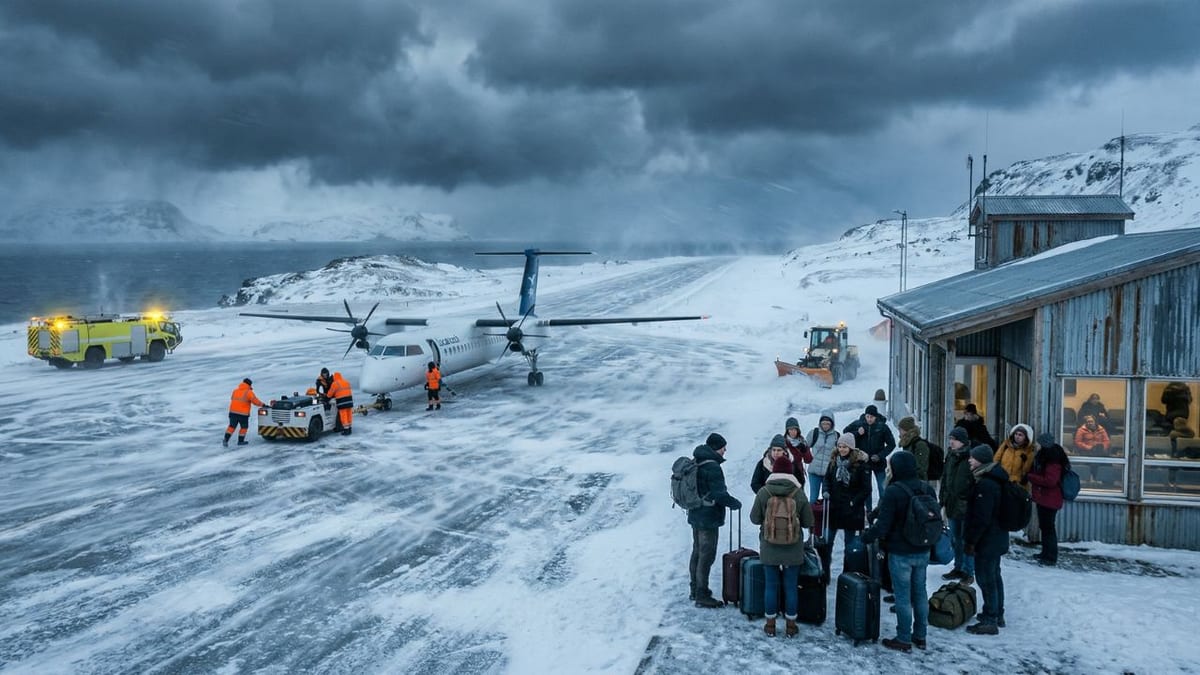
Remote Diversions Turn Small Islands Into Emergency Hubs
Recent weeks have seen a series of long‑haul flights diverted away from primary hubs in the United States, the United Kingdom and Canada toward smaller, more remote airports when medical issues, weather or airspace constraints left few alternatives. Publicly available reports highlight how a British Airways service from London to Houston was forced to divert to St. John’s in eastern Canada at the end of March, leaving 265 passengers stuck for two days in sub‑zero conditions while a replacement aircraft and ground handling were arranged.
St. John’s, typically a modest regional gateway on Canada’s Atlantic edge, suddenly operated as a makeshift long‑haul hub. Passenger accounts compiled by travel publications describe prolonged waits onboard the aircraft, limited local hotel capacity and stretched airport services as staff attempted to manage a wide‑body jetload of unplanned arrivals. The episode illustrated how quickly a routine diversion can become an extended ordeal when it unfolds at a small or remote facility in winter.
Similar vulnerability is evident at other remote island fields that underpin transoceanic routes. Saint Helena Airport in the South Atlantic, already challenged by geography and strong winds, was recently downgraded in firefighting capability after technical assessments, reducing the types of aircraft it can routinely accommodate. Although far from the North Atlantic storm belt, it exemplifies how tight regulatory margins and limited equipment can sharply constrain options when carriers seek diversion points far from major hubs.
Industry analysts note that, as traffic rebounds and route networks densify, these scattered islands and regional outposts are bearing a disproportionate share of risk. When weather or congestion closes primary gateways, the system increasingly leans on small airports that may lack the resilience, staffing and infrastructure to absorb large jets for more than a few hours.
Iceland’s Storm Chaos Sends Shockwaves Through Transatlantic Travel
Nowhere has the strain on remote‑island infrastructure been more visible this week than in Iceland. Severe winter weather on 6 and 7 April triggered around 130 flight cancellations and at least 21 delays at Keflavik, Reykjavik and several regional airports, according to travel‑industry coverage, grounding hundreds of travelers and disrupting operations for Icelandair, Air Iceland Connect, SAS, easyJet and other carriers.
The cancellations did not just impact point‑to‑point Iceland traffic. Keflavik functions as a crucial mid‑Atlantic transfer node linking North America and Europe, particularly for passengers traveling between the United States, Canada, the United Kingdom and mainland Europe. When blizzard conditions and high winds curtailed runway capacity and ground handling, the resulting backlog spilled quickly into wider networks, forcing missed connections, equipment shortages and last‑minute re‑routing across multiple continents.
Domestic links suffered as well. Reykjavik’s city‑center airport and regional fields such as Akureyri and Isafjordur provide essential connections for communities that may be cut off by snowbound roads. When those small airports halted operations, residents and visitors alike faced a combination of grounded flights, limited accommodation and difficult surface travel options, with some passengers turning to public forums to document missed departures and confusion over rescheduled services.
The Iceland disruption underscored a broader pattern: an entire system built around just a handful of island runways is acutely exposed when a single severe storm stalls operations. With winter weather lingering deeper into spring, travel observers warn that similar chains of disruption could recur as late‑season fronts sweep across the North Atlantic.
North American and UK Weather Turmoil Adds to Global Gridlock
While Iceland grappled with its own storm, airports across the United States, Canada and the United Kingdom have been handling overlapping bouts of extreme weather. Data cited by aviation and travel‑insurance outlets show that powerful winter systems in January, February and March drove some of the heaviest flight disruption in years, with more than ten thousand delays and cancellations on peak days in North America alone as hubs from New York and Chicago to Atlanta and Toronto slowed or shut down.
These storms hit at a time when airline networks in the United States and Canada were already operating close to capacity. Reports highlight how previous winter events in Toronto and Montreal had left schedules fragile heading into March, while a succession of blizzards and severe thunderstorms later in the month forced rolling ground stops across multiple hubs. Each new weather band translated into long queues for deicing, crew duty‑time expiries and ultimately the cancellation of entire waves of departures and arrivals.
In the UK, storm systems crossing the North Atlantic and the North Sea added further complications for flights departing for or returning from North America. European monitoring services documented days with more than a hundred cancellations and thousands of delays at major hubs as snow, freezing rain and high winds squeezed runway capacity at airports that also serve as key connection points for passengers heading onward to Australia and New Zealand.
The net effect was a patchwork of localized crises that, together, produced a sense of global gridlock. Travellers trying to move between any combination of the United States, the UK, Canada, Iceland, Australia and New Zealand often discovered that a delay or cancellation in one region quickly cascaded through several others as aircraft and crews failed to arrive where they were needed next.
Fragile Infrastructure at Small Airports Meets a Changing Climate
Beyond the immediate inconvenience for stranded passengers, the latest disruptions have renewed debate over how ready small and remote airports are for a future defined by more frequent and intense extreme weather. Research synthesized by organizations such as the International Civil Aviation Organization and academic institutions has highlighted a growing list of climate‑related risks to aviation, from heavier snowfall and more volatile storm systems in northern latitudes to flooding and heat extremes closer to the equator.
Remote island airports and small regional fields figure prominently in that risk landscape. Many were built with limited firefighting capability, modest terminal facilities and minimal redundancy in critical systems such as power, deicing and runway maintenance. When temperatures plunge, snow accumulates or visibility collapses, these airports may have to suspend operations entirely or restrict the size and type of aircraft they can handle. If a diverted wide‑body jet suddenly appears on the apron, local staff can find themselves overwhelmed.
Studies of recent events have also drawn attention to the social dimension of infrastructure fragility. With only a handful of hotels or guesthouses near many small airports, passengers forced to remain overnight can quickly saturate local capacity, sending some travelers to community centers, sports halls or improvised shelters while airlines work to source aircraft or reroute itineraries. In island settings where ferry schedules are weather‑dependent and roads may close, options for onward travel can narrow to almost nothing for hours or days at a time.
As late‑winter storms continue to disrupt air travel across multiple continents in early 2026, the convergence of climate volatility, tight airline schedules and constrained small‑airport infrastructure is becoming more visible to travelers and industry planners alike. Calls are growing, in policy papers and sector briefings, for new investment in cold‑weather resilience, emergency accommodation planning and clearer passenger‑rights frameworks tailored to diversion‑prone remote locations.
Cascading Disruptions Reach Australia and New Zealand Networks
Although much of the latest turmoil has played out in North Atlantic skies, aviation observers note that the consequences are being felt as far away as Australia and New Zealand. When storms and diversions in North America, the UK, Canada and Iceland throw off long‑haul schedules, aircraft rotations into Asia‑Pacific are often among the first to be adjusted, with carriers trimming frequencies, consolidating services or rerouting flights to reset networks.
Operational data from early March illustrate the scale of the challenge. An Asia‑Pacific flight disruption snapshot for 11 March recorded hundreds of cancellations and more than two thousand delays across the region, driven by a combination of local weather, airspace constraints in the Middle East and knock‑on effects from earlier disruptions in Europe and North America. Travel‑industry analysis linked part of that turbulence to aircraft and crews arriving late or out of sequence after earlier storms elsewhere.
For passengers connecting between Australia, New Zealand and North America via secondary hubs, the margin for error is slim. Missed transatlantic connections in London or European capitals can mean onward flights across Asia or the Pacific depart half empty or without key crew, prompting last‑minute cancellations that strand travelers far from either their origin or destination. The pattern has been especially visible on itineraries that thread through smaller hubs, where there is little backup capacity if a single rotation is lost.
With the southern hemisphere’s own storm seasons overlapping increasingly with northern extremes, analysts warn that multi‑region shocks are likely to become more common. The recent remote‑island flight crises serve as a stark reminder that a snow‑choked runway thousands of kilometers away can still dictate whether travelers in Sydney, Auckland or Queenstown make it home on time.