

More news on this day
Operations at Buenos Aires’ Ministro Pistarini International Airport experienced notable disruption today, with six flight cancellations and 11 delays affecting services operated by Flybondi, Aerolineas Argentinas, Delta Air Lines, and Ethiopian Airlines on key routes linking the Argentine capital with São Paulo, Miami, and New York.
Get the latest news straight to your inbox!
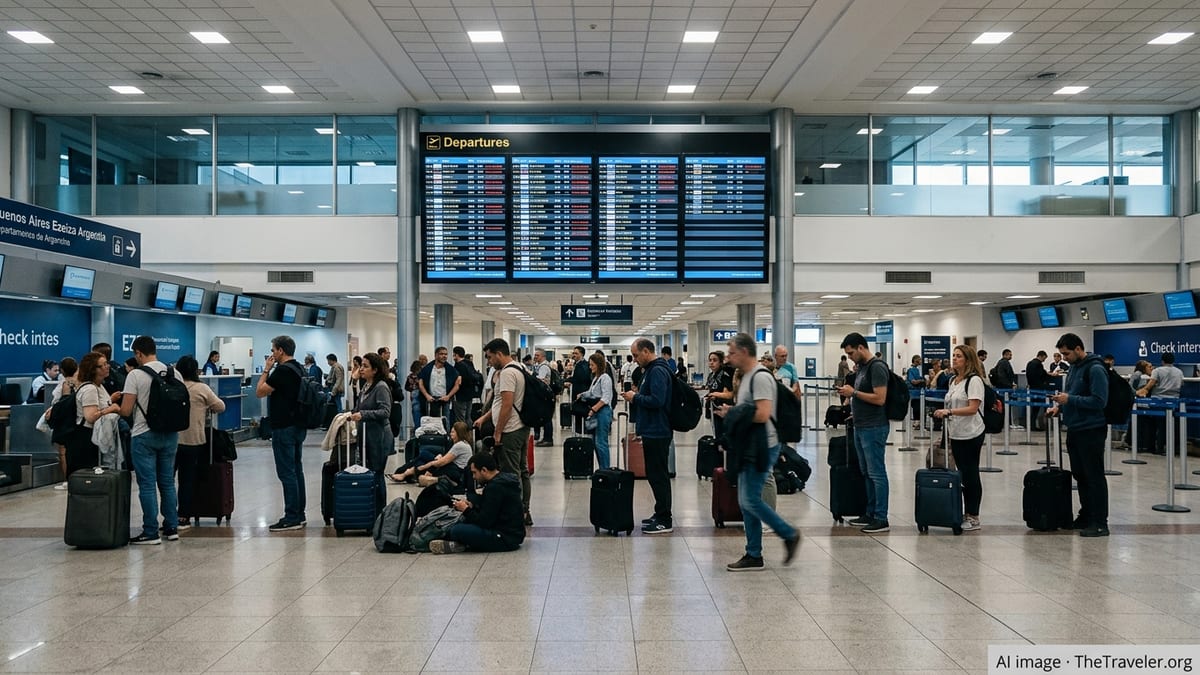
Operational Strain at Argentina’s Primary International Gateway
Ministro Pistarini International Airport, better known as Ezeiza and serving as Buenos Aires’ main long haul gateway, faced a wave of schedule disruptions that rippled across the regional and intercontinental network. Publicly available flight tracking information and Argentine aviation operations data indicate that a combination of operational constraints and tight scheduling contributed to an irregular day for several carriers.
The six cancellations and 11 delayed departures and arrivals were clustered around high demand corridors linking Buenos Aires with São Paulo Guarulhos, Miami International Airport, and New York’s John F. Kennedy International Airport. These routes are central to connectivity between Argentina, Brazil, and the United States, which amplified the impact for both local travelers and international visitors using Ezeiza as a transfer point.
The disruption came against the backdrop of a busy period for Ezeiza. As the primary base or long haul hub for multiple airlines, the airport routinely manages dense banks of departures and arrivals, meaning even limited irregular operations can quickly cascade across the schedule.
Key Routes to São Paulo, Miami, and New York Affected
Connections between Buenos Aires and São Paulo are among the busiest international links in South America, providing essential access to onward global networks in both directions. On the affected day, services on this corridor experienced a mix of delayed operations and at least one cancellation, trimming capacity between the two financial centers and forcing some passengers to be rebooked on later departures.
Long haul flights between Ezeiza and Miami, a major gateway for Latin American traffic to the United States, also faced schedule disruption. Delays of varying length affected departures and arrivals, extending travel times and complicating onward domestic connections within the United States for some passengers. The route is typically operated with widebody aircraft that carry substantial numbers of travelers, magnifying the overall effect of each irregular flight.
The Buenos Aires to New York link, served by a smaller number of daily frequencies compared with Miami, proved particularly sensitive to timing issues. Available tracking data show that at least one northbound departure experienced a notable delay, with knock-on effects for the corresponding southbound rotation. With fewer alternative flights on this city pair, some travelers faced limited same day reaccommodation options.
Flybondi and Aerolineas Argentinas Deal With Network Pressures
Argentina based carriers Flybondi and Aerolineas Argentinas were among the airlines most visible in the disruption. As domestic and regional operators with growing international reach, both airlines rely heavily on efficient aircraft utilization and tight turnaround times, which leaves limited margin when irregular operations arise.
Flybondi, a low cost carrier that has expanded rapidly within Argentina and to select international markets, has already drawn attention for schedule reliability concerns in previous months, according to published coverage and traveler reports. On the affected day at Ezeiza, at least one Flybondi service was canceled and others delayed, adding to pressure on its network and on passengers with onward connections.
Aerolineas Argentinas, the country’s flag carrier, also recorded delays affecting flights linked to Ezeiza. Publicly available information shows that the airline has been managing a complex pattern of schedule adjustments, including periodic airport changes within the Buenos Aires system and retimed domestic connections that feed its long haul network. When irregular operations hit at the main hub, the airline’s ability to protect connections for travelers heading to or from São Paulo, Miami, and New York can be strained.
For passengers, the combination of low cost and full service carriers experiencing concurrent disruption at the same airport reduced the scope to switch between airlines at short notice, particularly on peak departures.
Delta and Ethiopian Long Haul Operations Disrupted
Delta Air Lines and Ethiopian Airlines, both operating long haul services at Ezeiza, were also affected by the day’s operational challenges. Their flights typically run on tightly planned rotations that link South America with major hubs in North America, Europe, and Africa, so departure or arrival delays in Buenos Aires can propagate widely across their networks.
Delta’s services connecting Buenos Aires with the United States are structured to feed banked arrivals and departures at its hubs, which support connections to multiple US and international destinations. Delays departing Ezeiza compressed connection windows for some passengers and required schedule adjustments to preserve onward links where possible.
Ethiopian Airlines uses its Buenos Aires operation, often via São Paulo, to connect South America with its hub at Addis Ababa and onward routes to Africa, the Middle East, and Asia. When flights through Ezeiza experience extended ground times or cascading delays, aircraft and crew are often out of position for subsequent sectors, raising the risk of further disruption on later legs.
In such circumstances, airline operations teams typically prioritize repositioning aircraft and maintaining at least a skeleton timetable, but this can mean cancellations on lower frequency services or rebooking passengers onto different routings, occasionally via third country hubs.
Implications for Travelers Using Ezeiza as a Hub
The disruptions at Ezeiza underline the vulnerability of complex itineraries that depend on tight connections at a single primary airport. Travelers using Buenos Aires as a hub, particularly those combining long haul flights with regional or domestic sectors, are especially exposed when a cluster of cancellations and delays emerges on the same day.
Published travel advisories and recent traveler experiences in Argentina consistently emphasize the importance of allowing generous connection times at Ezeiza, and of avoiding itineraries that require same day airport changes within Buenos Aires when possible. The latest round of irregular operations reinforces that guidance, especially for peak season or shoulder season travel when flights tend to run closer to capacity.
For airlines, the events highlight the continued need to manage schedule resilience at Ezeiza amid infrastructure works, seasonal weather variations, and a dense wave structure of arrivals and departures. Carriers with smaller fleets or high aircraft utilization are particularly exposed when a handful of flights experience extended delays or unscheduled maintenance.
As operations stabilize after the latest disruptions, travelers on services linking Buenos Aires with São Paulo, Miami, and New York are likely to see schedules normalize. However, the concentration of cancellations and delays at Ezeiza serves as a reminder that contingency planning, flexible booking options, and realistic connection buffers remain essential for anyone transiting Argentina’s busiest international airport.