

More news on this day
Federal regulators are moving to cap flights at Chicago O’Hare International Airport for the summer 2026 season, stepping in as rapid expansion by United Airlines and American Airlines pushes the busy Midwest hub beyond what officials say the runways, terminals and air traffic control system can reliably handle.
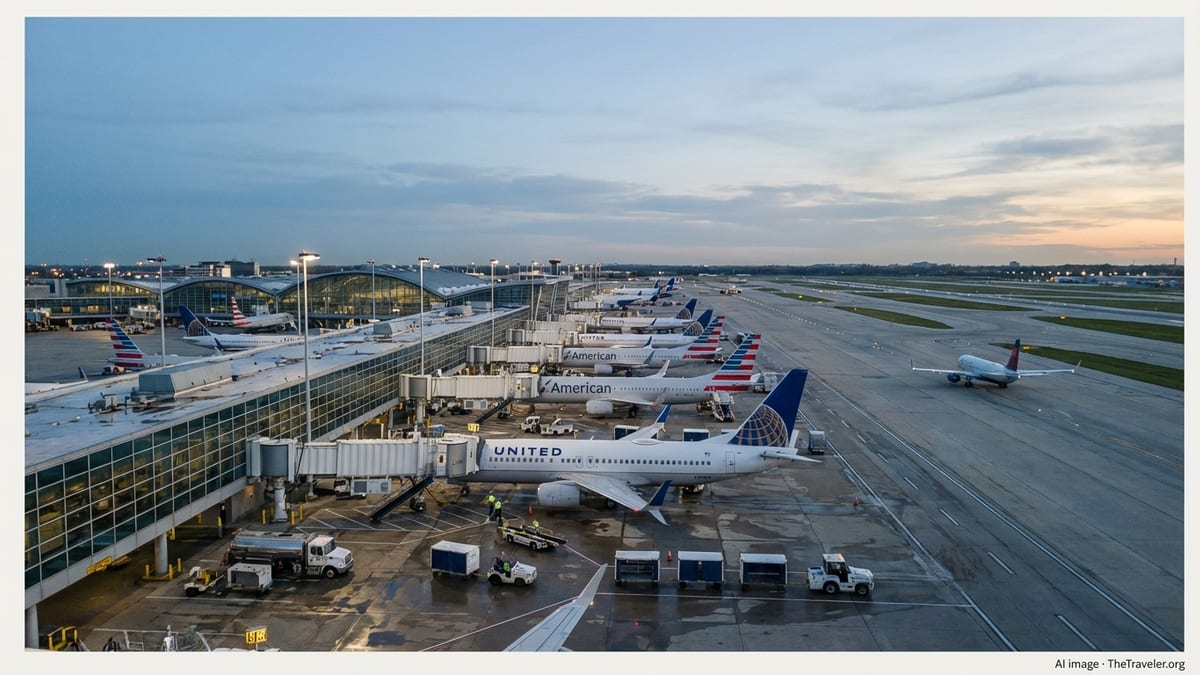
Regulators Step In as Schedules Outrun Airport Capacity
Documents released this week show the Federal Aviation Administration intends to limit operations at O’Hare to about 2,800 takeoffs and landings per day between late March and late October 2026, the official summer scheduling period. Published airline timetables currently project more than 3,080 daily movements on peak days, a jump of nearly 15 percent over last summer’s peak of 2,680 operations.
The agency argues that the proposed increase would strain O’Hare’s complex runway system, crowded terminals and already stretched air traffic control staffing. While the airport has been modernized with a six-runway parallel layout designed for high throughput, the FAA says the practical ceiling is closer to 100 departures and 100 arrivals per hour, or approximately 2,800 daily operations, given current infrastructure and personnel levels.
To keep flight levels within that band, the FAA is preparing an order under its delay reduction authority that will impose hard operating limits on United, American and other United States carriers using the airport. International airlines based overseas are not expected to be directly covered by the order, though their schedules could be affected indirectly as domestic feeds are reshaped.
The move comes as O’Hare rebounds faster than many rival hubs and reasserts itself as one of the busiest and most competitive aviation markets in the country. Regulators say intervening now is intended to prevent a repeat of the cascading delays and cancellations that have plagued other constrained airports during peak travel periods.
United and American Drive Aggressive Expansion at O’Hare
United and American, the two dominant tenants at O’Hare, have been racing to grow their presence in Chicago, using new flights to shore up market share and strengthen claims on valuable gate space while a multibillion dollar terminal expansion program is underway. That rivalry has been the principal driver of the recent surge in scheduled operations.
United has announced what it calls its largest ever summer schedule from Chicago, with plans to serve more than 220 destinations and operate up to roughly 750 or more daily departures in 2026. That represents about a 25 percent increase over its flying from the hub in 2019, before the pandemic, and significantly more than its average daily schedule last year.
American has also been on the offensive. The carrier unveiled plans late in 2025 to add around 100 daily departures to more than 75 destinations, creating its largest spring and summer schedule on record at O’Hare. Combined, the two airlines’ growth plans pushed projected peak day activity past 3,000 takeoffs and landings, well beyond what the FAA considers sustainable.
Industry analysts note that many of the additions have been short haul and regional services, which consume scarce runway and air traffic control capacity without generating the same revenue per slot as long haul flying. Those shorter routes are expected to face particular scrutiny as carriers decide where to trim.
How the New Flight Caps Will Be Implemented
The FAA plans to convene airlines at a closed door meeting in early March to launch a formal scheduling reduction process covering March 29 through late October 2026. Regulators will present a detailed thirty minute demand profile for the hours between early morning and late evening, highlighting periods they deem severely congested and setting reduction targets for those windows.
Carriers will then be asked to propose voluntary schedule cuts to bring their planned operations into line with the new limits. If the reductions fall short of the agency’s targets, the FAA is prepared to issue carrier specific caps through an operating order that would effectively ration access to runway capacity during the busiest periods.
Officials emphasize that the cap of about 2,800 movements per day is not a theoretical construct but reflects O’Hare’s demonstrated manageable capacity in recent summers. The agency maintains that staying near that level should reduce the likelihood of extreme delays and large scale disruptions when weather or technical issues arise.
The cap will apply only to flights operated by United States based airlines, but because United and American rely heavily on domestic feeders to fill international routes, adjustments could ripple through the broader network. The FAA has not indicated how long the limits might remain in place, leaving open the possibility they could be extended or revised in future seasons depending on infrastructure progress and staffing levels.
Impact on Travelers, Tourism and Competing Hubs
For travelers, the most immediate effect of the caps is likely to be a thinning of options rather than sweeping cancellations of marquee routes. Airlines are expected to protect their most profitable long haul and business heavy markets while trimming frequencies on short haul, high frequency domestic services and some regional connections.
Travel and tourism analysts warn that the cuts could nonetheless ripple across the Midwest and beyond. O’Hare functions as a critical connecting hub for journeys to and from smaller cities and for international trips linking the United States heartland with Europe, Asia and Latin America. Reductions in peak time flights could mean longer layovers, fewer same day return options and higher fares on constrained routes as capacity tightens.
Chicago’s own visitor economy may also feel the squeeze. The city’s convention and events calendar, along with peak summer tourism to nearby Great Lakes destinations, relies heavily on O’Hare’s ability to absorb large waves of arrivals and departures. Some meeting planners and leisure travelers could shift to itineraries that connect through other hubs if schedules at O’Hare become less convenient.
At the same time, rival airports such as Dallas Fort Worth, Denver and Atlanta may benefit at the margin as airlines rebalance their networks and route additional connecting traffic through hubs with more available capacity. For smaller communities that depend on a single daily connection to Chicago, however, even modest adjustments at O’Hare could translate into fewer seats or downgauged aircraft.
Airlines, City Officials and the FAA Look for a Compromise
Publicly, both United and American have welcomed the FAA’s effort to address congestion, framing the process as a collaborative step to safeguard safety and reliability during a critical travel season. In statements, the airlines said they support proactive action to ensure a smooth operation at O’Hare and pledged to work with regulators to adjust their schedules.
Chicago city officials have struck a similar tone, signaling support for a temporary recalibration of summer flights while underscoring the importance of maintaining O’Hare’s role as a premier global gateway. The city’s aviation department has pointed to ongoing construction, gate availability and air traffic control staffing as key constraints that need to be balanced against airlines’ growth ambitions.
Behind the scenes, however, the stakes are high. Access to prime departure and arrival times is central to the competitive strategies of both United and American, particularly as they vie for long term positioning in a reshaped terminal complex. How the reductions are apportioned between the two carriers will help determine which airline gains the upper hand in one of the nation’s most contested hub markets.
For the FAA, the challenge will be to enforce meaningful cuts without appearing to favor one carrier over another or unduly constraining Chicago’s economic engine. As summer 2026 approaches and bookings continue to build, travelers across the United States will be watching to see whether the flight caps deliver on the agency’s promise of a more predictable, less delay prone experience at one of the country’s busiest airports.