

More news on this day
Lengthy ground delays are continuing to frustrate travelers at New York’s LaGuardia Airport, as federal air traffic management programs and recent operational disruptions limit the number of flights able to depart and arrive on schedule.
Get the latest news straight to your inbox!
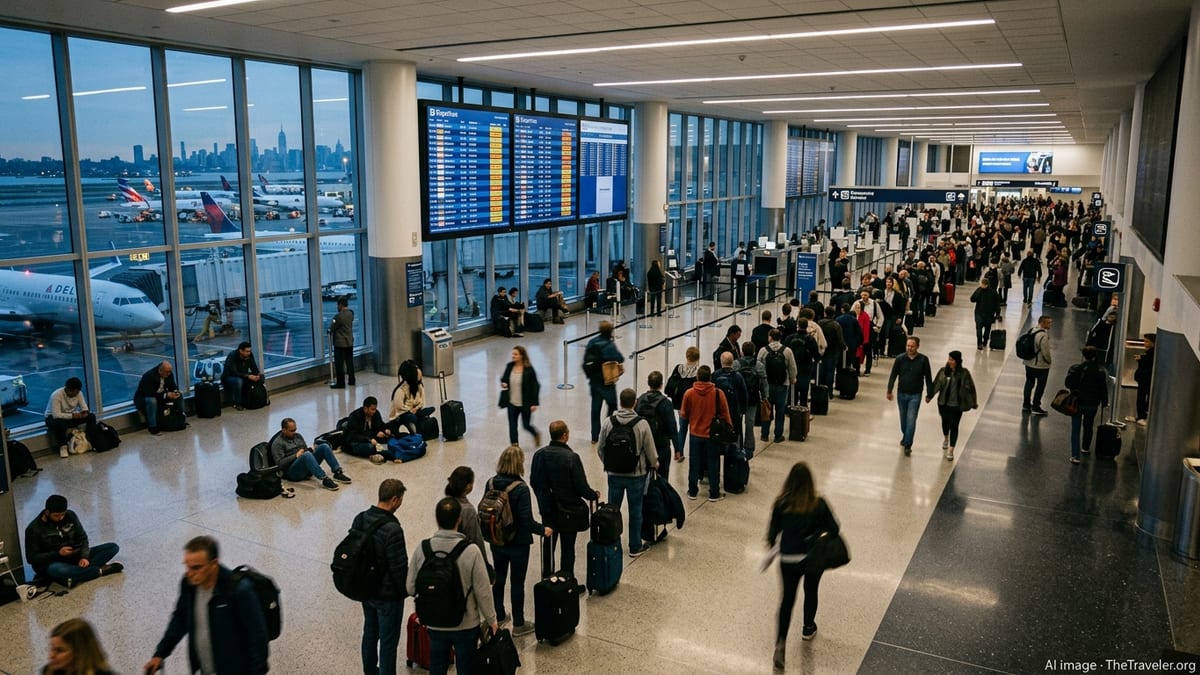
Ground Delay Programs Keep Pressure on LaGuardia Operations
According to publicly available Federal Aviation Administration traffic management advisories, LaGuardia has been under recurring ground delay programs following a series of disruptions in late March 2026. These measures, which meter departures from other airports bound for LaGuardia, have translated into extended waits at gates and on taxiways for many flights headed to the Queens airport.
Ground delay programs are a standard FAA tool used when an airport’s arrival capacity drops below expected demand, whether because of weather, runway closures or other constraints. The programs assign controlled departure times to inbound flights, effectively holding aircraft at their origin until the system can absorb them, rather than allowing long airborne holding patterns. For passengers, however, that often means sitting at the gate for hours or remaining on the tarmac as crews wait for release slots.
Recent FAA documentation and industry tracking sites indicate that LaGuardia’s effective arrival rate has been reduced at various points this week, triggering repeated extensions of delay programs. Average delays for some inbound flights have stretched beyond an hour, with peak holds considerably longer during busy afternoon and evening periods.
Travelers and airline staff posting on public forums describe a patchwork of rolling estimated departure times that shift throughout the day as the FAA adjusts the flow of traffic into the constrained airspace over New York City. While some flights see delays shrink as conditions improve, others experience multiple revisions before finally departing.
Runway Collision Aftermath Compounds Existing Congestion
The renewed focus on LaGuardia’s ground delays comes just days after a deadly collision between an Air Canada Express regional jet and an airport fire truck on one of the airport’s runways. Published coverage reports that the crash, which killed both pilots and injured dozens of people, forced LaGuardia to close one of its two runways and significantly restrict operations while federal investigators examined the site and repairs were completed.
The Port Authority of New York and New Jersey, which operates the airport, has stated in public updates that the affected runway has since reopened following inspections and infrastructure repairs. Even so, the days of reduced capacity created a substantial backlog of delayed and canceled flights, and recovery has been slow. Flight-tracking data cited in news reports shows LaGuardia leading the nation in delays and cancellations in the 24-hour period after the runway reopened, with several hundred flights disrupted.
Industry analysts note that LaGuardia routinely operates near its maximum capacity even under normal circumstances, leaving little margin when a runway is closed or traffic is rerouted. The combination of investigative activity on the airfield, temporary infrastructure constraints and heightened safety protocols in the wake of the accident has further strained ground operations and contributed to lingering delays.
The National Transportation Safety Board continues to probe how the fire truck came to cross the runway as the jet was landing, examining communication, staffing levels and airport safety systems. While the investigation is ongoing, the operational repercussions are being felt in terminal departure boards and on crowded concourses.
Staffing, Security Lines and Weather Add to Passenger Frustration
LaGuardia’s current disruption is not driven by a single cause. Parallel to the FAA’s traffic management measures, a prolonged federal government shutdown has created staffing challenges for Transportation Security Administration checkpoints, according to recent congressional testimony and media reports. Long security lines at LaGuardia have been described in published accounts as stretching across terminals, adding hours to the travel process even before passengers reach their departure gates.
In some cases, these staffing-related bottlenecks have intersected with weather-driven constraints. A mid-March storm system that disrupted air travel across large portions of the United States prompted ground stops and delays at several major hubs. Publicly available storm summaries indicate that while LaGuardia was not the epicenter of the blizzard’s impacts, ripple effects from delayed inbound aircraft and congested air traffic corridors contributed to schedule instability in the New York region.
Travelers have turned to social media and online forums to document missed connections, repeated rebookings and extended time spent waiting on aircraft that are held on the ground. Many posts reference official FAA delay advisories and show departure times sliding back as controllers adjust spacing between arrivals into LaGuardia and its neighboring airports.
For airlines, the combination of constrained arrival slots, crowded taxiways and slow passenger throughput at security has complicated crew scheduling and aircraft utilization. Some carriers have issued flexible travel policies for flights touching LaGuardia, encouraging customers with nonessential trips to consider alternate dates or airports in the region.
FAA Capacity Measures and Policy Debates Around New York Airspace
The persistent delays at LaGuardia are reviving debates about how federal regulators manage congested airspace in the New York metropolitan area. LaGuardia has long been subject to federal slot and schedule controls intended to keep operations within safe capacity limits. Government documents and prior rulemakings show that the FAA has periodically adjusted these controls in response to runway construction, staffing levels and chronic delay patterns.
Recent regulatory notices outline broader efforts to manage congestion at nearby Newark Liberty International Airport, including temporary reductions in scheduled operations to match available air traffic control staffing. While those measures are focused on another airport, they illustrate the tools the FAA can deploy when delays become persistent. Observers note that traffic shifts between Newark, LaGuardia and John F. Kennedy International can quickly affect delay patterns across the region.
Technical descriptions of ground delay programs emphasize that the decision to implement them hinges on an airport’s calculated arrival rate compared with the number of scheduled flights. When weather, runway work or other constraints reduce that rate, the FAA may hold departing aircraft at their origin for fixed windows of time. LaGuardia’s ongoing recovery from its runway accident and the knock-on effects of systemwide disruptions have kept that arrival rate under pressure.
Policy discussions in Washington and within the aviation industry continue to focus on long-term investments in technology, staffing and infrastructure that could reduce the need for such aggressive flow control measures. In the short term, though, LaGuardia passengers are experiencing the day-to-day reality of those policies as they watch departure boards fill with delay notices.
What Travelers Can Expect in the Coming Days
Public information from airlines and aviation tracking services suggests that LaGuardia’s operations are gradually improving as the reopened runway returns to full use and investigators scale back on-scene activity. However, schedules remain fragile, with relatively small disturbances still capable of triggering new rounds of ground delays.
Passengers scheduled to travel through LaGuardia in the coming days are being advised by airlines and airport communications to monitor flight status frequently, arrive early to navigate potentially long security lines and remain flexible about rebooking options. With FAA traffic management initiatives still in effect at various times of day, departures to LaGuardia from other cities may continue to receive revised pushback times.
Observers expect that once the immediate aftermath of the runway collision fully abates and federal staffing issues are resolved, LaGuardia’s delay profile may gradually return to its pre-incident baseline. For now, the airport remains a focal point of the broader conversation about aviation safety, workforce stability and how the nation’s busiest airspace copes with unexpected shocks.
For travelers caught in the current wave of disruptions, the situation underscores the interconnected nature of the air travel system, where a single runway closure, a staffing shortfall or a severe storm hundreds of miles away can cascade into hours of waiting on the ground in New York.