

More news on this day
A brief nationwide ground stop ordered for all JetBlue flights early Tuesday at the airline’s request disrupted travel across the United States, raising fresh questions about aviation technology reliability and what protections passengers can expect when an airline’s own systems go down.
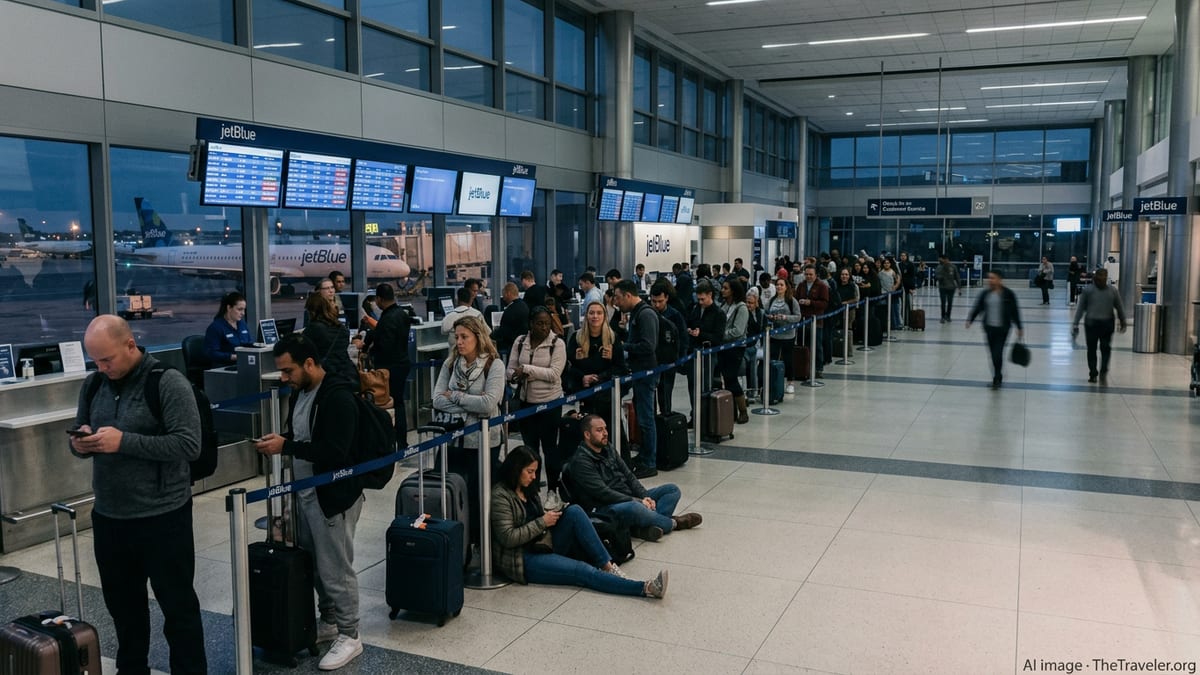
What Happened in the Overnight JetBlue Ground Stop
The Federal Aviation Administration issued a ground stop for JetBlue Airways flights to all destinations in the early hours of March 10, 2026, after the carrier reported a significant internal systems outage. The order, reflected in FAA advisories, temporarily barred JetBlue aircraft on the ground from taking off, although flights already in the air were allowed to continue to their destinations.
The event window, according to multiple operational summaries, ran for roughly an hour just after midnight Eastern time. While some outlets reported about 40 minutes between the initial and cancellation notices, both accounts point to a short but systemwide pause in departures rather than a prolonged shutdown. By around 1:30 a.m. Eastern time, the FAA confirmed the ground stop had been lifted and JetBlue said it had resolved the outage and resumed operations.
JetBlue described the incident as a brief system outage without specifying which part of its technology stack failed. Aviation tracking data and local airport reports showed clusters of delayed departures at major JetBlue bases, including New York’s John F. Kennedy International Airport, Boston Logan and Fort Lauderdale, consistent with an overnight halt that rippled into the early morning schedule.
The decision to seek an FAA-issued ground stop, rather than informally delaying flights on the airline’s own authority, underscores that the problem was serious enough that JetBlue wanted a clear, systemwide operational freeze while it worked to restore its systems.
Immediate Travel Impacts for JetBlue Passengers
Because the ground stop occurred during the overnight and early-morning hours, the immediate disruption was concentrated among red-eye departures, first-wave morning flights and connecting passengers scheduled through JetBlue’s East Coast hubs. Travelers arriving at airports in the Northeast and Florida reported departure boards switching from “on time” to “delayed” across multiple JetBlue routes as the stop went into effect.
For many customers, the most visible effect was a cascade of delays rather than outright cancellations. Once the FAA lifted the restriction, aircraft already at the gate could begin to push back, but crews, aircraft rotations and airport slots were no longer aligned to the original timetable. That meant some early-morning flights left late, others were swapped for different aircraft and a smaller share were canceled entirely where schedules could not be recovered.
Travelers with tight connections, particularly those connecting through New York and Boston to Caribbean and cross-country routes, were among the most vulnerable. Missed connections in the morning wave can be hard to reaccommodate until later in the day when additional seats open up. Some customers were rebooked on later JetBlue flights, while others were shifted to partner or interline carriers where agreements allowed.
By mid-morning, monitoring of major JetBlue stations indicated that operations were stabilizing, but with elevated delays and longer lines at customer service desks. Even after a relatively short ground stop, residual disruption can persist for much of the operating day as aircraft and crews work their way back into position.
Why a Brief IT Outage Can Ground an Entire Airline
The JetBlue incident highlights how deeply commercial airlines now depend on complex, interconnected digital systems for nearly every aspect of a flight, from crew scheduling and flight planning to dispatch, weight-and-balance calculations and customer check-in. When a critical platform fails or loses connectivity, safety protocols generally err on the side of halting departures until the airline can verify that all required data and real-time updates are accurate.
In recent years, several major carriers and technology providers have experienced outages that led to similar, if sometimes larger, meltdowns. Even when air traffic control, radar and weather systems are functioning normally, an airline’s inability to reliably generate flight plans or confirm load data can make it unsafe or noncompliant to dispatch aircraft. That is why airlines sometimes request a formal FAA ground stop, which provides a clear operational signal to airports and pilots while troubleshooting is under way.
Industry analysts say the JetBlue disruption will likely renew scrutiny of the resilience and redundancy of airline IT infrastructure. Regulators and lawmakers have increasingly pressed carriers to invest in backup systems, disaster recovery capabilities and clearer communication protocols after system failures. Questions are expected about what failed at JetBlue, whether there was a single point of failure and how quickly the airline can provide a public technical explanation.
For travelers, the episode is a reminder that even in clear weather, digital vulnerabilities can bring flying to a standstill. It also illustrates how incidents that unfold overnight can still affect morning commutes, business trips and vacation departures hours after the official all-clear.
What Passenger Rights Apply in a System Outage
For U.S. domestic flights, passenger rights in the event of an airline-caused disruption depend primarily on federal consumer protection rules and the airline’s own contract of carriage. A system outage of the type reported by JetBlue is generally treated as an airline-controlled event, as opposed to weather or air traffic control restrictions, which are considered outside the carrier’s control.
In practice, that distinction matters most for compensation and amenities. When an airline is responsible for a significant delay or cancellation, many carriers commit in writing to provide meal vouchers, hotel accommodations when an overnight stay is required and rebooking at no additional cost on the next available flight. JetBlue’s customer commitments include service standards for controllable disruptions, such as credits or vouchers above certain delay thresholds, although specifics can vary by ticket type and situation.
Unlike the European Union, the United States does not have an automatic cash compensation scheme tied to delay length and distance. Instead, the Department of Transportation has focused on transparency, requiring airlines to clearly disclose their policies and honoring them consistently. After recent high-profile meltdowns at other airlines, federal officials have also pressed carriers to expand their voluntary guarantees during airline-caused disruptions.
Passengers affected by the JetBlue ground stop are being encouraged by consumer advocates to keep records of their original itinerary, delay length, out-of-pocket expenses and any written communications from the airline. Those details can be important when seeking reimbursement, travel credits or filing a complaint if a customer believes commitments were not honored.
How Travelers Can Protect Themselves During Airline Ground Stops
For travelers, sudden ground stops are by definition unpredictable, but there are steps that can reduce the stress and financial impact when an airline’s operations grind to a halt. One of the most important is to monitor flight status directly through the airline’s app or text alerts in the hours before departure, especially for early-morning travel when overnight disruptions are more likely to surface.
Travel insurance, whether purchased as a separate policy or included as a benefit on certain credit cards, can offer another layer of protection. Some policies cover additional hotel nights, meals and alternative transportation when a trip is delayed by carrier-caused operational problems. Because coverage terms vary, passengers are advised to review what constitutes a covered event and what documentation is required before filing a claim.
At the airport, acting quickly can make a difference. When a ground stop is lifted and flights begin to move, seats on the earliest available departures tend to disappear fast. Using multiple channels at once, such as the airline app, airport kiosks and phone agents, can increase the odds of securing a workable rebooking option. In some cases, agents may be able to reroute customers through different hubs or onto partner airlines if space allows.
The JetBlue outage reinforces a broader lesson that applies across carriers: as airline operations become more technologically complex, travelers benefit from building extra time into tight itineraries, avoiding last departures of the day when possible and knowing in advance what remedies their airline and credit cards will provide if the unexpected happens.