

More news on this day
A midair close call between a United Airlines Boeing 737 and a military Black Hawk helicopter near John Wayne Airport in Santa Ana has prompted a new Federal Aviation Administration investigation and renewed attention on traffic around one of Southern California’s most space constrained commercial airports.
Get the latest news straight to your inbox!
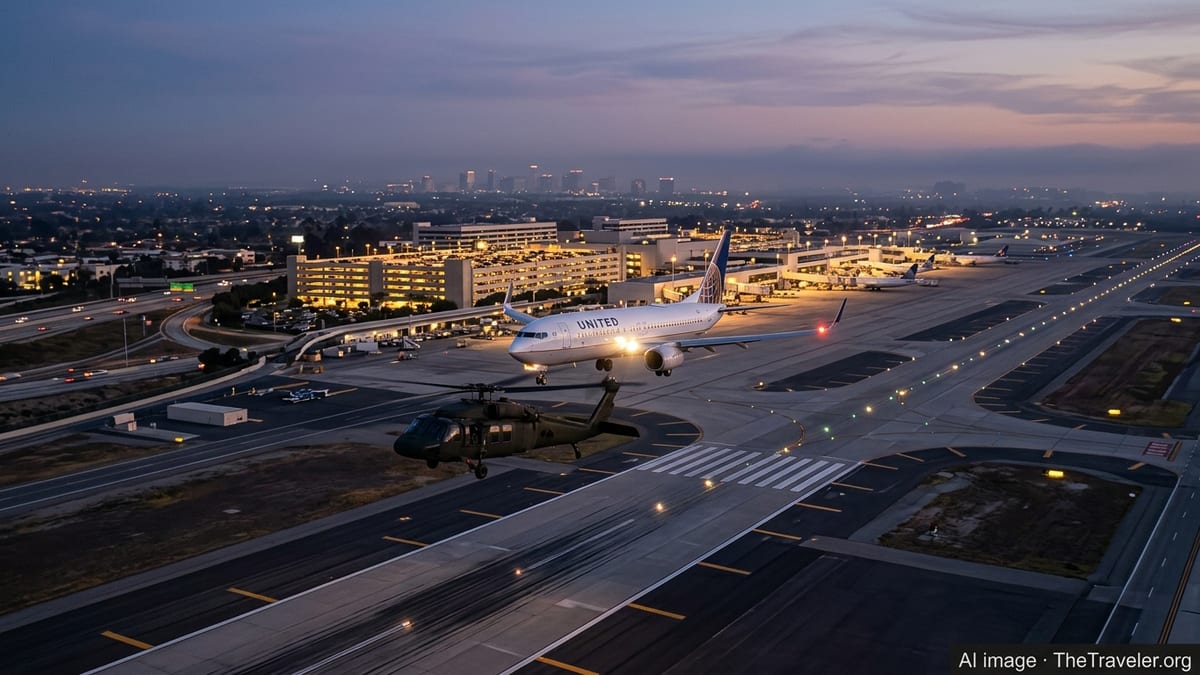
Close pass on approach to John Wayne Airport
Publicly available flight tracking data and news reports indicate that the incident occurred around 8:40 p.m. on Tuesday, March 24, as United Airlines Flight 589 from San Francisco was descending toward John Wayne Airport. The Boeing 737 was on final approach when a California National Guard UH 60 Black Hawk helicopter crossed its path, triggering a cockpit traffic alert and resolution advisory commonly referred to as a collision avoidance alarm.
Reports indicate the airliner was carrying more than 160 passengers and several crew members at the time. The helicopter was returning from a training mission in the region, operating under a military callsign and following an established route near the Orange County airfield.
Data cited in published coverage show that at their closest point the two aircraft were separated by roughly 500 to 600 feet vertically and about a quarter mile laterally, a margin that aviation specialists describe as uncomfortably tight in busy terminal airspace. The United crew leveled the aircraft and stopped its descent in response to the onboard warning, and the flight continued to land safely a short time later.
Initial accounts suggest that air traffic control had advised the United pilots to watch for the nearby helicopter shortly before the alert activated, highlighting how quickly converging traffic can go from known factor to potential conflict when speeds and closure rates are high.
FAA opens investigation into near miss
According to national wire service coverage, the FAA confirmed it has begun an investigation into the Santa Ana event, focusing on how the helicopter and airliner came to be on intersecting paths and whether controllers and flight crews followed existing procedures. The review is expected to examine radar data, recorded radio communications and information from onboard safety systems.
Part of the inquiry centers on the performance of modern collision avoidance technology, which monitors nearby aircraft transponder signals and issues traffic advisories and resolution commands when it detects a potential conflict. In this case publicly reported information indicates the system correctly identified the Black Hawk, issued a warning and directed the 737 crew to adjust their flight path.
Investigators are also expected to consider how local airspace design and traffic patterns near John Wayne Airport may have contributed. The airport sits in dense Southern California airspace with overlapping civilian, military and general aviation corridors, and relatively short approaches over nearby communities.
Published commentary from aviation observers notes that while midair collisions are rare in the United States, the agency treats any loss of separation involving commercial airliners and other large aircraft as a serious event that can reveal gaps in procedures, staffing or equipment.
New radar rules after deadly Potomac collision
The Santa Ana incident comes just over a year after a catastrophic midair collision over the Potomac River near Washington, D.C., in January 2025, when an American Eagle regional jet and a U.S. Army Black Hawk helicopter collided, killing all 67 people on both aircraft. The National Transportation Safety Board later pointed to shortcomings in how the airspace and helicopter routes were designed and monitored.
In response to that crash, publicly available regulatory records show that the FAA recently updated its guidance for controllers handling mixed helicopter and fixed wing traffic near busy airports. The new policy emphasizes the active use of radar vectors and separation standards, rather than relying primarily on pilots to see and avoid one another when operating in close proximity.
Agency statements about the Santa Ana near miss indicate that investigators will look specifically at whether those newer rules and practices were in effect and properly applied on the evening of the United 589 and Black Hawk encounter. That includes how traffic advisories were issued, how altitude assignments were managed and whether any gaps existed between civilian and military procedures.
Aviation safety analysts point out that when new policies are introduced after a major accident, early real world tests often expose ambiguities or edge cases that were not fully anticipated on paper. The Santa Ana event is likely to feed into that continuing refinement process.
Spotlight on John Wayne Airport’s complex airspace
John Wayne Airport, located between Santa Ana and Newport Beach, is known for its short runways, steep departure profiles and tight noise abatement procedures, all of which compress operations into a relatively small slice of Southern California’s crowded skies. Commercial traffic shares the region with military flights, corporate jets and general aviation aircraft transiting to and from nearby coastal bases and airfields.
Planning and safety documents for the airport highlight the layered structure of local airspace, where approach and departure corridors for large jets intersect with helicopter routes serving military installations, medical facilities and law enforcement operations. Under normal conditions, controllers sequence these flows using altitude stratification and carefully timed turns.
The March close call occurred at a point where inbound airliners are descending through a few thousand feet while helicopters may be operating at lower altitudes on instrument procedures to nearby facilities. Early reconstructions shared in specialist forums suggest the Black Hawk was on or near a published instrument approach while the 737 was descending visually toward John Wayne’s main runway, a combination that can work safely when everyone adheres to assigned altitudes and clearances.
Travelers and local residents have taken to online platforms to debate whether greater separation between commercial and military traffic is needed in the Orange County area, or whether this case reflects a rare convergence of events within an otherwise robust system.
Near miss adds to broader U.S. aviation safety debate
The Santa Ana event arrives at a moment of heightened scrutiny for U.S. air travel, following a series of runway incursions, close calls and high profile aircraft incidents that have raised questions about controller staffing, airline procedures and aging infrastructure. Recent oversight reports have pointed to resource strains at the FAA and the challenge of keeping pace with record traffic volumes and increasingly complex operations.
Within that context, the near miss between a United 737 and a military Black Hawk near John Wayne Airport has become part of a larger conversation about how to manage mixed civilian and military operations around major metropolitan areas. Commentators in aviation and travel circles are asking whether helicopter routes should be shifted farther from commercial approach paths, or whether technology such as enhanced traffic displays and automatic deconfliction tools should be expanded in cockpits and control facilities.
For travelers, the incident is a reminder of the layered safety net that underpins routine flights into and out of crowded airports. From collision avoidance computers to radar monitoring and standardized approach profiles, multiple safeguards exist to catch errors before they lead to disaster. In this case, the available evidence suggests that those systems did what they were designed to do by prompting the United crew to halt their descent as the helicopter crossed ahead.
As the FAA analysis proceeds, any findings or recommendations that emerge could affect how pilots and controllers coordinate mixed traffic near John Wayne Airport and other similar facilities nationwide, with potential implications for future flight procedures, training and route design that will matter to both the aviation industry and the traveling public.