

More news on this day
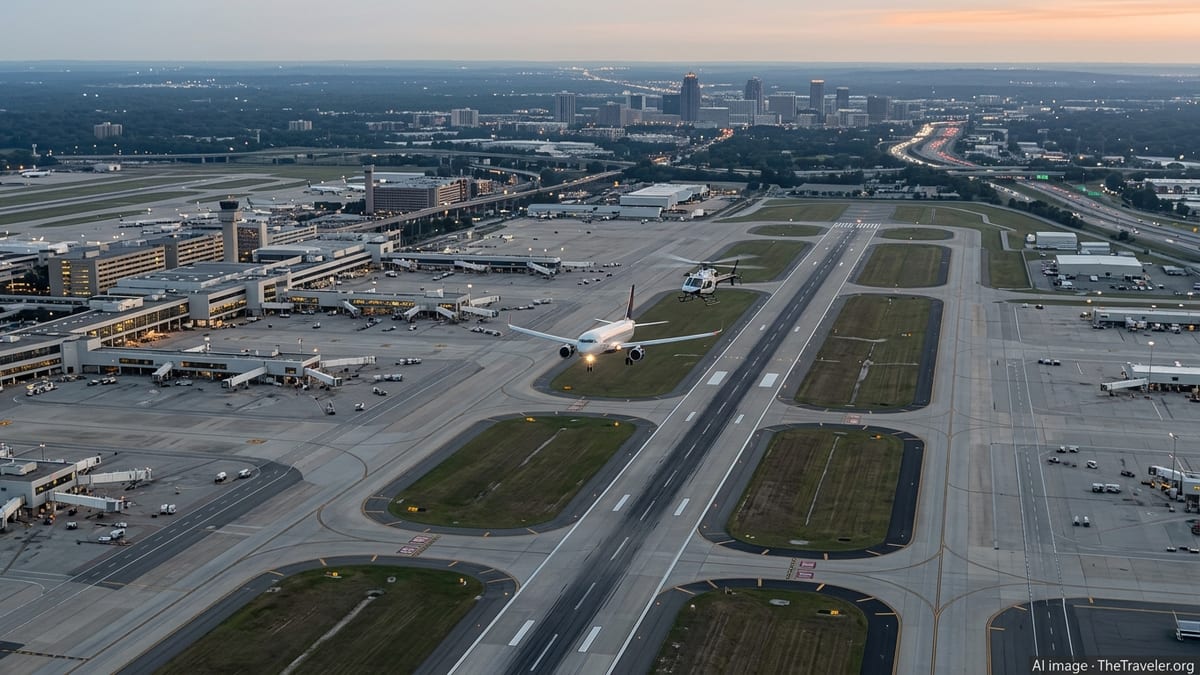
The Federal Aviation Administration has introduced a new radar-based separation regime for helicopters and airplanes at more than 150 of the busiest airports in the United States, replacing long-standing reliance on pilots visually keeping clear of each other in crowded airspace.
Get the latest news straight to your inbox!
Shift Away From Visual Separation After Deadly Collision
According to published coverage in recent days, the FAA move follows a series of high-profile safety events, including a fatal midair collision near Washington, D.C., in January 2025 that killed dozens of people on board a commercial jet and an Army helicopter. Investigations into that crash pointed to heavy dependence on the so-called “see and avoid” principle, in which pilots were expected to maintain their own visual separation from nearby traffic while controllers managed overall flows.
Publicly available summaries of the investigation indicate that controllers at Ronald Reagan Washington National Airport had repeatedly used visual separation as a tool to keep traffic moving in dense, complex airspace. In darkness and with multiple aircraft maneuvering close to one another, that method proved vulnerable to human limits in perception and reaction time. The helicopter crew involved in the crash is reported to have had little more than a second to react before impact.
Reports indicate that the Washington collision was not an isolated concern. Federal data and media analyses describe additional near-miss encounters between helicopters and commercial aircraft at other large airports, including incidents in San Antonio and Burbank in early 2026. Together, these events intensified scrutiny of how helicopters and fixed-wing aircraft mix near major hubs and whether visual practices developed decades ago remain adequate.
Safety specialists cited in recent coverage have framed the FAA’s radar-based separation requirement as part of a broader effort to address systemic risk rather than individual pilot error. The new approach is intended to reduce the chances that a momentary lapse in situational awareness, by either pilots or controllers, can escalate into a catastrophic collision in congested terminal airspace.
How the New Radar-Based Separation Will Work
Under the revised procedures, publicly available FAA descriptions show that controllers must now use radar displays and defined minimum distances to keep helicopters and airplanes apart as they arrive and depart at covered airports. Instead of clearing a helicopter to remain clear of a jet using visual judgment, the controller will apply explicit lateral or vertical separation standards, similar to those long used between two fixed-wing aircraft.
Radar surveillance provides a continuous electronic picture of all tracked aircraft in the vicinity of an airport, including their altitude, speed and direction. That data enables controllers to calculate safe spacing between each target and to detect developing conflicts earlier than would typically be possible by eye alone, especially in poor visibility or at night. In practice, this means helicopters may be vectored along more structured routes and altitudes when operating close to high-capacity runways.
The requirement extends what had already been implemented as a local restriction at Reagan National after the 2025 crash. According to news reports, the FAA has now applied similar radar-based helicopter separation procedures across a nationwide list of more than 150 large airports where mixed operations are common. The aim is to create consistent expectations for pilots and controllers regardless of location.
While the new rules focus on radar, they are also expected to mesh with existing surveillance tools such as Automatic Dependent Surveillance–Broadcast, or ADS-B. Many helicopters and airplanes in U.S. airspace already carry ADS-B equipment that broadcasts precise GPS-derived position information once per second. That data can complement conventional radar in helping controllers maintain safe separation contours around each aircraft.
Impacts on Helicopter Operations and Air Travel
For helicopter operators, the change is likely to alter how flights are planned into and out of busy metropolitan areas. Reports suggest that air ambulances, law enforcement aircraft, military helicopters and corporate shuttles could see more structured arrival and departure paths that keep them farther from jet corridors than under earlier visual arrangements. Some operators may face slightly longer routings or holding patterns during peak airline traffic banks.
Industry observers note that additional spacing can, in some cases, translate into marginal delays or reduced flexibility for ad hoc helicopter movements, particularly where aircraft once relied on nimble maneuvering between streams of jet traffic. However, analysts also point out that more predictable radar-managed flows may make it easier to integrate helicopters into traffic sequences without last-minute vectoring or abrupt restrictions that can disrupt missions.
For airline passengers, the effect is expected to be largely invisible in day-to-day travel. According to aviation analysts quoted in recent coverage, major carriers already operate under radar-based separation rules for virtually all jet-to-jet interactions near major airports. The new standards primarily formalize and tighten how helicopters are slotted into that environment, which could marginally reduce certain operational risks without significantly affecting gate-to-gate schedules.
Airport operators and regional planners are watching how the changes interact with future growth in advanced air mobility concepts, such as electric vertical takeoff and landing aircraft. As new forms of rotorcraft-style traffic emerge around cities, the radar-based framework being applied now may become an important foundation for safely scaling higher volumes of point-to-point aerial service.
Part of a Broader Modernization of U.S. Airspace
The radar separation mandate arrives amid a years-long modernization of the National Airspace System, often described in FAA planning documents under the NextGen banner. That broader program has focused on shifting from purely ground-based radar to a hybrid surveillance environment in which satellite navigation, digital communications and performance-based routes all play a role in improving efficiency and safety.
NextGen implementation plans highlight the importance of reliable surveillance for maintaining safe separation as traffic grows and operations become more complex. The new helicopter separation rules can be seen within that context as a targeted adjustment, using existing radar and data tools in a more conservative way where the risk of mixed operations is highest. It does not require new cockpit technology overnight but instead changes how current systems are used.
Publicly available material from safety researchers indicates that integrating helicopters, drones and future air taxis into already dense terminal airspace is one of the most pressing challenges in global aviation. By codifying radar-based separation between helicopters and airplanes at major airports, the FAA is effectively setting a baseline expectation before those new entrants arrive in large numbers.
Aviation policy commentators note that the measure could also influence international practice. Other countries with heavy helicopter traffic around major airports may look to U.S. experience as they refine their own surveillance requirements and separation standards. Over time, that may contribute to more harmonized procedures for mixed rotary- and fixed-wing operations in crowded skies.
Balancing Safety Gains With Implementation Challenges
While safety advocates have generally welcomed stronger protections against midair collisions, industry commentary suggests that implementing the new radar-based standard will require adjustments in training, staffing and technology use across air traffic control facilities. Controllers must become accustomed to treating helicopters more like jets in terms of required spacing, and facilities may need to refine local procedures to avoid bottlenecks at peak times.
Helicopter pilots, for their part, will be operating under clearer but potentially more restrictive instructions in and around Class B and other busy airspace. Training materials and standard operating procedures are expected to evolve to emphasize coordination with radar vectors, altitude assignments and arrival or departure corridors that maintain consistent separation from airliners.
Reports indicate that lawmakers and aviation stakeholders continue to debate whether additional steps are needed, such as new equipage mandates for collision-avoidance technology specific to helicopters or further restrictions on where they may fly near large hubs. Earlier legislative efforts focused on helicopter safety, including proposals that followed the Potomac River collision, have drawn renewed attention as the radar measures roll out.
For travelers and city residents beneath busy flight paths, the most immediate consequence of the FAA’s decision may not be readily visible, but it represents a significant shift in how busy U.S. airspace is managed. By anchoring helicopter and airplane interactions in radar-based separation instead of visual judgment, the agency is reshaping long-established practices in the name of reducing the likelihood of another devastating midair collision.