

More news on this day
San Francisco International Airport is entering a prolonged period of disruption after a permanent Federal Aviation Administration rule change effectively ends simultaneous parallel landings on its closely spaced runways, cutting hourly arrivals and triggering mounting delays for passengers across the network.
Get the latest news straight to your inbox!
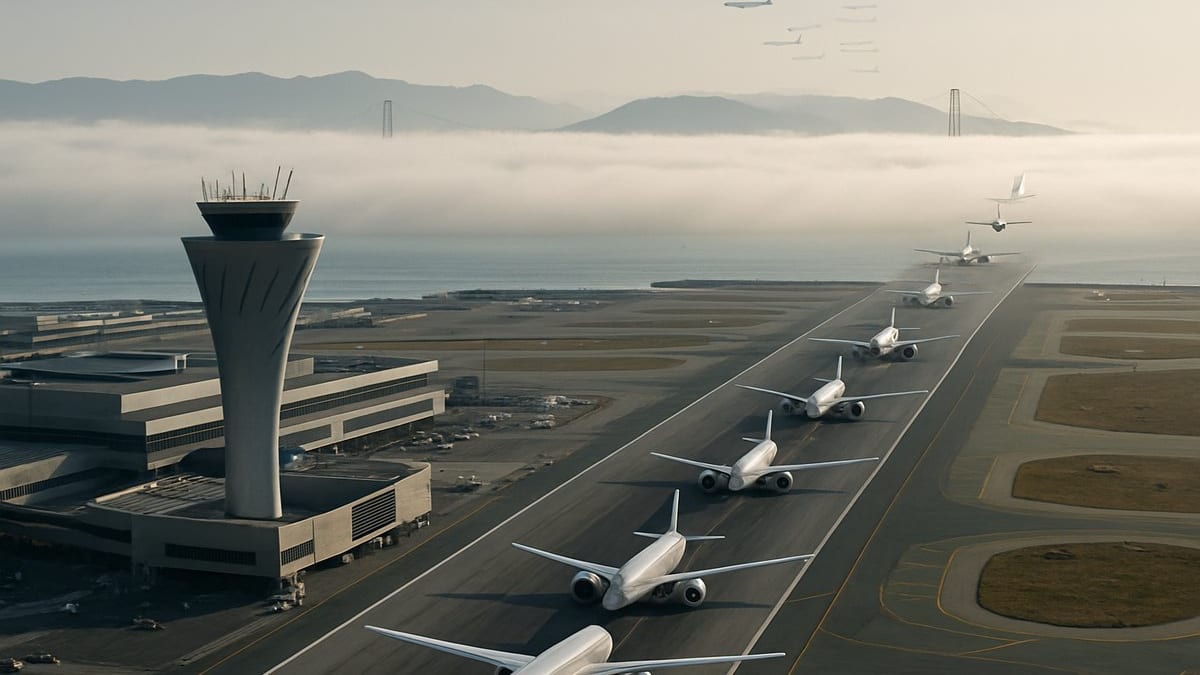
Image by Nomad Lawyer
Permanent Limits on Parallel Landings Reshape SFO Operations
Published coverage indicates that on March 31, 2026, the FAA implemented new restrictions on visual side by side approaches to San Francisco International Airport’s main parallel runways, which sit only about 750 feet apart. Under the new rules, aircraft arriving on the east west runways can no longer conduct true simultaneous visual approaches in clear weather when pilots maintain separation by sight. Instead, approaches must be staggered, with one aircraft offset from the other, reducing the number of planes that can land in a given time period.
Industry reports describe the change as a permanent safety measure specific to SFO’s geometry and surrounding airspace, rather than a nationwide policy shift. The combination of very closely spaced runways, heavy traffic and nearby airports in Oakland and San José has long made SFO an outlier in how parallel operations are managed. Analysts note that the new restrictions formalize a more conservative stance on separation that had already applied during poor weather and certain nighttime conditions.
The rule arrives against the backdrop of a broader tightening of FAA safety practices after a series of near misses at major U.S. airports in recent years. While regulators have not linked the SFO decision to any single incident, safety reviews have repeatedly identified closely spaced parallel approaches as a point of vulnerability, particularly when traffic levels push toward historical maximums.
For SFO, the immediate operational impact is a sharp reduction in arrival capacity. Historical planning documents and recent coverage place the airport’s typical maximum at around 54 arrivals per hour under favorable conditions with side by side approaches. With staggered arrivals now required, that figure is being cut to roughly 36 per hour, representing a one third drop in potential inbound traffic.
Runway Construction Intensifies Delay Risks
The new parallel landing restrictions are taking effect at the same time as a major runway repaving project, compounding the disruption. One of SFO’s north south runways closed this week for an estimated six month construction program that will resurface the pavement and upgrade associated taxiways and lighting. During this phase, some traffic that would normally be spread across multiple runway pairs must be funneled onto fewer operational surfaces.
According to airport operations updates cited in local coverage, the runway closure alone would have reduced the permitted arrival rate from 54 to about 45 aircraft per hour. Layering the permanent FAA rule change on top of that pushes the ceiling further down to around 36. Even if construction finishes on schedule in early October and the closed runway returns to service, the parallel landing restriction is expected to remain in place, meaning SFO’s maximum arrival rate would only partially recover.
Airport representatives have indicated in public briefings that roughly a quarter of arriving flights could face delays of at least 30 minutes once the combined effects of construction and the new rules fully filter through schedules. The heaviest impact is expected during peak morning and evening periods when inbound waves from other hubs converge on the Bay Area. Airlines are examining whether to trim schedules, retime flights or upgauge aircraft, but many carriers are waiting to see how traffic patterns evolve over the coming weeks.
Because the runway project is temporary and the FAA rule is permanent, aviation planners are treating the current months as a stress test for long term operations at a lower structural capacity. Even after the paving work concludes, SFO is unlikely to regain the level of simultaneous parallel activity that defined its pre change arrival flow.
Airlines and Passengers Face a Network Domino Effect
The reduction in arrivals at SFO is already rippling outward through airline networks. United Airlines, the airport’s dominant carrier, and Alaska Airlines, the second largest, are both reviewing their schedules in light of the new operating limits. Public statements highlighted in travel industry reports suggest that carriers are monitoring daily performance and may adjust frequencies or aircraft types if chronic bottlenecks emerge.
In the short term, many of the delays are expected to manifest as ground holds at origin airports, as air traffic managers meter inbound flows to avoid excessive stacking in the skies above the Bay Area. This can create frustration for travelers who depart late despite clear weather, or who find their aircraft waiting for a departure slot tied to congestion hundreds of miles away. Missed connections in San Francisco are another concern, particularly for long haul international services that rely on tight banks of feeder flights.
Travel data providers are warning corporate travel managers and leisure passengers to build more slack into itineraries that touch SFO, especially for same day connections. Some advisories recommend avoiding the tightest legal minimum connection times and considering alternate routings through other West Coast hubs when schedules are inflexible. For point to point travelers to and from the Bay Area, the main effect is likely to be more frequent moderate delays rather than large numbers of outright cancellations, at least in the early stages of the new regime.
There are signs that some demand may shift to Oakland and San José as airlines explore redistributing capacity. However, both airports have their own operational limits, and most transcontinental and international traffic remains anchored at SFO. Analysts note that any significant rebalancing would take months to materialize, as carriers must secure gates, staffing and infrastructure support before moving meaningful volumes of flights.
Unique Runway Geometry Drives Safety Rationale
Aviation specialists point out that SFO’s runway layout has long been central to its on time performance challenges. The airport operates two pairs of intersecting parallels, oriented roughly north south and east west. The main arrival runways used in good weather, 28L and 28R, are separated by only about 750 feet, far less than the standard spacing associated with fully independent parallel operations at other major hubs.
Under previous procedures, SFO relied on closely managed visual approaches in which pilots on converging paths maintained awareness of one another and controllers carefully sequenced arrivals to maximize throughput. Historical analyses have shown that the airport’s best hour over hour performance was dependent on these side by side visual operations, which become unavailable whenever clouds or low visibility push traffic onto instrument approaches.
The FAA’s latest move effectively codifies a preference for additional safety margin by preventing those visual side by side operations even in clear conditions. Observers note that the change aligns with a broader global trend that prioritizes standardized, instrument based approaches and greater reliance on radar separation in dense terminal airspace. While the statistical safety record of SFO’s parallel arrivals has been strong, regulators appear to be acting on the principle that rare but high consequence risks should be mitigated whenever feasible.
The agency has emphasized in public information that the timing of the landing restrictions is independent of the runway construction schedule, even though the two developments are now intersecting. This framing underscores that the new approach regime is intended as a lasting adjustment to how SFO manages its unique geometry, rather than a temporary response to infrastructure work.
What Travelers Should Expect in the Months Ahead
For travelers passing through San Francisco this spring and summer, the new operating environment will likely translate into more unpredictable arrival times and occasional extended waits on the tarmac. Weather that previously produced only minor slowdowns could now trigger more significant knock on delays as the airport has less slack to absorb disruptions within each hour.
Consumer advocates are encouraging passengers to monitor their flights closely and to prepare contingency plans for tight connections, including understanding rebooking options and the last departures of the day to key onward destinations. Travel planners also suggest that early morning arrivals may enjoy slightly better odds of staying on schedule, since the system has not yet accumulated the delays that tend to build throughout the day.
In the medium term, airport and federal planners are exploring procedural adjustments and technology upgrades that might recover some lost capacity without eroding safety margins. Concepts under discussion in industry forums include refined sequencing tools, enhanced navigation procedures and more dynamic use of crossing runway configurations when winds permit. None of these options are expected to restore SFO to its historical peak arrival rates while the new parallel landing constraints remain in force.
For now, San Francisco International stands as a prominent example of how evolving safety standards can reshape the experience of air travel. The decision to curtail parallel visual landings is intended to reduce risk in one of the country’s most complex pieces of airspace, but it also underscores the delicate balance between safety, efficiency and passenger convenience at the heart of modern aviation.