

More news on this day
San Francisco International Airport is confronting a cascading wave of delays after a new Federal Aviation Administration rule sharply curtailed parallel landings, colliding with an already disruptive six-month runway closure to slash the airport’s arrival capacity by roughly one third.
Get the latest news straight to your inbox!
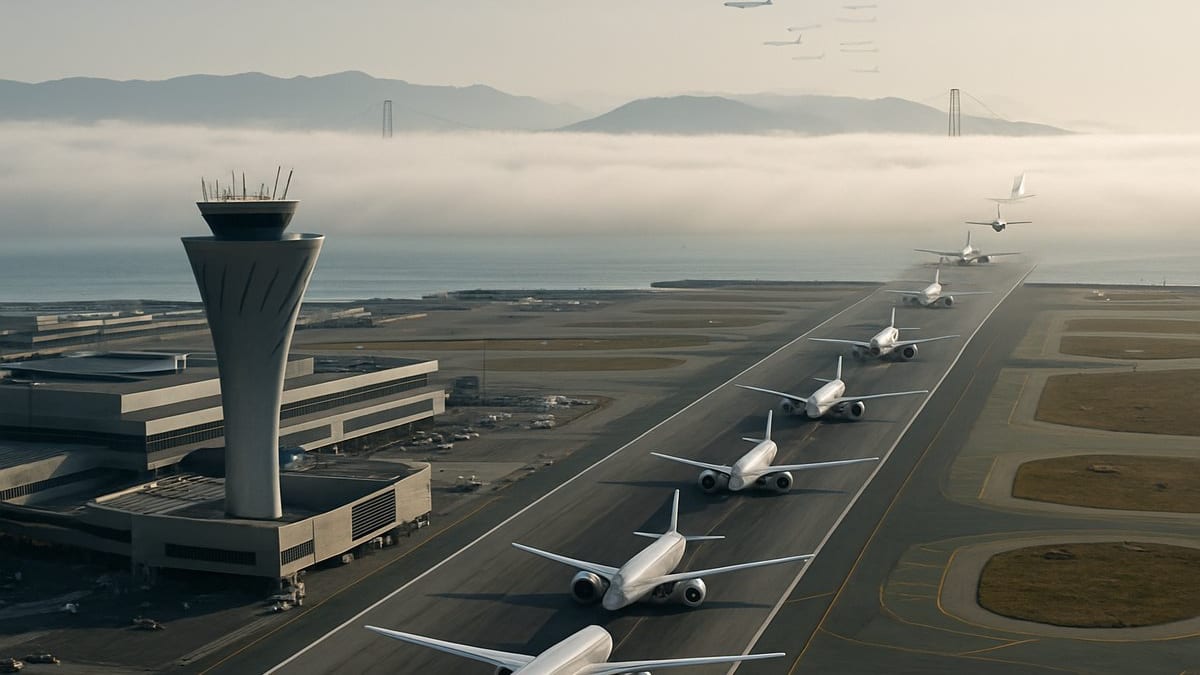
Image by Nomad Lawyer
New FAA Restrictions Upend SFO’s Signature Parallel Approaches
Publicly available information shows that the FAA has moved to permanently restrict side by side visual approaches to San Francisco International Airport’s closely spaced east west runways, a maneuver that had become an iconic part of the travel experience for many Bay Area fliers. The change, which took effect March 31, 2026, effectively ends routine simultaneous arrivals to runways 28 Left and 28 Right in clear weather, requiring greater separation between inbound aircraft.
Reports indicate that the agency’s internal review concluded SFO’s long standing practice of closely spaced visual approaches was no longer compatible with current separation standards, given the airport’s tightly packed parallel runways and congested surrounding airspace. While simultaneous instrument approaches remain possible in certain conditions, the most capacity boosting side by side visual operations that once helped SFO surge through peak banks are now off the table.
Aviation coverage notes that the FAA has linked the change to broader safety work on parallel runway operations nationwide, rather than to a single incident at SFO. However, the timing coincides with heightened scrutiny of runway conflicts and near midair events at several large US airports, adding urgency to efforts to build in larger safety margins at complex hubs.
For SFO, the result is an immediate structural reduction in how many planes can land per hour during good weather, even before considering any knock on effects from poor visibility or strong winds that already tend to snarl Bay Area schedules.
Runway 1R Closure Compounds Capacity Crunch
The new landing restrictions arrive just as SFO embarks on a major infrastructure project that has closed one of its four runways for much of the busy spring and summer period. Airport documents and prior announcements show that Runway 1 Right shut on March 30, 2026, for a six month repaving and taxiway realignment program scheduled to last until early October.
During the works, traffic that would normally be spread across multiple runway configurations is being funneled primarily onto the 28 Left and 28 Right pair. The airport has stated that the parallel north south runway, 1 Left, will be used as an additional taxiway rather than for takeoffs and landings while construction is underway, tightening the squeeze on usable pavement.
Before the FAA rule change, SFO officials had forecast a noticeable but manageable impact from the project, with earlier estimates suggesting that roughly 10 to 15 percent of flights could face delays. That planning assumed the airport could continue to rely on visual parallel approaches to keep arrivals flowing during peak periods on the remaining runways.
With those operations now curtailed, the combination of a closed runway and stricter approach rules has sharply reduced theoretical throughput. Aviation specialists note that even modest changes in runway availability and approach procedures can ripple into hours long disruptions at hub airports, especially where schedules are already tight.
Hourly Arrivals Cut, Delays Spread Across the Network
Recent coverage from Bay Area and national outlets indicates that SFO’s maximum permitted arrival rate has been cut from about 54 flights per hour to roughly 36 under the new FAA regime, a reduction of approximately one third. That means fewer landing slots in each 60 minute window and a higher likelihood that inbound aircraft will be held in airborne stacks or slowed en route before reaching the region.
Early data and airport briefings suggest that the share of arrivals experiencing significant delays is already climbing. Where planners once anticipated that around one in seven flights might be delayed at least 30 minutes during the runway project, updated estimates now point to roughly one in four arrivals facing half hour or longer disruptions as airlines and controllers adjust to the new constraints.
The pressure is most acute during morning and evening peak banks, when transcontinental and international waves converge and many travelers are relying on tight connections. When the landing rate is capped at 36 per hour but scheduled demand exceeds that level, aircraft must be sequenced into longer lines, creating rolling knock on effects that can extend deep into the day.
Because SFO functions as a major West Coast gateway and connecting hub, disruptions there quickly propagate across the national network. Industry analysts note that missed slots and extended taxi times in San Francisco can translate into late departures for onward legs to cities across the United States and Asia, straining crew duty limits and aircraft rotations.
Safety Tradeoffs and the End of a Visual Spectacle
The FAA’s decision underscores a long running tension between capacity and safety margins at airports with tightly spaced parallel runways. SFO’s 28 Left and 28 Right sit only about 750 feet apart, significantly closer than at many other large hubs. For years, specialized procedures and intensive pilot and controller training made it possible to run simultaneous visual approaches in clear conditions, squeezing more landings into each hour.
Those operations also created one of commercial aviation’s most distinctive sights, with two jets appearing to float down side by side over the Bay before touching down near simultaneously. Many travelers sought out window seats to watch the choreography on approach, and social media posts often highlighted the thrill of seeing another airliner apparently just outside the wingtip.
Safety advocates have long warned, however, that very closely spaced runway operations can leave less room for error when traffic is dense or when unexpected events occur. Recent high profile runway incursions and near collisions in other cities have renewed public attention to how quickly a minor miscommunication on the ground or in the cockpit can escalate when aircraft are operating in tight quarters.
By eliminating the highest density side by side visual arrivals, regulators are prioritizing wider buffers between planes at SFO, even at the cost of capacity. Observers expect that additional technological upgrades, such as enhanced satellite based guidance and surveillance tools, may in time help restore some efficiency, but those benefits are unlikely to materialize in the short term for travelers caught in this year’s disruption.
Travelers Pivot to Alternatives as Airlines Rework Schedules
As the new rules bed in, airlines are beginning to adjust schedules, swap aircraft types and re time certain flights to work within SFO’s reduced arrival rate. Industry reporting indicates that carriers are evaluating whether to move some point to point services to nearby Oakland and San Jose, or to trim frequencies on marginal routes into San Francisco itself.
For passengers, the immediate advice from travel experts is to build extra buffer time into itineraries that touch SFO, especially for same day connections. Early signs from booking platforms and industry trackers show that average departure and arrival delays at the airport have ticked upward since the rule change, and that day of travel disruptions may be more common than in past spring and summer seasons.
Regional tourism and business groups are also watching closely. With SFO acting as the primary international gateway for Silicon Valley and the wider Bay Area, sustained operational constraints could affect inbound visitor numbers, convention planning and corporate travel budgets if carriers pare back capacity or raise fares to manage limited slots.
In the longer term, the episode is likely to fuel renewed debate over Bay Area airport capacity, noise distribution and investment priorities. For now, though, the practical reality for many travelers is simple: flying through San Francisco this year is likely to involve longer waits on the ground and in the air, as a signature feature of the airport’s operations gives way to a more conservative safety standard.