

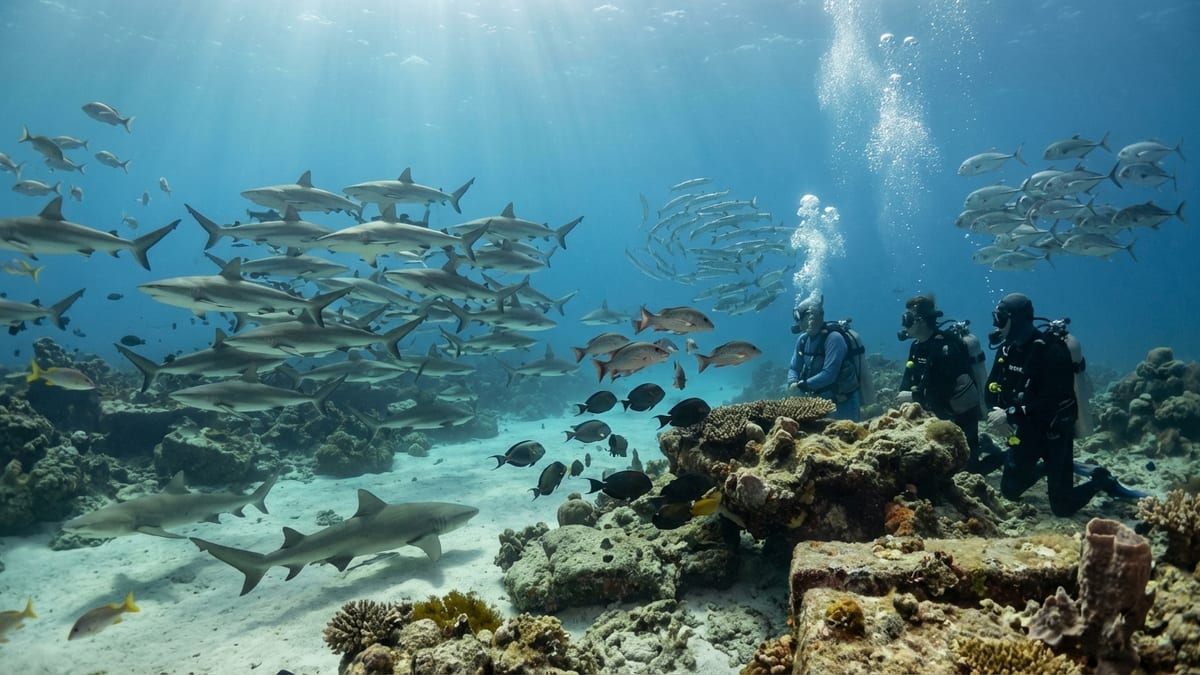
Fakarava has become one of the world’s most sought after dive destinations, not for colorful resorts or nightlife, but for the raw, theatre-like spectacle that unfolds beneath its passes.
This remote atoll in the Tuamotu Archipelago of French Polynesia is a UNESCO Biosphere Reserve, home to legendary sites such as the South Pass at Tumakohua, the vast Garuae Pass in the north and the famous “shark walls” that have reshaped many divers’ ideas of what wild oceans look like.
This guide unpacks how to dive Fakarava’s iconic passes, what to expect underwater, when to go, and how to prepare for currents, big animal encounters and some of the most intense shark diving on the planet.
Understanding Fakarava and Its Two Iconic Passes
Fakarava is a long, narrow coral atoll encircling a lagoon of staggeringly blue water. Its healthy reefs and high biomass of fish are funneled through two main channels that connect the lagoon to the open Pacific. These natural conduits for tidal water are Garuae Pass in the north and Tumakohua, often simply called the South Pass. Each has a distinct character, and together they offer a complete portrait of Tuamotu pass diving: vast pelagic highways, shark-filled canyons and intimate coral gardens squeezed between.
Garuae is one of the widest passes in French Polynesia, roughly 1.6 kilometers across. That breadth means huge water movements and complex currents, from gentle lagoon-side drifts to powerful incoming streams that can send divers flying over reef ridges. Tumakohua, by contrast, is narrower and more intimate, a chiseled valley in the reef that focuses life and current into a relatively small area. There, the famed shark walls and seasonal grouper aggregations play out along a route that many dive operators know meter by meter.
Fakarava’s designation as a UNESCO Biosphere Reserve has helped preserve its ecosystems while allowing controlled tourism. Fishing pressure is limited in key zones, shark populations are protected and dive operations are required to follow local regulations, including limits on the number of dives per day. For visiting divers, this translates into exceptional densities of marine life in water that typically ranges from about 26 to 29 degrees Celsius, with visibility often around 30 meters or more in the passes and lagoon.
While many tropical atolls offer pretty reefs, Fakarava stands apart because of biomass and behavior. Schools of snapper, surgeonfish and barracuda are so thick that they can partially block the light. Grey reef sharks cruise in long lines across the current, sometimes stacking into columns that form the celebrated “walls.” During certain lunar windows, tens of thousands of marbled grouper gather to spawn, attracting hundreds of sharks into a narrow run of reef. These are not staged encounters, but wild ecological events that divers can witness at close range.
South Pass: Tumakohua, Shark Walls and Grouper Spawning
The South Pass at Tumakohua is where Fakarava earns its reputation as a shark diving mecca. Divers descend along ledges, canyons and coral blocks that line a narrow, gently curving channel. On an incoming tide, clear oceanic water surges into the lagoon, sweeping across observation points where dive guides often settle groups. From these vantage spots, you can watch hundreds of grey reef sharks, with lemon sharks and the occasional hammerhead patrolling the blue beyond.
The “shark wall” is not a geological feature but a behavior pattern. At certain depths and current strengths, the sharks align themselves in the flow, maintaining position like birds in a headwind. The result is an almost architectural structure of sharks, sometimes so dense that you lose sight of the background. Experienced guides know where and when to position divers, often at around 20 to 30 meters, where natural hollows in the reef offer both shelter and a clear line of sight along the channel.
Within the South Pass lies Shark’s Hole, a valley or depression in the channel side where sharks gather in still greater numbers. Here, divers might see layers of grey reef sharks stacked over resting lemon sharks, while jacks and snappers mill through the water column. The scene is often surprisingly calm. Sharks in French Polynesia are accustomed to divers and show little interest in them, allowing for long, contemplative encounters rather than fleeting glimpses.
Between June and July, the full moon brings one of Fakarava’s most celebrated events: the marbled grouper spawning. Thousands of grouper migrate to the South Pass, where they gather in dense clusters along the reef edge. As the timing of the tide and lunar cycle align, pairs surge upward to release eggs and milt into the current. The sharks respond in kind, arriving in even greater numbers to hunt amid the chaos. Securing a spot during these weeks often requires booking many months, even a year, in advance, and operators may impose experience requirements given the intensity of current, depth and animal activity.
Garuae Pass: Big Water and High-Energy Drift Diving
If the South Pass is a concentrated amphitheater, Garuae is a stadium. Its sheer width means enormous water exchanges as tides shift between lagoon and ocean. For divers, this creates everything from tranquil, slow-motion drifts to fast-paced rides that demand solid buoyancy control and confidence in current. Guides carefully plan entry and exit points, often timing dives for incoming tides that carry clear offshore water into the lagoon.
Garuae’s topography includes large coral bommies, ridges and sandy channels that funnel life. Schools of barracuda, bigeye jacks and surgeonfish cruise in dense packs, while grey reef sharks quarter the pass in search of prey. On some days, aggregations of sharks in Garuae rival what you see in the South Pass, but the sense of scale is different. Because the pass is so broad, marine life can seem more spread out, and divers often cover more horizontal ground during a single drift.
Several named sites within or near Garuae are known among local centers. Coral gardens at shallower depths offer a more leisurely experience, with hard coral formations in generally good condition supporting reef fish, napoleon wrasse and turtles. Deeper sections expose divers to stronger current and larger pelagics. Visibility often runs around 30 meters and can exceed that on peak days, delivering classic Tuamotu blue water with sharp-edged shafts of sunlight.
Diving Garuae tends to suit intermediate to advanced divers best, especially on days when the maramu, a seasonal southeasterly wind, roughens the surface. Entry and pickup can be choppy and boat rides are longer than those around the South Pass for operators based in northern Fakarava. Nonetheless, many divers consider a blend of Garuae and Tumakohua dives essential to understanding the atoll’s full character, pairing the high-energy, big-scale drifts of the north with the more concentrated shark shows of the south.
Shark Walls and Seasonal Spectacles
Fakarava’s shark encounters are shaped by three main forces: currents, prey availability and long-standing protections in French Polynesia. The country banned shark finning and established shark sanctuaries over the past two decades, allowing populations of grey reef, blacktip, whitetip, lemon and other species to recover or remain stable. Combine that with healthy reef fish stocks and concentrated passes, and you get an environment where sharks are both numerous and relaxed in the presence of divers.
The defining image of a Fakarava dive is the shark wall: a dense aggregation of sharks holding station in the current. On an incoming tide at the South Pass, divers often tuck behind coral outcrops referred to by some operators as “observatories.” From these perches, you can watch hundreds of grey reef sharks stream past like a living conveyor belt, their ranks sometimes extending as far as the eye can see. In good conditions, it is possible to hover for 20 or 30 minutes observing this behavior without needing to move more than a few meters.
Seasonality adds extra drama. In June and July, the marbled grouper aggregation at Tumakohua is the headline event, but other spawning and aggregation cycles also draw attention. Between roughly November and February, certain schooling fish such as paddle tail perch gather to breed, again attracting sharks to the passes. Hammerheads are more likely to be sighted in the region between December and March, particularly on deeper or offshore dives, while manta rays and eagle rays appear throughout the year, sometimes gliding through the passes or visiting nearby cleaning stations.
Because many of these events are linked to lunar cycles, tides and water temperature, exact dates vary year by year. Dive centers in Fakarava track local patterns closely and often schedule special trips or extended dive programs around full moons associated with grouper spawning. For visiting divers, planning a trip around these windows requires flexibility and early booking, as small pensions and dive outfits in the south can fill up quickly when conditions align.
Dive Conditions, Seasons and When to Go
Diving in Fakarava is possible year round, but conditions and underwater highlights shift with the seasons. Broadly, May to October is the drier period, with slightly cooler water and often exceptional visibility in the passes. During these months, water temperatures tend to hover around 25 to 27 degrees Celsius, and visibility can reach 30 to 40 meters or more on good days. Seas are usually calm, although trade winds in midwinter can bring choppier conditions, especially around the northern pass.
From November to April, air and water temperatures climb, often reaching 28 to 30 degrees Celsius. The atmosphere is more humid, with a higher chance of passing showers and squalls, but the low-lying Tuamotu atolls generally see less continuous rain than mountainous islands. Visibility can be more variable because of increased plankton, yet the same plankton supports rich pelagic life and can bring in more manta rays and other filter feeders. Cyclones are rare but not impossible in this period, so travel insurance and some flexibility are wise.
Different visitors prioritize different windows. Photographers often favor the dry season from roughly May to October, when light and clarity in the passes are at their best. Shark enthusiasts with an eye on the grouper aggregation target late June or early July full moons, accepting that these peak weeks are busier and need long-term planning. Budget-minded divers may lean toward the shoulder or wet seasons, when some accommodations and packages are priced lower and dive boats are less crowded, yet shark action remains robust.
Water temperature and exposure protection are straightforward. Most divers are comfortable in a 3-millimeter full suit throughout the year, with some preferring a 5-millimeter in the coolest months or for long repetitive dives. Gloves and hoods are often discouraged or regulated by operators to reduce the temptation to hold onto living coral in strong currents. Instead, guides teach divers how to use natural rock outcrops or dead coral heads as temporary braces when the current is strongest.
Skill Level, Safety and Environmental Best Practice
Although Fakarava has lagoon and inner reef sites suitable for less experienced divers, the iconic pass dives at Garuae and Tumakohua are best approached with solid foundational skills. Buoyancy control, situational awareness and comfort in moderate to strong current are essential. Many operators recommend at least Advanced Open Water certification and some drift diving experience before attempting the more demanding pass dives, especially during spring tides or peak current days.
Currents in the passes can be unpredictable and may change direction during a dive as the tide turns. In briefings, guides typically explain entry strategy, planned depth profile, signals for moving from sheltered “observation” positions into the drift and the location of exit points in or near the lagoon. Negative entries, where divers deflate at the surface and descend immediately to avoid being swept off target, are sometimes used. Surface markers, whistles and strict adherence to the guide’s instructions help keep groups together and improve pickup efficiency for the boat crew.
Emergency facilities in French Polynesia are centralized, with a recompression chamber located on Tahiti. Dive boats in Fakarava carry oxygen and first aid equipment, and instructors are trained in emergency response protocols. Because evacuation to Tahiti can involve significant time and cost, divers are strongly advised to carry appropriate travel and dive insurance that covers hyperbaric treatment and remote evacuation. Staying within conservative depth and no decompression limits, respecting local rules on maximum daily dives and avoiding deep repetitive profiles also help manage risk.
Environmental etiquette is critical in a biosphere reserve. Sharks and other wildlife in Fakarava are habituated to divers but remain wild animals. Chasing, touching or blocking the path of sharks or rays is strongly discouraged. Feeding is prohibited under local rules. Good practice includes keeping a respectful distance from cleaning stations, maintaining neutral buoyancy over coral gardens and avoiding contact with living coral. Many operators encourage guests to use reef-safe sunscreen and to minimize single-use plastics during their stay.
Planning Your Trip: Logistics, Operators and Where to Stay
Reaching Fakarava typically begins with an international flight to Tahiti’s main airport near Papeete, followed by a domestic hop operated by the local carrier network to Fakarava’s small airstrip. Flight schedules can be limited, especially in shoulder or low seasons, so aligning arrival and departure days with dive packages or liveaboard itineraries requires advance planning. Some visitors combine Fakarava with other Tuamotu atolls such as Rangiroa or with the main Society Islands like Moorea and Bora Bora, using multi-island air passes.
Dive operations are clustered near the northern village around Garuae Pass and in the southern motu near Tumakohua. In the north, you will find a slightly broader choice of guesthouses and pensions, modest grocery options and a bit more infrastructure. Dayboats from north-side centers often focus on Garuae and other northern sites, with occasional expeditions south if weather and logistics allow. In the south, accommodations tend to be more rustic and intimate, sometimes described as glamping rather than full-service resorts, but you are minutes from the South Pass and can often dive it multiple times per day.
Because capacity in the south is limited, staying near Tumakohua is the most reliable way to secure repeated shark wall dives and, in season, grouper aggregation dives. Some pension-based operations in this area are known for dedicated shark and night dives, giving guests a chance to experience the pass in different moods and light conditions. If you prefer more comforts, air conditioning and easier access to transport, staying in the north and arranging a split trip or additional nights in the south can balance convenience with access.
Liveaboards operating in French Polynesia sometimes include Fakarava on extended itineraries that link several Tuamotu atolls. These trips can be an efficient way to experience multiple passes and pelagic hotspots in a week or ten days, with the advantage of waking up near the next site each morning. However, space on vessels is limited and routes can be seasonal, with some focusing on grouper spawning or other peak wildlife events. Booking well ahead and confirming which passes and sites are prioritized is essential if Fakarava is the centerpiece of your trip.
The Takeaway
Diving in Fakarava is less about ticking off individual species and more about immersing yourself in a living current of life. The South Pass at Tumakohua delivers the kind of concentrated shark encounters and group behavior that many divers only ever see in documentaries, while Garuae Pass in the north offers sweeping, adrenaline-rich drifts through one of the largest tidal channels in the Tuamotus. Both are framed by a lagoon of clear, warm water and an atoll culture that remains quiet, low key and tightly tied to the sea.
Success in Fakarava hinges on preparation and realistic expectations. This is a remote environment with limited infrastructure, strong currents and complex logistics, especially if you want to be in the right place at the right lunar phase for grouper spawning or other seasonal events. Taking the time to build drift-diving skills, choosing operators whose approach to safety and conservation aligns with your values, and booking sufficiently far ahead for peak weeks all pay dividends once you are in the water.
For divers willing to make the journey and adapt to the rhythms of the tides, Fakarava offers some of the most compelling, unscripted wildlife encounters available anywhere. Shark walls that seem to go on forever, lagoons of luminous turquoise and the hush of a small atoll at night combine into an experience that feels more like entering an oceanic sanctuary than visiting a typical resort destination. It is a place that many divers leave already plotting how to return, perhaps at a different moon phase or season, to see what new spectacle the passes will reveal.
FAQ
Q1: Do I need to be an advanced diver to enjoy Fakarava’s passes?
Most of the classic pass dives at the South Pass and Garuae are best suited to divers with Advanced Open Water or equivalent experience and some comfort in current. However, lagoon and inner reef sites can accommodate less experienced divers, and many operators can help you build drift skills gradually before attempting the strongest-current dives.
Q2: When is the best time to see the famous shark walls?
Sharks are present year round, and impressive walls of grey reef sharks can be seen in all seasons, especially on incoming tides with clear water. The density of sharks often peaks around the marbled grouper aggregation in June and July, but even outside those weeks, divers frequently report seeing hundreds of sharks in a single dive at the South Pass.
Q3: How far in advance should I book if I want to see the grouper spawning?
Because marbled grouper spawning around the June or July full moon is globally famous and accommodation near the South Pass is limited, booking 9 to 12 months in advance is often recommended. This is particularly true if you want specific dates, a preferred guesthouse or a private guide.
Q4: What kind of wetsuit should I bring?
Water temperatures generally sit between about 26 and 29 degrees Celsius. Most divers are comfortable in a 3-millimeter full wetsuit year round. If you are prone to getting cold, especially on multiple daily dives in the drier, slightly cooler months, consider a 5-millimeter suit or an extra thermal layer such as a hooded vest.
Q5: Are the sharks in Fakarava dangerous?
Sharks in French Polynesia are generally wary but accustomed to divers and are not considered aggressive under normal circumstances. Incidents are extremely rare. Following your guide’s instructions, avoiding sudden chasing or blocking behavior, and never attempting to feed or touch sharks are the keys to safe, respectful encounters.
Q6: Can non-divers or snorkelers enjoy Fakarava’s marine life?
Yes. Many operators offer guided snorkeling in the lagoon and even gentle drift snorkels along parts of the pass when conditions allow. The shallow coral gardens near the South Pass are particularly beautiful from the surface, with abundant reef fish and the occasional passing shark visible in clear water.
Q7: How many dives per day are typical in Fakarava?
Local regulations and operator policies usually limit divers to a maximum of three dives per day. A common schedule might include two morning dives in or near the passes and an optional third dive in the afternoon or at dusk. In the South Pass, some centers also offer night dives when conditions and tides are suitable.
Q8: Is travel insurance with dive coverage really necessary?
Given Fakarava’s remoteness and the fact that the nearest recompression chamber is on Tahiti, comprehensive travel and dive insurance that includes hyperbaric treatment and medical evacuation is strongly recommended. While operators run safe, conservative dive programs, an unforeseen emergency can be complex and expensive without proper coverage.
Q9: Should I stay in the north near Garuae, the south near the South Pass, or both?
If time and budget allow, splitting your stay between north and south offers the best overall experience, combining Garuae’s big drifts with the concentrated shark spectacles of Tumakohua. If you must choose, serious shark enthusiasts often prioritize staying near the South Pass, while those who value more amenities and easier logistics may favor the north.
Q10: How far ahead should I plan my flights and accommodations?
For regular high and dry season travel, planning three to six months ahead is usually sufficient, though earlier is helpful for the most popular pensions. For peak events such as the grouper aggregation, planning nine months to a year in advance is prudent, especially if you have fixed vacation dates or want to coordinate domestic flights with liveaboard or multi-island itineraries.