

Faliraki on the Greek island of Rhodes has spent years reshaping its image from party hot spot to one of the Aegean’s most approachable family resorts.
With a long sandy bay, shallow waters, the largest water park in Greece and a rising number of kid-focused hotels, it is now firmly on the radar for parents who want sunshine and easy entertainment without sacrificing comfort.
This guide explores how Faliraki works for families in 2025, from beaches and water parks to the best areas and hotels to consider.
Why Faliraki Works So Well For Families
Faliraki sits on the north‑east coast of Rhodes, about 14 kilometres from Rhodes Town and roughly a 20‑minute drive from the island’s airport.
Its location keeps transfer times short with tired children, yet puts you within reach of historic sites, pretty coves and inland excursions.
Once known largely for nightlife, the resort has leaned heavily into family tourism, investing in attractions, play spaces and hotels with kids’ clubs and pools while keeping the classic Greek tavernas and long beachfront that first put it on the map.
The main draw for parents is how straightforward Faliraki makes a beach holiday. The bay is deep and wide, with pockets that feel almost tailor‑made for toddlers, while older children can ramp things up with water sports, inflatable sea parks and day trips along the coast.
Add a major water park, go‑karting, bowling and mini golf into the mix and you have a resort where you can easily fill a week or more without once hearing the words “I’m bored.”
Family‑Friendly Beaches in and Around Faliraki
Faliraki’s coastline stretches for around five kilometres, ranging from busy central sections with every facility you could need to quieter inlets tucked between rocky headlands.
For families, the key questions are always safety, shade and services, and the resort scores strongly on all three.
Lifeguards are present at main sections in summer, sunbeds and umbrellas are widely available, and most beaches back directly onto cafés or tavernas where you can escape the midday sun.
Faliraki Main Beach
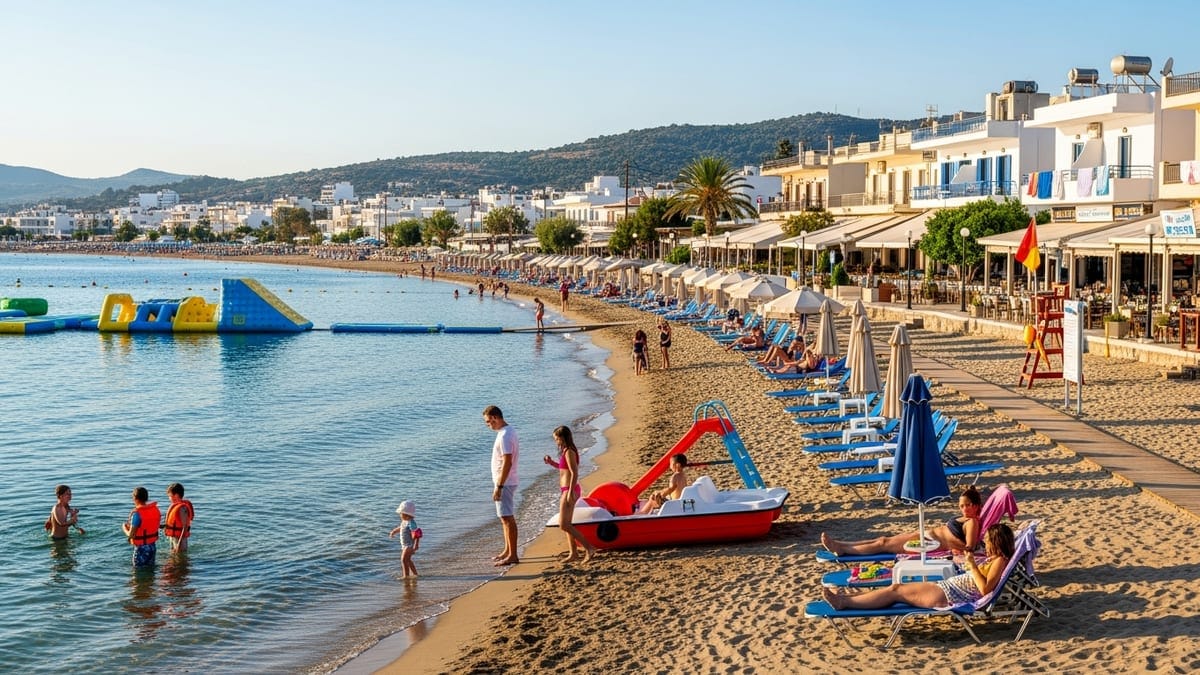
Faliraki’s main beach is the hub of seaside life and the easiest option for families who want everything within arm’s reach.
The sand here is a soft golden mix with some pebbly patches at the waterline in places, and the bay shelves gradually so that even a few metres out the water is only waist‑deep on an adult.
On calm days, which are frequent throughout the long summer season, this creates ideal paddling conditions for younger children.
Sunbeds and umbrellas line almost the entire stretch, often managed by neighbouring tavernas that will bring drinks and snacks directly to your lounger.
Showers, toilets and changing cabins are available in several places along the promenade, and many sections are backed by low‑rise hotels, mini markets and ice‑cream stands.
For active families, there are pedalos with slides, banana boat rides and jet skis, alongside floating inflatable obstacle courses that appear offshore in peak months.
Kathara Beach
Just south of the main strip, Kathara Beach provides a calmer contrast that suits families with toddlers or anyone seeking a less crowded feel. Smaller in scale and bordering low, rocky outcrops, it tends to attract guests from the nearby apartments rather than day visitors from across the island.
The water here is known for being particularly clear and gently shelving, and because there is less through‑traffic of water sports you get a more relaxed atmosphere.
Facilities are simpler but still cover the essentials. A few tavernas and cafés supply food, drinks and washrooms, and a limited number of sunbeds and umbrellas help you settle in for the day.
Parents often appreciate that it is compact enough to keep an eye on older children exploring the shore while younger siblings potter at the water’s edge close by.
Anthony Quinn Bay and Ladiko Bay
A short drive or boat ride from central Faliraki brings you to Anthony Quinn Bay and neighbouring Ladiko Bay, two photogenic coves framed by cliffs and pine trees.
While more commonly associated with snorkelling and scenic swims than with bucket‑and‑spade holidays, they can work well for families with confident swimmers and school‑age children who enjoy a little adventure.
The shorelines here are narrower and more pebbly, and space for strollers is limited, so they are best approached as half‑day explorations rather than your primary base.
On the plus side, the water is usually very calm and incredibly clear, making it fun for spotting fish close to the rocks with a mask and snorkel. A few rows of sunbeds and a taverna or snack bar complete the picture, and many families combine a visit with a boat trip along the coast.
Traounou (Traganou) Beach
Further along the coast, Traounou, often called Traganou Beach, offers a wilder, more natural stretch of shoreline that suits families seeking peace and space.
The beach is largely pebbly with a dramatic backdrop of cliffs and small caves, and the sea here can get deeper more quickly than in Faliraki Bay.
That said, on calm days the water is beautifully clear and the lack of development creates a sense of getting away from it all.
There are usually sunbeds and umbrellas for hire near the main access points along with a beach bar or taverna, but facilities thin out as you walk further along.
This is a good option for a family who has already spent a few days in the thick of things and wants to spread out with older kids who enjoy exploring rock formations and snorkelling in deeper water.
Faliraki Water Park and Other Splash‑Ready Fun
No family discussion of Faliraki would be complete without the water park. Prominently perched on a hillside just outside the resort, it has become a major reason many families book Faliraki in the first place.
With an opening season in 2025 running from early May to the end of October and long daily hours, it slots easily into most itineraries as either a headline day out or a repeat favourite.
Faliraki Water Park
The Faliraki Water Park is regularly cited as the largest in Greece, and the range of slides and pools reflects that status.
The park is divided into zones, with shallow splash areas and mini slides for toddlers, more complex interactive play structures and a pirate ship zone for younger children, and a collection of faster, steeper rides for teenagers and adults.
For those who prefer a gentler pace, lazy rivers and wave pools offer soaking without the adrenaline.
Recent timetables indicate the park plans to operate daily from early May through late October 2025, typically from mid‑morning until early evening, with slightly extended hours in the height of summer.
Food kiosks, snack bars and shaded seating areas are spread throughout, and there are lockers, changing rooms and plenty of lifeguard cover. A free shuttle bus from Rhodes Town and other resort areas, alongside local buses and easy road access, makes the park reachable even if you are not staying nearby.
Families often find that arriving close to opening time keeps queues to a minimum and secures shady loungers, particularly in July and August.
Water shoes are useful on hot pathways, and flotation vests for less confident swimmers are recommended. With toddlers, many parents opt for a midday break back at the hotel to avoid the strongest sun before returning later in the afternoon.
Hotel Aquaparks and Splash Zones
Several of Faliraki’s larger resorts now include their own on‑site water attractions, ranging from simple splash pads and children’s pools to full‑scale mini water parks.
These facilities can be especially appealing for families with younger children who may not last a whole day at the main water park or who prefer more controlled, less crowded environments.
On‑site aquaparks typically feature low‑rise slides, tipping buckets, fountains and shallow pools supervised by lifeguards. Parents can often watch from nearby sunbeds or a poolside bar with everything charged back to the room.
If you anticipate spending much of the holiday by the pool, it is worth prioritising hotels that offer this level of water play, as it can significantly reduce the pressure to seek out daily excursions.
Inflatable Sea Parks and Beach Water Sports
During the main summer months, floating inflatable parks set up just off Faliraki Beach provide extra entertainment for older children and teens.
These obstacle courses, accessed from platforms or small boats, combine climbing walls, slides and balance challenges anchored in calm sections of the bay. They generally require participants to be confident swimmers and may have age or height minimums.
Traditional beach water sports are also readily available, including banana boat rides, sofa inflatables, jet skis and pedalos with slides.
Operators usually cluster around the busier middle section of Faliraki Beach, with lifejackets and basic safety briefings provided as standard. For families, these add on a burst of excitement without needing to leave the resort or commit a full day.
Kid‑Friendly Hotels and Family Resorts in Faliraki
As Faliraki has shifted toward a broader audience, its accommodation scene has diversified to match.
Today you can choose from large all‑inclusive resorts with kids’ clubs and water slides, mid‑sized hotels near quieter beaches and self‑catering apartments that suit families who prefer flexible routines.
When evaluating options, consider your children’s ages, tolerance for noise, desired proximity to the centre and whether you prioritise on‑site activities over exploring the broader island.
All‑Inclusive Resorts with Kids’ Clubs
Full‑service family resorts are popular in and around Faliraki, particularly along the beach road running south toward Kalithea.
These properties typically combine multiple pools, children’s clubs, playgrounds and organised entertainment with buffet restaurants and snack bars, allowing families to settle in without worrying about daily budgets or finding somewhere new to eat each night.
Kids’ clubs usually divide activities by age, with arts and crafts, sports, treasure hunts and mini discos among the standard offerings.
Teen hubs, while less common, are gradually appearing, often with games consoles, table tennis and organised sports tournaments. If your children enjoy making friends and joining in group activities, this style of hotel can transform the dynamic of the holiday.
Hotels Near Quiet Beaches
Not every family wants to stay inside a large complex, and Faliraki offers smaller, often family‑run hotels and apartments particularly around Kathara Beach and the quieter ends of the bay.
These establishments might lack extensive facilities but tend to compensate with a more relaxed atmosphere, personal service and immediate access to softer, less crowded sands.
For parents of very young children, the ability to stroll to the beach without crossing busy roads, return easily for naps and dine at low‑key tavernas nearby can be as valuable as any water slide.
Rooms with kitchenettes or at least fridges and kettles help manage early breakfasts, bottles and snacks on your own schedule.
Self‑Catering Apartments and Villas
Families travelling in larger groups or with relatives in tow often find self‑catering apartments or villas around Faliraki a practical solution. These can range from basic studios near the centre to multi‑bedroom homes in the surrounding hills.
The key advantages are space, separate bedrooms and the ability to prepare simple meals rather than eating every one in a restaurant.
When choosing a self‑catering option, pay attention to walking distances into Faliraki and the gradient back from the beach, particularly in summer heat. Properties slightly inland may offer quieter surroundings and private pools but will require a rental car or regular taxis.
For families happy to drive, this set‑up opens the door to combining beach days with island‑wide sightseeing without constantly packing and unpacking.
Things To Do With Kids Beyond the Beach
Faliraki’s beaches and pools can easily fill your days, but the wider area offers a surprising amount of variety, especially for curious children and teens.
From go‑kart tracks and bowling to mini trains and observatories, you can balance the classic seaside routine with new experiences that appeal to different ages and interests.
Bowling, Soft Play and Indoor Fun
Families quickly learn the value of indoor, air‑conditioned activities in the height of a Greek summer. Faliraki delivers with modern entertainment centres offering bowling lanes, roller skating, trampolines, soft play areas and mini golf under one roof.
These venues are particularly useful on very hot afternoons, on breezy days when the beach feels less inviting or when younger children simply need a change of scene.
Soft play centres, some with supervised sessions, are a lifeline for parents who want to sit down with a coffee while the kids climb, bounce and slide safely indoors. Older children can join bowling games or try mini golf, fostering a bit of friendly competition before or after dinner.
Because they stay open into the evening, these spots can also fill that tricky gap between the end of the beach day and a later Greek mealtime.
Go‑Karting and Mini Golf
For motor‑mad kids and teenagers, outdoor go‑kart tracks near Faliraki provide an adrenaline hit with safety measures in place. Tracks offer different kart sizes so younger drivers can ride with a parent or graduate to solo karts as they gain confidence.
Helmets and briefings are standard, and sessions are usually sold in timed blocks, making it easy to slot a race or two into a broader day out.
Mini golf courses add a lighter, more inclusive form of competition suitable for the whole family.
Often themed with jungle or adventure motifs and lit for evening play, they can serve as pre‑dinner entertainment and a way to explore small side streets you might otherwise miss. Scores matter less than the laughter when a shot ricochets unexpectedly off the scenery.
Boat Trips from Faliraki Harbour
Faliraki’s small harbour is the departure point for a range of family‑friendly boat trips. Options include short coastal cruises that stop at nearby coves for swimming and snorkelling, excursions to Anthony Quinn Bay and Ladiko Bay, and longer journeys south toward Lindos.
Boats range from simple glass‑bottom craft to more comfortable vessels with shaded seating and snacks on board.
For families, half‑day trips often work best, providing a sense of adventure and the thrill of swimming from the boat without overtiring younger children.
Lifejackets are usually provided, and many operators are well accustomed to hosting families, offering ladders for easy water access and pointing out good spots for fish spotting.
Rhodes Observatory and Stargazing
Up in the hills above Faliraki, an observatory and café combination offers a different kind of attraction: stargazing and astronomy sessions with a view.
The site features telescopes, educational displays and outdoor seating overlooking the lights of the coast, creating a memorable evening for older children and teens curious about space.
Sessions typically include guided explanations of visible planets and constellations, with staff on hand to help position telescopes and answer questions.
Parents can enjoy a drink while children take turns at the eyepiece, and cooler evening temperatures make this an appealing way to spend time outdoors after dark.
Day Trips to Rhodes Town and Beyond
Faliraki’s position makes day trips across the island straightforward. Rhodes Town, with its medieval Old Town and harbour, lies a short drive or bus ride away and offers cobbled streets, historic walls, museums and shopping.
Children often enjoy simply walking atop the fortifications, spotting knights’ emblems on stone facades or watching boats in Mandraki Harbour.
Further afield, inland attractions such as the Valley of the Butterflies in season, traditional villages and small museums introduce a different side of the island beyond the resort strip.
Car hire for a day or two allows families to build their own loop, combining cooler forested areas with swims at less‑visited beaches and lunch in village squares.
Practical Tips for a Smooth Family Stay
A successful family trip to Faliraki is as much about logistics as it is about the big sights.
With strong summer heat, variable crowd levels and different ages to cater for, a bit of planning on arrival can help keep everyone comfortable and safe while still leaving room for spontaneity.
Getting Around with Children
Faliraki itself is compact enough that many families rely primarily on walking for local journeys, especially if staying near the beach. Pavements along the main roads are generally adequate for strollers, though smaller lanes can be uneven.
Mini tourist trains, running short circuits around the resort, give young children a fun way to see the area without tiring their legs.
For journeys beyond Faliraki, public buses connect the resort with Rhodes Town and other east‑coast destinations, with more frequent services in peak season.
Taxis are readily available and can be a practical option for evening trips or when returning with tired children from a day out.
Hiring a car for at least part of the stay provides maximum flexibility, but be prepared for limited parking directly by the busiest beach sections in high summer.
Best Time of Year for Families
The main season in Faliraki runs from May to October, with July and August delivering the hottest temperatures and the most activity.
For families with younger children or those sensitive to heat, late May, June, September and early October can be more comfortable periods, with warm seas, long daylight hours and typically fewer crowds.
Visiting at the very start or end of the season does mean some attractions and hotel facilities may be operating on reduced schedules or in the process of opening and closing, so checking specific 2025 dates for water parks and seasonal excursions before booking is worthwhile.
School‑age families bound to peak holiday periods should focus on securing air‑conditioned rooms, shade by the pool and flexible daily routines to manage the midday heat.
Safety, Sun and Sea
Faliraki is broadly regarded as a safe and welcoming resort for visitors, with a strong focus on family tourism. Usual travel common sense applies: keeping valuables secure, agreeing meeting points with older children and ensuring small ones have contact details on hand when exploring busier areas.
Lifeguards patrol main beach sections and water parks, but parents should still supervise closely, particularly around pools with varying depths.
Sun protection is essential from late spring through early autumn. High‑factor sunscreen, hats, rash vests and frequent breaks in the shade are particularly important around midday.
The Aegean sun can catch even experienced travellers off guard, and mild breezes along the coast can make conditions feel deceptively gentle.
Around the sea, jellyfish are not typically a major concern, but wearing water shoes can protect against sharp pebbles or rocks along less sandy stretches.
The Takeaway
Faliraki has evolved into a genuinely well‑rounded family destination, blending the convenience of a modern resort with access to one of the Mediterranean’s most historic islands.
Its sandy bay, shallow water and broad choice of accommodation provide the framework for an easy beach holiday, while the major water park, boat trips, observatory and nearby coves add layers of variety that keep older children engaged.
Whether you choose an all‑inclusive hotel with a built‑in splash park, a quiet base near Kathara Beach or a self‑catering apartment that serves as a springboard for wider island exploration, Faliraki offers the building blocks for a classic family escape.
With some attention to timing, sun safety and the balance between activity and downtime, parents can look forward to a holiday that feels as rewarding and restorative for them as it is exciting for their children.
FAQ
Q1. Is Faliraki suitable for families with very young children?
Faliraki is well suited to families with babies and toddlers thanks to its shallow, gently shelving main beach, short transfer from the airport, and growing number of hotels with children’s pools, cots and highchairs. Choosing accommodation close to the beach and supermarkets makes nap times and early bedtimes easier to manage.
Q2. How many days should a family spend in Faliraki?
A stay of seven to ten nights works well for most families, allowing time for relaxed beach days, at least one full day at the water park, a boat trip, and a visit to Rhodes Town or another island highlight without feeling rushed.
Q3. Do we need to rent a car in Faliraki?
You do not need a car if you plan to stay mainly within Faliraki and take the occasional organised excursion or bus into Rhodes Town. Renting a car for two or three days is worthwhile if you want to visit inland villages, quieter beaches or attractions scattered across the island on your own schedule.
Q4. When is the Faliraki Water Park open in 2025?
The Faliraki Water Park is scheduled to open in early May 2025 and operate daily through late October, with hours typically from around 10:00 in the morning to early evening. Exact dates and times can vary slightly year to year, so it is wise to confirm closer to your travel dates.
Q5. Are there quiet areas in Faliraki away from nightlife?
Yes. While Faliraki retains some late‑night bars in its central streets, much of the resort, including areas around Kathara Beach and the southern and northern ends of the main bay, has a low‑key, family‑focused feel in the evenings. Choosing accommodation a little away from the main bar streets keeps noise to a minimum.
Q6. What is the best beach in Faliraki for families?
Faliraki’s main beach is the most convenient for families, offering soft sand, shallow water, lifeguards and extensive facilities. Families seeking a quieter setting often favour Kathara Beach, which has calmer surroundings but still provides sunbeds, umbrellas and nearby tavernas.
Q7. Is Faliraki expensive for families?
Faliraki offers a range of price points. All‑inclusive resorts can help control overall costs by bundling meals and drinks, while self‑catering apartments let you manage spending by cooking some meals. Eating at local tavernas away from the busiest seafront stretches and using public transport can keep daily expenses moderate.
Q8. Are there medical facilities nearby in case of emergencies?
Faliraki has pharmacies and local medical clinics that can handle minor injuries and common illnesses, with a larger hospital and more comprehensive services available in Rhodes Town a short drive away. Most hotels have staff who can assist with contacting medical help if needed.
Q9. What activities are available for teens in Faliraki?
Teens can make use of the larger water slides at the water park, inflatable sea parks, water sports such as banana boats and jet skis, go‑karting, bowling, mini golf and evening visits to Rhodes Town. Some resorts also offer teen‑focused activities or sports programmes during high season.
Q10. Is Faliraki safe to walk around at night with children?
Faliraki is generally considered safe to walk around in the evening, and families commonly stroll the beachfront and main streets after dinner. As in any busy resort, it is sensible to keep an eye on belongings, agree a meeting point with older children and avoid the densest bar areas late at night, but overall the atmosphere is relaxed and family‑oriented.