

Rhodes is one of Greece’s most versatile islands, and nowhere is that more obvious than in the trio of Faliraki, Lindos and Rhodes Town.
All three sit along the island’s popular east and north coasts, all have beaches within easy reach, and all are well connected by the island’s main road.
Yet the atmosphere, pace, nightlife and practicalities in each place are very different. Choosing where to stay can shape your entire holiday, from how you spend your evenings to how long you sit on a bus to reach the sites you want to see.
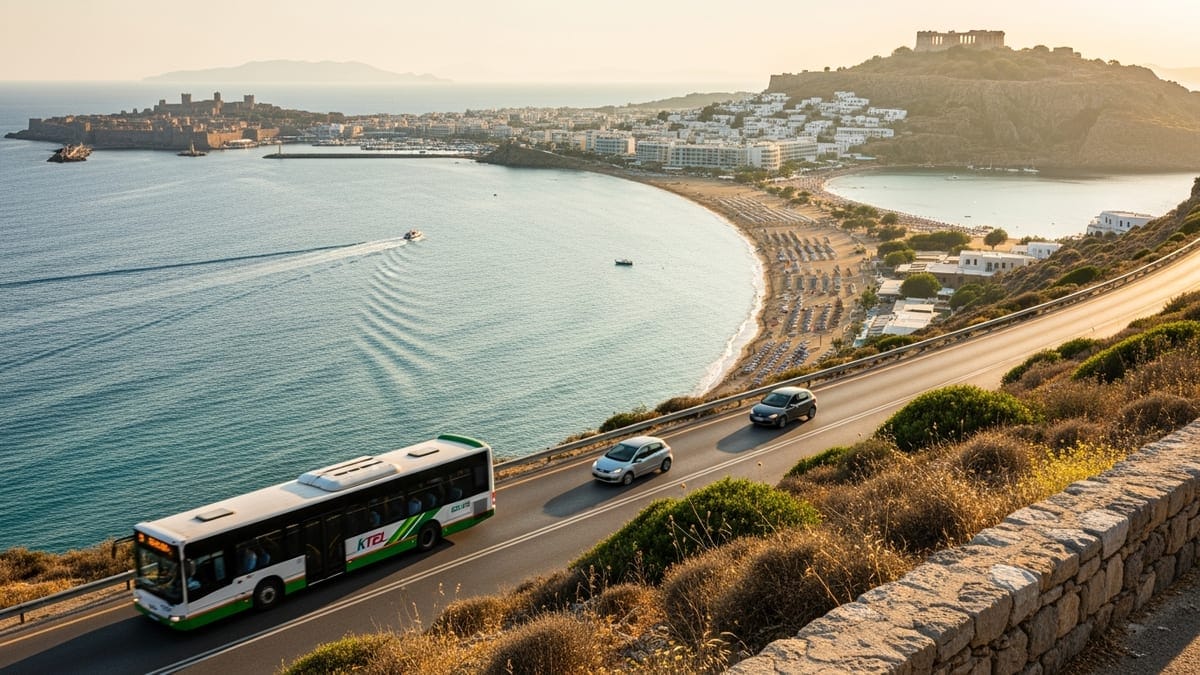
Orientation: How Faliraki, Lindos and Rhodes Town Fit Together
Rhodes is long and narrow, with most resorts and villages spread along the coastline. Rhodes Town anchors the north of the island and acts as the main transport hub, ferry port and cultural center.
From here, Greek National Road 95 runs down the east side to Faliraki and onwards to Lindos, broadly following the coast and linking the three locations in a straight line.
Rhodes International Airport lies west of Rhodes Town, which means transfers to the north and northeast are generally shorter than to the southeastern resorts.
Rhodes Town sits at the island’s northern tip and is divided into two clear areas: the UNESCO-listed medieval Old Town with its stone walls, alleys and historical monuments, and the New Town and resort strip that fan out along the coastline.
Faliraki lies roughly 15 to 18 kilometers south along the east coast, close enough to Rhodes Town for day trips or nights out yet far enough to feel like a distinct resort.
Lindos is about 40 kilometers south of Rhodes Town on the same side of the island, set in a natural bay under a dramatic acropolis; it feels more like a small Cycladic-style village than a modern resort.
Public buses link Rhodes Town, Faliraki and Lindos frequently in season, making it entirely possible to stay in one and visit the others without hiring a car. Taxis are regulated and widely used, especially for airport transfers and evening returns after late dinners or bar nights.
Because these three locations all sit on the island’s main corridor, it is practical to split time between them or choose one base and explore the rest as day trips.
When deciding where to stay, think first about how you want to spend your days. If your priority is wandering medieval streets and having a broad choice of bars and restaurants at your doorstep, base yourself in Rhodes Town.
If you want a sandy beach resort with a big nightlife scene and family-friendly attractions, Faliraki fits the bill. If you picture whitewashed houses, postcard views and boutique-style evenings, then Lindos is likely to be your ideal base.
Rhodes Town: Culture, Convenience and City Energy
Rhodes Town is the island’s capital and its most atmospheric urban center. The medieval Old Town, encircled by imposing stone walls and punctuated by gates and towers, is one of the best-preserved fortified cities in Europe.
Staying within or just outside these walls immerses you in a world of cobbled lanes, Ottoman-era houses, Italian architectural flourishes and lively squares.
By day, cruise-ship passengers and tour groups drift through, but evenings belong to residents and overnight visitors lingering in courtyards and small tavernas.
For travelers who like to walk everywhere, Rhodes Town is the most practical base on the island. The Old Town, New Town, Mandraki harbor and Elli Beach are all within strolling distance of each other.
The main bus station for island routes sits just outside the walls, making day trips to Faliraki, Lindos, the east-coast beaches and the island’s interior straightforward. If you plan to explore widely without hiring a car, Rhodes Town minimizes your reliance on long transfers and taxi rides.
In terms of atmosphere, Rhodes Town offers variety. Parts of the New Town feel modern and busy, with shops, cafes and bars that stay open late in summer.
The Old Town itself has both quiet residential corners and livelier stretches, particularly around main pedestrian thoroughfares where restaurants, wine bars and small clubs cluster.
While there is a nightlife scene, it is more dispersed and mellow than Faliraki’s; you will find bar streets and late-night venues, but also many romantic spots and places suited to mature travelers, couples and culture-focused visitors.
Accommodation in Rhodes Town ranges from simple guesthouses tucked inside stone alleyways to polished boutique hotels and larger properties near the waterfront.
Prices are often higher in the peak months of July and August, especially inside the medieval walls, but shoulder-season stays in May, June, September and early October can offer strong value. For many visitors, the ability to walk from their door to historical sites, restaurants and the harbor in minutes easily justifies paying a little more.
Faliraki: Beaches, Nightlife and Family-Friendly Fun
Faliraki is Rhodes’s classic beach resort, known for its long sweep of golden sand, shallow waters and lively evening scene. Once famous primarily as a party hotspot for young clubbers, Faliraki has broadened its appeal over the last decade.
Today it balances its bar and club strips with family-friendly attractions, including a large water park, mini-golf, bowling and a fun-park for younger children. The main beach is fully serviced with sunbeds, water sports and plenty of cafes and tavernas lining the shore.
For sun-and-sea holidays, Faliraki is one of the most convenient options on the island. The beach is wide, sandy and generally well protected from strong waves, making it especially suitable for families with younger children.
At the southern end of the bay there is also an official naturist section, which can be easily avoided or sought out, depending on your preferences.
A small harbor serves as a departure point for boat trips to nearby coves, Lindos, Rhodes Town and other parts of the coast, allowing you to see more of the island without a car.
Nightlife remains a defining feature of Faliraki, especially in high season. The resort’s central streets host a dense collection of bars, late-night lounges and clubs that come alive after dark, particularly in July and August.
If you want to stay close to the action, you can choose accommodation near the bar and club streets. If you prefer quieter evenings, look for properties slightly away from the center or at either end of the bay; you will still be within walking distance of restaurants and the beach but less exposed to late-night noise.
Accommodation in Faliraki caters to a broad spectrum of budgets and tastes. You will find everything from simple studios and small family-run hotels to all-inclusive resorts along the beachfront.
Because Faliraki is a purpose-built resort, many properties offer pools, on-site entertainment and easy beach access. The resort’s position between Rhodes Town and the mid-east coast also makes it a useful base if you want to split your time between city visits, boat trips and relaxed days by the sea.
Lindos: Postcard Village, Romance and Boutique Charm
Lindos is one of Rhodes’s most photographed locations, perched in a natural amphitheater below a rocky headland crowned by an ancient acropolis.
Whitewashed houses cluster along steep lanes, rooftop restaurants look out over tile roofs and the sea, and three main bays curve around the settlement: Lindos Main Beach, Pallas Beach and St Paul’s Bay. The whole scene feels closer to a small Cycladic island than a large resort, and that is part of its enduring appeal.
For couples, honeymooners and travelers who prioritize atmosphere over convenience, Lindos is hard to beat. The village’s pedestrianized core encourages strolling and lingering, with small boutiques, jewelry shops and local crafts tucked into stone buildings.
Rooftop dining is a highlight, especially at sunset when the acropolis glows and the lights of the village gradually flicker on. Evenings are lively but generally refined, with music drifting from bars and restaurants rather than blaring from large clubs.
The beaches around Lindos are particularly inviting. Lindos Main Beach offers soft sand, sunbeds, calm water and several tavernas right on the shore, making it simple to spend entire days without leaving the bay.
Pallas Beach, just around a small headland, feels more intimate and slightly quieter while still providing facilities. St Paul’s Bay, framed by dramatic cliffs and a small chapel, is one of Rhodes’s most photographed spots, known for its clear, sheltered water and romantic vibe.
All three areas are walkable from the village, though be prepared for some uphill sections on your return.
The main trade-offs with Lindos are heat, hills and access. The village sits on a slope and much of it is not accessible by car, so you should expect to walk on cobblestones and negotiate steps. In the height of summer, the white surfaces reflect the sun and midday temperatures can be intense.
Day-trippers from across the island flock to Lindos during late morning and early afternoon, crowding the streets and beaches. However, staying overnight lets you experience Lindos at its best: quieter mornings, glowing evenings and a noticeably more relaxed pace once day visitors leave.
Transport, Time and Practicalities
When deciding where to stay, consider how long you are willing to spend in transit. Rhodes Town is closest to the airport, usually around a 20 to 30 minute drive depending on traffic and your exact location.
Faliraki is slightly further along the east coast, typically reached in about 25 to 35 minutes. Lindos requires the longest transfer, often close to an hour or more by car or taxi and longer by bus, which makes its atmosphere feel more removed but also adds travel time at the beginning and end of your trip.
The bus network links Rhodes Town, Faliraki and Lindos in a straightforward line. In high season, buses run frequently between Rhodes Town and Faliraki during the day and at regular, though less frequent, intervals down to Lindos.
They can become crowded at peak times, particularly on routes serving popular beach areas and Lindos’s day-trippers. If you are relying on buses, Rhodes Town gives you the most flexibility, while Faliraki works well if you mainly want to move up and down the east coast.
Staying in Lindos without a car is still feasible, but you should be comfortable planning around bus times and occasionally waiting in the sun.
Taxis are widely used throughout the island, with fixed or regulated prices for common routes. They are particularly useful if you want to return to your base late at night after dinner or bar visits, or if you are staying up or down the coast but want to avoid multiple bus changes.
For example, a taxi between Rhodes Town and Faliraki, or between Faliraki and Lindos, can be a worthwhile convenience if you are traveling with luggage or in the heat of the day. Pre-booking in peak season is advisable, and asking your accommodation to arrange transfers can smooth the process.
If you plan to hire a car, all three locations are workable bases. Rhodes Town demands more confidence when driving and parking due to traffic and narrow streets, especially near the Old Town.
Faliraki and Lindos present fewer driving challenges, but parking near the center of Lindos can still be limited in peak season, with designated car parks at the edge of the village.
A car gives you freedom to explore the island’s interior, west coast and smaller, less crowded beaches, but is not strictly necessary if your focus is on these three main centers and their immediate surroundings.
Who Should Stay Where: Matching Destination to Travel Style
Your ideal base in Rhodes depends heavily on what you hope to get from your holiday. For culture-focused travelers, history enthusiasts and those who enjoy a city feel with easy day trips, Rhodes Town is usually the best fit.
You can sleep inside medieval walls, explore museums and historical sites by day, then choose between quiet wine bars or livelier streets at night.
Day trips to Faliraki’s beaches or Lindos’s postcard views are straightforward, but you return each evening to a full-service town where shops, ATMs, pharmacies and services are concentrated.
Faliraki suits travelers whose top priorities are beach time, nightlife and resort-style convenience. Young adults, groups of friends and mixed-age families often appreciate the combination of shallow sandy beach, plentiful water sports, cheerful daytime atmosphere and energetic bar and club scene after dark.
Parents often value the selection of family-friendly hotels with pools and children’s facilities, as well as easy access to Rhodes’s largest water park and other activities that keep younger travelers entertained without long journeys.
Lindos is the standout choice for couples, romantic getaways and travelers who are willing to trade shorter transfers and wider urban amenities for charm and setting.
The village’s intimate scale, rooftop terraces, boutique-style accommodations and stunning bays make it especially appealing if your idea of a perfect evening is a leisurely dinner with a view followed by a stroll through whitewashed alleys.
It also works well for photography-minded travelers and those who want a “classic Greek island” aesthetic without hopping to a smaller island.
If your group spans different preferences, consider a split stay. Many visitors spend a few nights in Rhodes Town to explore its walls, museums and harbor, then move on to Lindos for relaxation by the sea, or to Faliraki for a more resort-focused second half.
Because the distances are relatively short along the east coast, changing base once during a week-long trip is logistically straightforward and lets you experience more than one side of the island without constant packing and unpacking.
Seasonality, Budget and Overall Value
Season matters when choosing between Faliraki, Lindos and Rhodes Town. In high summer, typically from late June through August, Faliraki is at its liveliest, with full nightlife, busy beaches and a broad program of activities.
Lindos sees the highest volume of day-trippers, and temperatures in the village and on its beaches can be particularly intense in midday hours. Rhodes Town remains busy but offers more shade, museums and indoor attractions to escape the heat.
Hotel rates are at their peak across the island in this period, especially in the most sought-after areas within Lindos and Rhodes’s Old Town.
In the shoulder seasons of May, early June, September and early October, the equation changes. Faliraki’s nightlife is toned down outside the core summer weeks, making it more appealing to visitors who want beach convenience without loud clubs every night.
Lindos feels less crowded, with more space on its beaches and in its restaurants, though some seasonal businesses may operate on reduced hours at the edges of the season.
Rhodes Town is arguably at its best in shoulder months, with pleasant temperatures for exploring the medieval streets and fewer queues at major sights.
In terms of budget, you can find options for most price ranges in all three bases, but patterns emerge. Rhodes Town carries a premium for well-located boutique properties inside or near the Old Town, though there are also midrange hotels and more affordable guesthouses further from the walls.
Faliraki offers a wide spread of prices, from simple studios to larger resort complexes; value can be excellent if you are flexible with your exact location within the resort.
Lindos tends to run more expensive per night in peak season due to its limited space and high demand, especially for accommodations within the village core or overlooking St Paul’s Bay.
For overall value, consider not just room rates but how much you will spend on transport, activities and dining. In Rhodes Town you may use buses more often for beach days, but you can also walk to many sights and have a deep choice of restaurants at various price points.
In Faliraki, you may spend less on transport because the beach and activities are at your doorstep, but more on nightlife if you go out frequently.
In Lindos, the combination of higher accommodation prices and the temptation of rooftop dining every night can increase your daily spend, though many visitors feel the setting more than justifies the cost.
The Takeaway
If your image of Rhodes centers on stone walls, knights and history with a side of city-style convenience, Rhodes Town is the strongest base. You will have museums, the harbor, shopping streets and a choice of beaches within walking distance, plus direct bus and taxi connections across the island.
It is the most versatile choice, especially for first-time visitors, culture lovers and those traveling outside the hottest months.
For classic beach-holiday energy with a big nightlife scene, family attractions and easy sand underfoot, Faliraki delivers. It is the most overtly resort-like of the three, with a long sandy beach, shallow water, a water park, and streets full of bars and clubs in high season.
It suits travelers who want to relax by day and have a wide selection of evening entertainment without needing to venture elsewhere, yet still like the option of day trips to Rhodes Town or Lindos.
If you are after romance, postcard views and a village that feels like a destination in its own right, Lindos is your place. Its acropolis, whitewashed lanes and trio of bays create a setting that feels both intimate and iconic.
It is less practical in terms of airport transfers and day-to-day logistics, and it fills with visitors during the middle of the day, but mornings and evenings in Lindos are among the most memorable experiences Rhodes can offer.
Ultimately, the best choice often comes down to your trip’s emphasis. For culture and convenience, choose Rhodes Town. For beaches and nightlife, head to Faliraki.
For romance and scenery, opt for Lindos. If you have the time and inclination, a combination of two of these bases gives you a broader picture of the island and ensures that you experience both its historic heart and its glittering bays.
FAQ
Q1: Is Rhodes Town, Faliraki or Lindos best for a first visit to Rhodes?
For a first visit, Rhodes Town is usually the safest choice because it offers history, beaches, nightlife and the island’s main transport hub in one place. From there you can easily make day trips to Faliraki and Lindos, then decide if you would like to base yourself in one of them on a future trip.
Q2: Which is better for families with young children, Faliraki or Lindos?
Faliraki generally suits families better thanks to its long shallow sandy beach, large water park, family-oriented hotels and abundance of casual dining options. Lindos can also work for families, especially with older children, but its hilly streets, steps and more compact beaches can be challenging with strollers or toddlers in high heat.
Q3: Where should I stay if I want strong nightlife?
If nightlife is your top priority, Faliraki has the densest concentration of bars and clubs, particularly in July and August. Rhodes Town offers a more varied and slightly more low-key scene spread across different streets and squares, while Lindos focuses more on atmospheric bars and rooftop lounges than large-scale clubbing.
Q4: Is Lindos worth the longer transfer from the airport?
For many visitors, Lindos is absolutely worth the extra time. The combination of whitewashed village, acropolis views and beautiful bays creates a unique setting that feels quite different from the resorts closer to the airport. If you value ambiance and scenery over short transfers, the journey to Lindos quickly feels like a worthwhile investment.
Q5: Can I manage without a car if I stay in Faliraki or Lindos?
Yes, both Faliraki and Lindos are doable without a car, especially in the main tourist months when bus services are frequent. Faliraki has direct buses to Rhodes Town and onward connections to other resorts, while Lindos is linked to the north of the island along the main east-coast route. Taxis fill in the gaps, particularly for airport transfers or late-night returns.
Q6: Which area is best outside the peak summer months?
Outside July and August, Rhodes Town is often the best base because it remains lively with residents and has year-round services, shops and cultural attractions. Faliraki becomes quieter but still works well from late spring to early autumn. Lindos is very pleasant in May, June, September and early October, with fewer crowds and more comfortable daytime temperatures.
Q7: Is Rhodes Town noisy at night if I stay inside the Old Town walls?
Noise levels inside the Old Town vary street by street. Some lanes near popular bar areas and main thoroughfares can stay busy until late, while other corners are surprisingly quiet even in high season. If you are sensitive to noise, look for accommodation on a side street away from main bar clusters, and check recent guest feedback for comments on nighttime sound.
Q8: How easy is it to visit Lindos as a day trip from Rhodes Town or Faliraki?
It is straightforward to visit Lindos as a day trip. Regular buses depart from Rhodes Town, often stopping in Faliraki, and take you directly to the village’s upper parking area from which you walk down. Many boat excursions also run from Rhodes Town and some from Faliraki, combining sea views with time ashore in Lindos.
Q9: Which base is best if I want both beach time and cultural sightseeing?
Rhodes Town offers the best combined access to culture and beaches. You can explore the medieval Old Town, Palace of the Grand Master and museums in the morning, then walk to Elli Beach or take a short bus or taxi to nearby coastal areas in the afternoon. Day trips to Faliraki and Lindos allow you to sample different beach styles while keeping your base in the cultural center.
Q10: Should I split my stay between two places or choose one base for a week?
Both approaches work, but many travelers enjoy splitting a week between Rhodes Town and either Lindos or Faliraki. This allows a few days focused on culture, shopping and harbor life, followed by several days of beach relaxation and slower evenings. If you prefer to unpack only once, choose the base that best matches your priorities and use buses, taxis and boat trips for variety.