

More news on this day
In the western reaches of Gloucestershire, the Forest of Dean is strengthening its reputation as one of the United Kingdom’s most family-friendly forest destinations, pairing centuries-old woodland and cavern systems with a growing choice of trails, heritage railways and adventure attractions designed for all ages.
Get the latest news straight to your inbox!
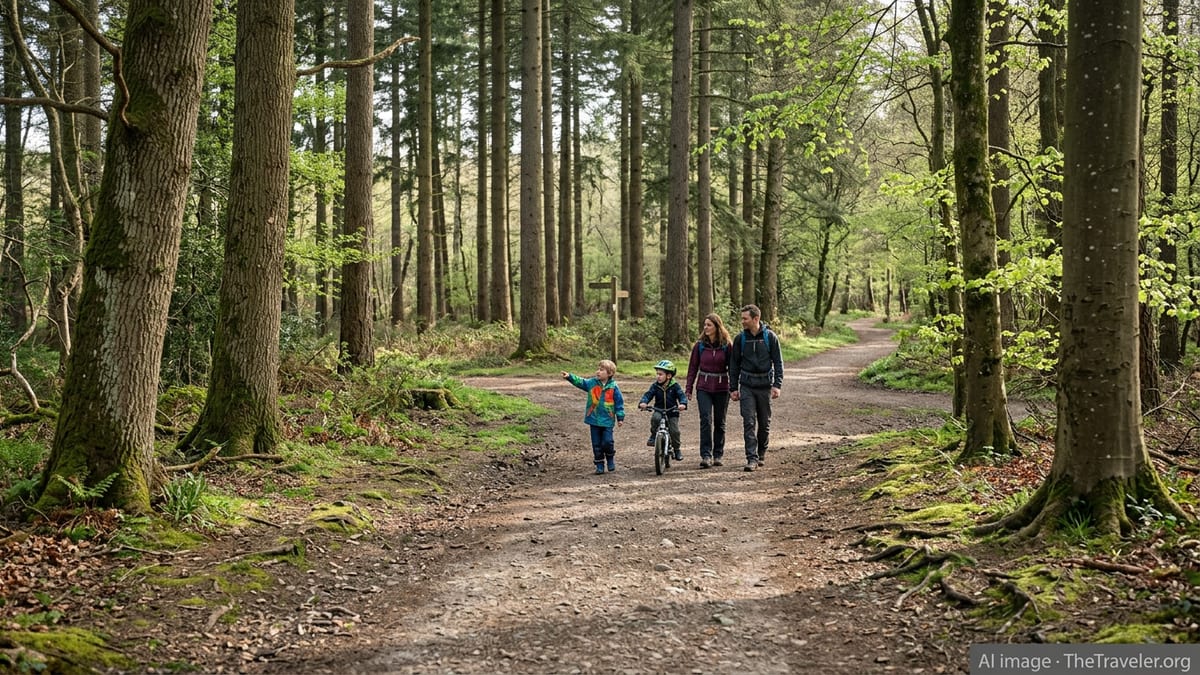
Ancient Woodland Trails Tailored to Families
The Forest of Dean’s network of managed walking and cycling routes continues to attract families looking for accessible ways to experience one of England’s most historic woodlands. Publicly available visitor information highlights clearly waymarked trails starting from key hubs such as Beechenhurst and the Forest of Dean Cycle Centre, where graded paths allow children and less experienced riders to join seasoned mountain bikers on the same landscape at different levels of difficulty.
One of the most visited routes is the Forest of Dean Family Cycle Trail, also known as the Colliers Trail, which loops through former mining areas and areas of mixed woodland. The largely traffic-free route follows disused railway lines and forestry tracks, creating a relatively gentle circuit suitable for family groups towing trailers or carrying younger children on bike seats. Recent destination guides note that this trail connects with viewpoints such as New Fancy, where panoramic platforms interpret the forest’s mining history and offer wide views over the canopy.
For those on foot, the Forest of Dean Sculpture Trail near Beechenhurst remains a signature experience, combining art and nature on a waymarked route that has evolved since the 1980s. Current descriptions indicate that visitors encounter around 16 permanent sculptures set within the trees, with paths of varying length allowing families to choose shorter loops or tackle the full trail. The installations are designed to emerge from clearings and glades, encouraging children to look more closely at their surroundings while maintaining the feel of a traditional woodland walk.
Further west, viewpoints along the Wye Valley Area of Outstanding Natural Beauty give families a chance to pair forest walking with far-reaching river scenery. Spots such as the Devil’s Pulpit, reached by well-trodden paths, offer dramatic views across to Tintern and the winding River Wye, adding a sense of scale to a region already known for its dense, atmospheric woodland.
Underground Worlds: Caves and Mining Heritage
Beneath the trees, the Forest of Dean’s limestone geology has created a series of natural and man-made cave systems that now serve as key visitor attractions. Clearwell Caves, promoted as ancient iron mines, give a structured introduction to the area’s underground world. Visitor information describes extensive caverns shaped by thousands of years of ochre and iron ore extraction, with interpretive displays explaining how miners once worked in near-darkness to extract mineral wealth from beneath the forest floor.
Clearwell Caves are regularly highlighted in regional travel features as a rainy-day favourite, offering level walkways, atmospheric lighting and seasonal events that appeal to families with younger children. The caves provide insight into how local communities depended on the forest’s mineral resources, linking the underground chambers with surface features such as former tramways, spoil heaps and small quarries still visible along nearby footpaths.
Elsewhere in the district, more technical cave systems such as Slaughter Stream Cave and Miss Grace’s Lane continue to attract experienced cavers rather than casual visitors, underscoring the variety and complexity of the area’s subterranean landscape. These systems, which require permits, specialist equipment and club oversight, highlight how the same limestone that created show caves for families also forms challenging sporting cave networks.
Above ground, museums and interpretation points help place this mining heritage in context for younger audiences. Regional travel coverage points to family attractions across the Forest of Dean that present coal and iron mining stories through interactive displays, reconstructed workings and short heritage trails, underscoring how closely the modern leisure landscape is tied to centuries of industrial activity.
Puzzlewood and Storybook Landscapes
Among the Forest of Dean’s best-known family sites, Puzzlewood near Coleford continues to draw attention in guidebooks and online reviews for its unusual topography and fairy-tale atmosphere. The 14-acre ancient woodland is threaded with narrow paths laid out in the 19th century, weaving between moss-draped rock formations, deep gullies and twisted tree roots. Geological studies describe these formations as “scowles,” surface features created where cave roofs collapsed and eroded over millions of years.
Contemporary travel pieces often highlight Puzzlewood as a place where children can explore a natural maze-like environment at their own pace, with supervision from adults on the main paths. The close-set rocks, short tunnels and sudden viewpoints create a sense of discovery on a compact scale, appreciated by families who prefer immersive walks to formal play areas. Seasonal opening hours and timed entries, detailed in attraction information, are designed to manage visitor numbers and preserve the site’s fragile ecosystem.
The surrounding area offers opportunities to extend a day out without long transfers. Driving routes promoted by local tourism bodies note that Puzzlewood sits within a short distance of Clearwell Caves and other Coleford-based attractions, allowing visitors to combine woodland exploration with underground tours and small-gauge railways. This cluster of family-friendly sites has helped consolidate the southern Forest of Dean as a short-break destination, particularly for visitors arriving from the Midlands, South Wales and the Bristol region.
Elsewhere in the forest, smaller walks around viewpoints, picnic areas and riverside sections of the Wye provide alternative settings for families who enjoy the storybook ambiance of Puzzlewood but want quieter paths. Local accommodation providers increasingly reference these options in their own visitor guides, encouraging guests to balance headline attractions with low-key exploration.
Adventure Rides, Treetop Thrills and Heritage Railways
For families seeking more adrenaline, the Forest of Dean features a growing mixture of treetop adventure courses, heritage train rides and child-focused attractions. At Beechenhurst, Go Ape’s Forest of Dean site offers treetop courses, aerial crossings and zip wires high among the conifers. Promotional material and regional news coverage describe platforms reaching some of the brand’s higher UK heights, alongside junior routes designed for younger children to build confidence on lower, shorter obstacles.
Nearby, Mallards Pike is regularly mentioned in outdoor features as another adventure hub, pairing lakeside trails and picnic spots with access to forest activities such as paddle sports and running events. Together with Beechenhurst, it forms part of a network of managed recreation sites that give families clear entry points into the wider forest, supported by parking, cafés and basic visitor facilities.
Railway-themed attractions add another layer of appeal. Dean Forest Railway, which operates along a section of preserved branch line between Lydney and Parkend, markets itself as a family-friendly heritage railway with steam and diesel services. Recent updates on the line’s official channels outline seasonal timetables, special event days and hands-on experiences such as footplate sessions, while day visitors typically enjoy short return journeys, wayside station stops and access to woodland walks close to the tracks.
Also close to Coleford, Perrygrove Railway Adventure operates a narrow-gauge line aimed squarely at families with younger children. Public information describes unlimited train rides on short loops through fields and woodland, combined with indoor and outdoor play areas and treehouses. Travel writers covering the area often recommend combining Perrygrove with Puzzlewood or Clearwell Caves to create a full family day out centred on gentle rides and imaginative play rather than high-adrenaline thrills.
Planning a Family Break in One of the UK’s Most Beautiful Forests
Recent destination guides position the Forest of Dean and the adjacent Wye Valley as a compact but varied region, where short driving distances make it possible to pair tranquil woodland walks with high-energy adventures in the same day. Family-focused accommodation providers increasingly package stays around key attractions such as the Cycle Centre, Puzzlewood, Go Ape and Clearwell Caves, while also promoting softer experiences like wildlife watching, river canoeing on the Wye and stargazing in relatively dark skies.
Publicly available visitor information highlights that most major attractions operate seasonal timetables, with longer opening hours in school holidays and special events around Easter, Halloween and Christmas. Families are encouraged to check the latest schedules, book timed tickets where required and factor in parking availability at popular sites, particularly during peak weekends and bank holidays.
Transport options reflect the rural setting. The area remains easiest to explore by car, though regional travel forums point out that visitors can combine mainline rail services to Lydney or Gloucester with local buses and taxis to reach parts of the forest. Once in situ, the network of trails from hubs such as Beechenhurst, Mallards Pike and the Cycle Centre allows many families to leave the car parked for the day.
With its blend of towering conifers, storybook ravines, illuminated caverns and child-friendly adventure courses, the Forest of Dean continues to evolve as a destination where parents and children can share active days in natural surroundings. The combination of heritage, geology and purpose-built attractions is helping this corner of Gloucestershire stand out in a crowded field of UK family holiday options.