

Oktoberfest may be Germany’s most famous party, but it is only one chapter in a remarkably diverse festival story. Across the country, centuries-old traditions collide with avant-garde culture, world-class music and exuberant street parades. From riverbank fireworks to medieval markets and thundering open-air concerts, Germany’s calendar is packed with events that reveal a more nuanced picture of the country than beer tents and brass bands alone. For travelers willing to look beyond Munich in late September, the rewards are rich, surprising and often unforgettable.
Karneval: Germany’s Wild Fifth Season
In many German cities, the year is said to have a “fifth season” that begins on 11 November at 11:11 a.m. and reaches its wild peak in the days before Lent. Known as Karneval, Fasching or Fastnacht depending on the region, this pre-Lenten carnival season mixes satire, social commentary and sheer revelry. Cologne is its spiritual capital, but cities along the Rhine such as Düsseldorf and Mainz, as well as towns in Swabia and the Black Forest, celebrate with equal intensity. For visitors, it is one of the most immersive ways to see normally orderly German streets transformed into a riot of color and costume.
Central to Karneval are the parades that sweep through city centers, most famously on Rosenmontag, or Rose Monday. Elaborately decorated floats carry costumed groups who toss candy and small gifts into cheering crowds, while marching bands provide a relentless soundtrack of drums and brass. Many floats poke fun at political leaders and current events, reflecting the festival’s long tradition of biting satire and speaking truth to power in coded, humorous ways. Costumes run from whimsical animals to coordinated group themes, and locals often spend months planning their outfits.
Each region stamps its own character on carnival. In Cologne, where the cry “Kölle Alaaf” echoes from packed squares and bars, the mood is unabashedly boisterous and inclusive. By contrast, in parts of southern Germany, especially around the Swabian-Alemannic communities, carnival takes on a more folkloric tone. There, wooden masks, hand-carved to represent witches, devils or forest spirits, recall pre-Christian winter rituals. Parades in towns like Rottweil or Villingen-Schwenningen can feel almost theatrical, as masked figures leap, ring bells and playfully chase onlookers.
For travelers, practicalities matter as much as pageantry. Trains and hotels around the peak carnival weekend in February often book out early, and many businesses close or operate limited hours during the biggest parades. In large carnival cities, the old town becomes a pedestrian party zone where glass is restricted, portable toilets appear on corners and spontaneous singing erupts in tram stops and side streets. Joining in with a simple costume, such as a colorful hat or face paint, is both welcomed and expected, and it helps break the ice with locals who are usually eager to share a song or a plastic cup of sparkling wine.
Christkindlesmarkt and the Magic of German Christmas Markets
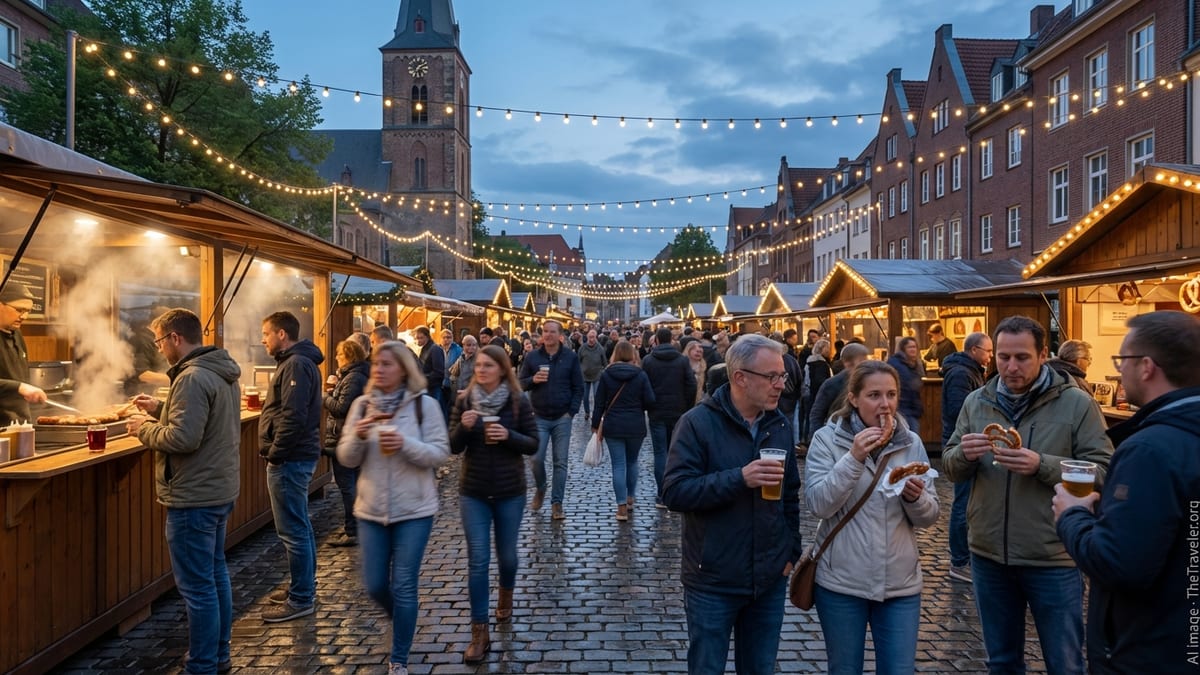
While Christmas markets have spread worldwide, their roots are distinctly German, and some of the most atmospheric can still be found in cities and towns across the country. From late November through December, central squares glow with strings of lights, wooden stalls and the scent of roasted almonds and spiced wine. Among the many markets, Nuremberg’s Christkindlesmarkt stands out as one of the most storied, blending tradition, craftsmanship and a strong sense of place on the cobbled Hauptmarkt beneath the spires of the Frauenkirche.
Nuremberg’s market is presided over by the Christkind, a symbolic gift-bringer played by a local young woman chosen every two years. Dressed in a golden robe and crown, she delivers an opening prologue from the church balcony that signals the start of the season. Stalls below sell regional specialties such as Nuremberg gingerbread, grilled sausages and the city’s famous prune figures, small figurines crafted from dried plums and nuts. Away from the main square, a “sister cities” section showcases crafts and snacks from Nuremberg’s international partner cities, adding a subtle global note to the otherwise resolutely Franconian atmosphere.
Beyond Nuremberg, almost every German region has its own take on the Christmas market. In Dresden, the Striezelmarkt places a spotlight on local baking traditions, especially the buttery Stollen fruit bread that is famous throughout Germany. In Stuttgart and Frankfurt, ornate wooden roofs, carved figures and animated displays turn the market stalls themselves into attractions. Smaller towns in the Harz Mountains or along the Rhine often combine markets with historical reenactments or torchlit walks, lending a storybook quality that is especially captivating in fresh snow. Even in big cities like Berlin or Hamburg, neighborhood markets create a more intimate, local feel than their size would suggest.
Traveling to Germany in Advent is about more than shopping. Many markets host daily concerts in nearby churches, children’s choirs, or small stage performances, reinforcing the communal, cultural side of the season. At dusk, families and colleagues gather at standing tables to warm their hands around mugs of mulled wine or nonalcoholic punch, turning after-work hours into a social ritual that locals anticipate all year. For visitors, moving from stall to stall provides a gentle introduction to regional dishes and crafts, from hand-blown glass ornaments to woollen hats knitted in Alpine patterns.
To make the most of Christmas markets, timing and expectations are key. Early evenings can be crowded, particularly on Fridays and weekends, so late afternoon weekdays are often more relaxed. Weather in December can be damp and chilly rather than postcard-perfect, so warm, waterproof clothing is essential, as is a tolerance for standing outdoors for long stretches. Many markets charge a small deposit for ceramic mugs, which makes for a charming, practical souvenir if you choose not to return it. Cashless payments are becoming more common, but some smaller stalls still prefer coins and notes, especially in smaller towns.
Wacken Open Air: The Pilgrimage of Heavy Metal Fans
Every summer, a quiet farming village in northern Germany transforms into one of the world’s most famous heavy metal gatherings. Wacken Open Air, held in the community of Wacken in Schleswig-Holstein, has grown since 1990 into a multi-day festival that draws tens of thousands of fans from more than 80 countries. It is widely regarded as one of the largest and most influential metal festivals anywhere, a place where legendary bands share top billing with rising acts, and where muddy fields and dramatic pyrotechnics form part of the experience.
The festival typically unfolds over several days in early August, with two massive main stages and a constellation of smaller performance areas. Its program spans the spectrum of heavy music, from classic and power metal to extreme subgenres and related styles, often featuring around 200 bands across the event. For many fans, the appeal lies as much in the community as in the lineup. Campsites become temporary villages, decorated with homemade flags, inflatable mascots and makeshift bars, and it is not uncommon to meet multi-generational families for whom Wacken has become an annual tradition.
Wacken’s organizers have steadily expanded the festival grounds into a self-contained world. Dedicated zones include a medieval-inspired “Wackinger” village, where visitors can watch historical reenactments, buy rustic food and listen to folk-inflected bands, as well as a post-apocalyptic themed area with costumed performers and scrap-metal structures. Food stalls run from classic German sausages and pretzels to vegan options and international street food. Despite the hard-edged soundtrack, the overall atmosphere is generally cooperative and surprisingly good-natured, supported by a large volunteer and security presence accustomed to managing large crowds.
For travelers, Wacken is not a casual side trip. Tickets often sell out months in advance, and the logistics of reaching the rural site and camping for several days require planning. The festival’s unofficial motto, “Rain or shine,” reflects the reality that northern German weather in August can swing from sun to heavy downpours, turning fields into mud within hours. Sturdy boots, quick-drying layers and a relaxed tolerance for dirt are all part of the dress code. At the same time, the event showcases a different, more playful side of German organization, where meticulous infrastructure quietly supports what appears from the outside to be glorious chaos.
Berlinale: Berlin’s Global Celebration of Film
In February each year, Berlin steps into the spotlight of world cinema as host of the Berlin International Film Festival, widely known as the Berlinale. Founded in 1951 and now recognized as one of the most prestigious film festivals globally, the event combines high-profile premieres with a strong emphasis on politically engaged and socially conscious storytelling. Screenings take place in venues around Potsdamer Platz and other neighborhoods, drawing industry professionals, international media and a broad local audience.
The Berlinale’s competition films vie for the Golden Bear and a series of Silver Bear awards, honors that have helped launch careers and bring attention to bold, sometimes challenging work. Beyond the main competition, the festival presents a wide range of sections, from experimental and arthouse films to genre cinema and documentaries. A dedicated program for younger viewers and families, as well as special retrospectives and tributes, ensure that the event appeals to both specialists and the general public. Recent editions have also reflected ongoing debates about representation, diversity and the role of film festivals in times of political tension.
What sets the Berlinale apart from some other major festivals is its accessibility. While accreditation is essential for many industry events, a large portion of screenings are open to the public, with tickets sold through regular box-office channels. Berliners treat the festival as a winter ritual, queuing in cold winds for tickets and comparing notes on favorite discoveries in cafés and U-Bahn stations. Red-carpet premieres attract international stars and photographers, yet it is equally possible to find yourself in a small cinema watching a debut from a little-known director, followed by an in-depth question-and-answer session.
Travelers visiting Berlin during the Berlinale should anticipate crowded accommodation, particularly around central districts such as Mitte, Tiergarten and Kreuzberg. Winter weather in the German capital can be raw, with short daylight hours and a damp chill that seeps into bones, so planning for indoor breaks between screenings makes a difference. On the plus side, the festival infuses the city with energy during an otherwise quiet season. Posters, pop-up venues and festival-branded cafés create an atmosphere in which cinema spills onto the streets, and conversations about films continue late into the night.
Bayreuth Festival: A Temple to Wagnerian Opera
High on a hill above the Franconian town of Bayreuth stands a theater that, for devotees of Richard Wagner, is something close to sacred ground. The Bayreuth Festival, held annually in a purpose-built Festspielhaus, is dedicated primarily to Wagner’s own works and has been a magnet for opera lovers since the late 19th century. Tickets are notoriously hard to obtain, with demand often exceeding supply by a considerable margin, and the audience is a mix of lifelong admirers, musical professionals and curious first-timers willing to immerse themselves in long, intense performances.
The festival’s particular appeal stems from the combination of Wagner’s music and the unique acoustics of the Festspielhaus, which was designed to create a sense of the orchestra rising from an invisible pit. Productions at Bayreuth have evolved over time from traditional stagings to highly conceptual interpretations, sparking debate and sometimes controversy. Directors use the stage as a laboratory to reconsider familiar works, and each season tends to generate lively discussion in international arts coverage. For many visitors, the intellectual and emotional engagement is as central as the music itself.
Attending Bayreuth requires forward planning and a tolerance for formalities. Performances are long, often stretching to five hours or more including intermissions, and the atmosphere can feel ceremonious, with many guests choosing evening wear. Temperatures in the unair-conditioned auditorium can be warm during heatwaves, which are becoming more frequent in German summers, so experienced attendees dress in layers of natural fibers. In town, the festival spills into outdoor cafés and beer gardens where conversations about staging choices and singers’ interpretations carry on late into the evening.
For travelers who may not consider themselves opera aficionados, Bayreuth can still be a fascinating cultural experience. The city itself has a rich history, including connections to 18th century patronage and architecture, and during festival season it hosts exhibitions, talks and smaller concerts that provide context for Wagner’s influence. Even if you do not secure a ticket to the main performances, the atmosphere of anticipation around the Festspielhaus and the influx of international visitors can make a visit worthwhile, offering a glimpse into one of Europe’s most enduring artistic pilgrimages.
Karneval der Kulturen and Berlin’s Urban Diversity
Not all of Germany’s famous festivals are rooted in centuries-old tradition. The Karneval der Kulturen, or Carnival of Cultures, is a comparatively young event that has become a fixture of Berlin’s early summer. Held over a long weekend, usually around Pentecost, it celebrates the city’s multicultural communities through music, dance, food and street performance. While the name references carnival, its timing and concept differ from the pre-Lenten Karneval along the Rhine, and it offers a very different perspective on German identity.
The heart of the event is a large street parade in the Kreuzberg district, where elaborately decorated floats and walking groups represent cultural associations, diaspora communities and artistic projects. Rhythms from West Africa, Latin America, the Balkans and the Middle East mingle in the air, and many participants invite spectators to join improvised dances along the route. Costumes range from folkloric outfits to contemporary urban styles, reflecting the diversity of a city that has long been a magnet for migrants and creatives.
Around the parade, a street festival unfolds over several days, with stages hosting live bands and DJs, and stalls offering everything from Jamaican jerk chicken to Turkish gözleme. Environmental and social organizations use the opportunity to present their work, underscoring the event’s emphasis on coexistence and civic engagement. For visitors, it is an accessible way to experience Berlin’s neighborhood culture beyond the major sights, with families, students and long-time residents sharing sidewalks and park lawns.
As with many large urban festivals, crowds can be intense, and recent years have seen ongoing discussions about safety, waste management and noise. Authorities and organizers periodically adjust routes, crowd-control measures and schedules in response to changing conditions. Travelers who prefer a calmer experience may choose to visit earlier in the day, when families dominate, and retreat before the late-evening crush. The event reflects both the energy and the challenges of a rapidly changing city, making it a revealing, if sometimes chaotic, snapshot of Berlin today.
Documenta in Kassel: A Festival of Contemporary Art
Every five years, the central German city of Kassel hosts one of the world’s most influential exhibitions of contemporary art, known simply as Documenta. Founded in the 1950s as a way to reconnect postwar Germany with international modernism, it has grown into a sprawling, months-long event that attracts artists, curators and visitors from across the globe. Rather than a conventional fair, Documenta is more like a temporary reimagining of the city, with works appearing in museums, parks, abandoned buildings and unexpected public spaces.
Each edition of Documenta is curated by a new artistic team, which means that themes, formats and focal points shift dramatically over time. Some years emphasize political and social issues, others foreground experimental forms or explore the boundaries between art and everyday life. Installations can range from intimate video pieces to monumental outdoor sculptures that become landmarks in their own right. Debates about curatorial choices and public funding are common, reflecting the event’s role as a lightning rod for broader cultural conversations.
For travelers, Documenta offers an unusual way to experience a mid-size German city. Navigating between exhibition venues often leads visitors through Kassel’s parks, residential areas and post-industrial zones, creating a sense of exploration that goes beyond gallery walls. Locals open pop-up cafés and temporary project spaces, and conversations about particular works spill out into beer gardens and tram stops. Because the exhibition runs for several months, from early summer into autumn, it can be combined with wider travels through Germany and neighboring countries.
Planning a visit to Documenta requires attention to dates and logistics, as accommodations in Kassel tend to fill quickly at peak times. Travelers should expect some works to be challenging or provocative, and in recent years discussions about representation, colonial legacies and political symbolism have been particularly intense. Those willing to engage with these complexities, however, often find the experience deeply rewarding, offering insights into how contemporary artists around the world grapple with urgent questions of identity, power and the environment.
The Takeaway
Looking beyond Oktoberfest reveals a festival landscape in Germany that is dramatically more varied than the familiar image of beer tents and alpine bands. From the raucous street theatre of Karneval and the quiet glow of Christmas markets to the intellectual rigor of Bayreuth and Documenta, each event opens a window onto different aspects of German life. Together, they showcase a country that is at once rooted in tradition and open to reinvention, where local customs coexist with global influences.
For travelers, the practical advantages are clear. Many of these festivals fall outside the peak summer tourist season, making flights and accommodations more flexible, even if specific event dates can still drive up demand. By aligning a trip with one or more of these celebrations, visitors gain access not just to performances and decorations, but to the rhythms of everyday German society. Street parades, open-air stages and temporary markets become spaces where guests and residents mingle, share food and discuss everything from weather to world politics.
Choosing which festival to attend depends on personal interests and tolerance for crowds, but there is something here for almost every traveler. Music lovers can gravitate toward Wacken or Bayreuth, cinephiles toward the Berlinale, art enthusiasts toward Documenta, and families toward Christmas markets or the Carnival of Cultures. What connects them all is a sense of collective experience, a reminder that culture in Germany is not confined to museums and concert halls, but lives just as vividly in streets, squares and fields.
Ultimately, venturing beyond Oktoberfest is less about avoiding clichés and more about expanding horizons. By seeking out festivals that speak to different histories, communities and creative impulses, travelers can assemble their own multifaceted portrait of Germany. In doing so, they join millions of locals who, year after year, step out into the cold of February, the dust of August fields or the glow of Advent lights to celebrate in ways that are both familiar and continually evolving.
FAQ
Q1. When is the best time of year to experience German festivals beyond Oktoberfest?
The festival calendar runs year round, but major highlights cluster in February for Karneval and the Berlinale, late spring and early summer for the Carnival of Cultures and many outdoor events, August for Wacken and Bayreuth, and late November to December for Christmas markets. Your ideal time depends on whether you prefer winter lights, spring street parades or summer open-air concerts.
Q2. How far in advance should I book tickets and accommodation for these festivals?
It is wise to plan several months ahead for high-demand events such as Wacken, the Bayreuth Festival and the Berlinale, as tickets and nearby hotels can sell out quickly. For Christmas markets and the Carnival of Cultures, accommodation in city centers also fills early on peak weekends, though day visits from nearby towns remain feasible.
Q3. Are German festivals suitable for families with children?
Many are, particularly Christmas markets, the Carnival of Cultures and daytime Karneval events, which offer plenty of visual spectacle and kid-friendly food. Evening crowds, loud music and alcohol consumption at some festivals can be overwhelming, so families often focus on afternoon visits and smaller towns where the mood is more relaxed.
Q4. Do I need to speak German to enjoy these festivals?
While some knowledge of German enhances the experience, especially for wordplay-heavy carnival traditions, it is not essential. Major festivals in cities such as Berlin, Cologne and Nuremberg are accustomed to international visitors, and many signs, programs and announcements include at least some English. Gestures, smiles and a few basic phrases go a long way.
Q5. What should I pack if I am traveling to Germany for a winter festival?
For events like the Berlinale or Christmas markets, plan for cold, often damp conditions and long periods outdoors. A warm, waterproof coat, insulated footwear, gloves, a hat and layers of clothing are essential, as are lip balm and hand cream to combat dry air. Reusable mugs and small power banks can also be useful for long evenings outside.
Q6. How expensive are these festivals compared to Oktoberfest?
Costs vary widely, but in broad terms, accommodation near major festivals can be similarly priced to Oktoberfest in peak periods, even if individual food and drink items are often more affordable. Some events, like Christmas markets and street parades, can be enjoyed at relatively low cost, while opera tickets at Bayreuth or multi-day passes for Wacken represent a more substantial investment.
Q7. Are there any important etiquette rules or customs I should know?
Basic courtesy and respect for local traditions go a long way. At Karneval, joining in with simple costumes and responding to local cheers is appreciated. In more formal settings like Bayreuth, punctuality and switching off phones are essential. At all festivals, following waste-sorting rules, using designated smoking areas and respecting residential neighborhoods are taken seriously.
Q8. How safe are large German festivals for solo travelers?
Large events in Germany are generally well organized, with visible security, medical services and clear crowd-management plans. As at any major gathering, solo travelers should remain aware of their belongings, avoid overly intoxicated areas late at night and agree on meeting points if joining temporary groups. Many people attend alone and find festivals a sociable way to meet others.
Q9. Can I combine multiple festivals in one trip?
With careful planning, it is possible to link events, particularly those that occur in the same season. For example, a February itinerary could combine the Berlinale in Berlin with Karneval in Cologne, while a winter trip might include several Christmas markets in neighboring cities. Travel times between major German hubs are often manageable by train.
Q10. How can I find up-to-date information on festival dates and programs?
Because dates and formats can change from year to year, especially in response to public health or security considerations, it is important to consult the latest information from official festival organizers or local tourism offices. Checking details a few months before travel and again shortly before departure helps avoid surprises and ensures you have the most current schedules.