

More news on this day
Rail passengers using London Paddington are facing significant disruption after a fatal incident on the Oxford–Worcester rail corridor led to the suspension and diversion of key services across the Great Western network.
Get the latest news straight to your inbox!
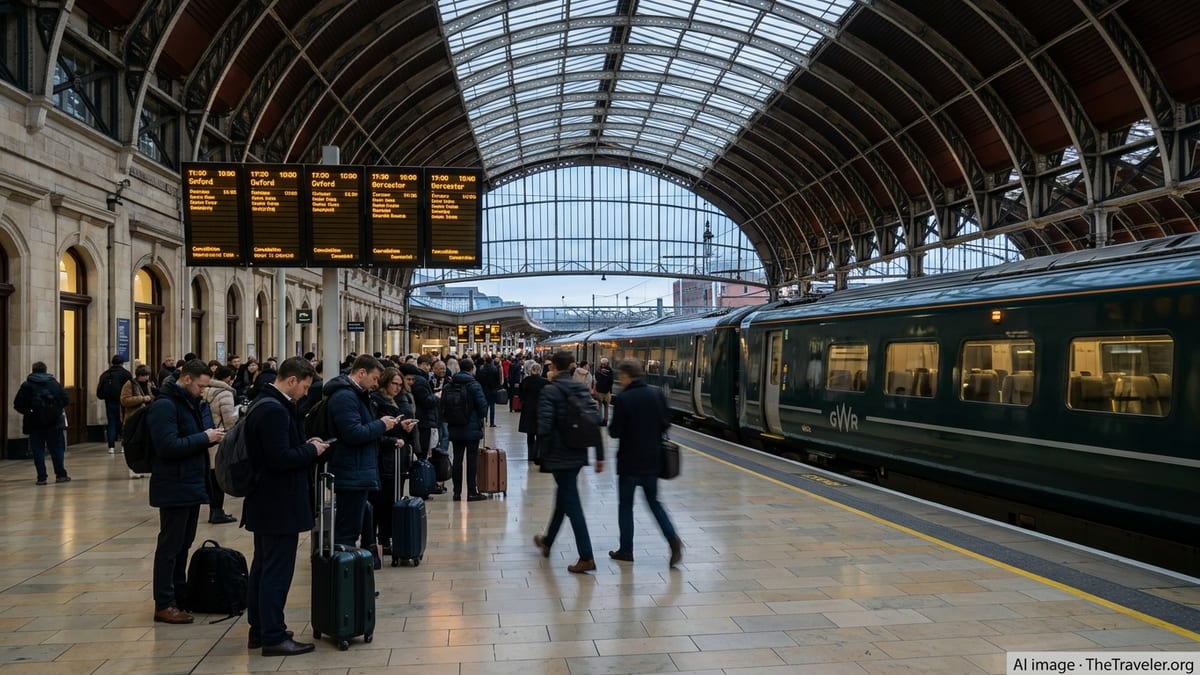
What Is Known So Far About the Fatal Incident
Initial reports indicate that services on the Oxford–Worcester corridor were brought to a standstill following a fatality on the line. The incident occurred on a section of track used by Great Western Railway services linking Worcester, the Cotswolds and Oxford with London Paddington, prompting an immediate shutdown of movements through the affected area while emergency teams and rail staff responded.
Publicly available information shows that the line was closed in both directions for several hours, with trains held at stations or terminated short of their destinations. In keeping with standard practice after a fatality on the railway, investigations were initiated and the route could only begin to reopen once rail infrastructure managers confirmed the tracks were safe to use.
The Oxford–Worcester corridor forms part of the long-established route that connects the Cotswolds with the Great Western Main Line, and disruptions here typically have a ripple effect across the wider timetable. On this occasion, the impact was felt quickly at London Paddington, where long-distance and regional services share platform and track capacity with suburban and airport trains.
Impact on London Paddington and the Wider Great Western Network
Train movements into and out of London Paddington were significantly curtailed following the incident, with real-time journey information boards showing multiple cancellations, severe delays and alterations to services scheduled to operate via Oxford and Worcester. Some trains were terminated at intermediate hubs, while others were diverted away from the affected route to keep parts of the network moving.
Passengers reported crowded concourses and busy information points at Paddington as those heading towards the Cotswolds and the West Midlands sought alternative options. Knock-on delays also affected trains that do not run directly over the incident site but rely on the same pool of rolling stock and paths into the terminus, including some services towards Reading and intermediate Thames Valley stations.
According to published coverage of recent disruption patterns on the Great Western network, incidents around Oxford and on feeder lines often compound existing capacity pressures at Paddington, where high-speed intercity services, regional routes and airport links all converge. This latest fatality has again highlighted how an incident on a single corridor can cascade through a tightly timed timetable.
Current Service Status and Alternative Routes for Travelers
As the line gradually reopens, trains between London Paddington, Oxford and Worcester are expected to run with substantial residual delays, short-notice cancellations and possible short formations. Passengers may find that some services operate only over part of their normal route, with replacement road transport or connections offered at key interchanges.
Travelers attempting to reach destinations in the Cotswolds and Worcestershire are being advised, via journey planners and operator updates, to check trains immediately before travel and to allow extra time. In some cases, passengers heading towards Oxford and beyond may be routed on alternative lines or asked to change at intermediate stations where connecting services are still operating.
For those whose journeys are flexible, publicly accessible guidance suggests considering later departures or travelling on different days if possible, particularly while rolling stock and crews are being re-positioned after the disruption. Season ticket holders and regular commuters on the Oxford–Worcester corridor are encouraged to monitor live information channels closely, as timetables may be adjusted further while the network recovers.
Passenger Rights, Refunds and Compensation Options
Under national rail conditions of travel, passengers whose journeys have been severely delayed or cancelled due to this incident may be entitled to compensation. Most operators on the Great Western routes participate in Delay Repay schemes, which provide partial refunds based on the length of delay to the individual trip, regardless of the underlying cause of the disruption.
Travelers are generally required to keep their tickets or booking confirmations and to submit claims online through the relevant train operator’s portal. Published guidance explains that claims typically need to be made within a set period and that processing times can vary, particularly after major disruption when volumes are high. Passengers who chose not to travel because their booked service was cancelled can usually request a full refund with no administration fee from their original retailer.
Those who incurred additional costs, such as overnight accommodation or alternative transport, should retain receipts and refer to the operator’s published customer charter, which sets out when such expenses may be considered. While policies differ between companies, publicly available information shows that reimbursement beyond standard Delay Repay is often assessed on a case-by-case basis.
Safety Protocols and Why Disruption After a Fatality Lasts So Long
Major disruption following a fatality on the railway is governed by strict safety and investigative procedures. When a serious incident occurs, rail traffic in the area is halted so that emergency responders and infrastructure teams can access the site without risk from moving trains. The location is treated with care so that investigators can understand what happened and ensure that there are no ongoing hazards.
According to industry incident-handling guidance, the line can only reopen once specialist staff have completed examinations of the track, signalling and overhead or third-rail equipment where applicable. Trains that were in the vicinity at the time of the incident may also require checks before they can re-enter service, adding to the time it takes for normal operations to resume.
Even after the route is technically available again, services do not immediately return to the published timetable. Trains and crews are often out of position, and network controllers must rebuild the schedule gradually to avoid further congestion. For a busy terminus like London Paddington, where capacity is already tightly managed, this process can take many hours, particularly when disruption strikes during peak travel periods.
The incident on the Oxford–Worcester corridor serves as a reminder of the interlinked nature of the national rail network and of the priority given to safety and thorough investigation when a fatality occurs. While the immediate focus for many passengers is understandably on delays and missed connections, the procedures that follow such an event are designed to protect both current travelers and future journeys across one of the country’s busiest rail corridors.