

More news on this day
British holidaymakers and business travellers are being urged to rethink journeys to the Middle East and beyond as war-related airspace closures strand hundreds of thousands of people and trigger fresh warnings from the UK Foreign, Commonwealth & Development Office (FCDO).
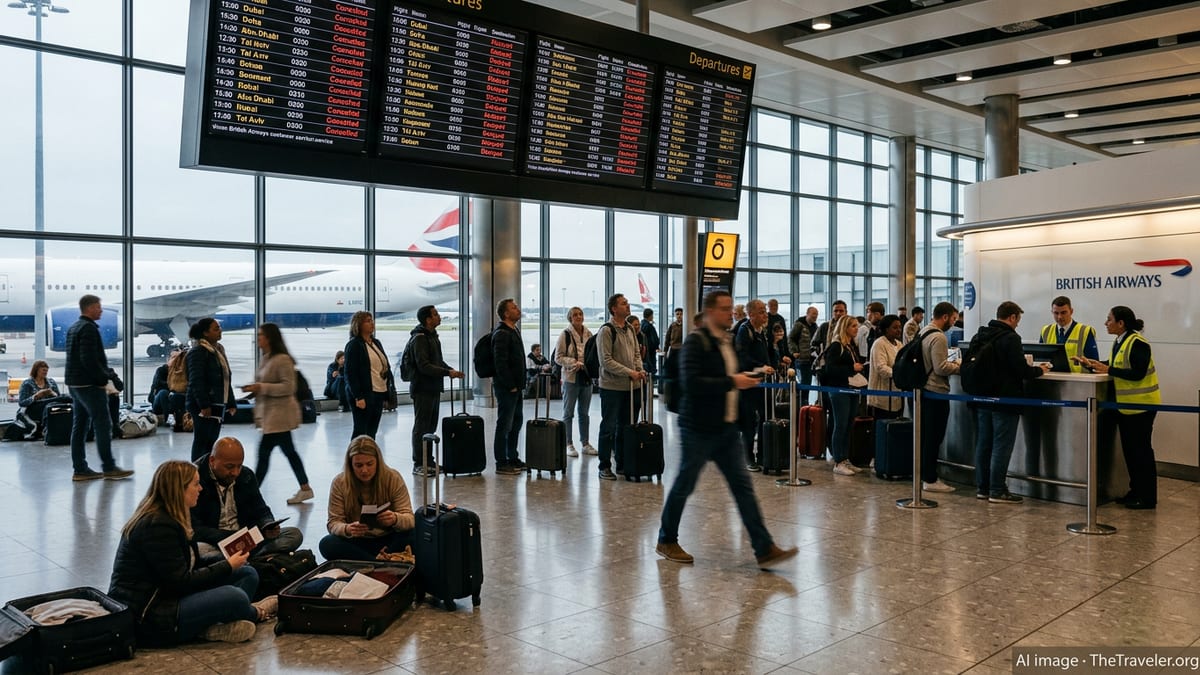
Escalating conflict shuts key Middle East air corridors
Air travel across the Middle East has been thrown into disarray after US and Israeli strikes on Iran on 28 February 2026 and subsequent Iranian retaliation prompted widespread airspace closures. Authorities in Iran, Iraq, Israel, Jordan, Lebanon, Bahrain, Kuwait, Qatar, the United Arab Emirates, Oman and Saudi Arabia have either fully or partially shut their skies to civilian traffic, according to aviation bulletins and flight-tracking data. The affected area covers some of the world’s most heavily used long haul corridors linking Europe with Asia, Africa and Australasia.
Industry estimates suggest thousands of flights have been cancelled or diverted since the weekend, with hubs such as Dubai, Abu Dhabi and Doha seeing large parts of their schedules scrubbed or suspended. Aviation analytics firms report cancellation rates in some Gulf states running far above normal levels as airlines scramble to keep aircraft and crews clear of potential military activity. Passengers are facing long queues, limited rebooking options and rapidly changing information at airports across Europe, South Asia and East Africa.
The European Union Aviation Safety Agency has issued a Conflict Zone Information Bulletin advising carriers not to operate at any altitude within the airspace of the eleven affected states because of the risk posed by missiles, air defence systems and electronic interference. Airlines that continue to serve the wider region are being forced into lengthy detours, using narrow corridors over the Caucasus or southern routes over Egypt and the Arabian Sea, adding two to five hours to some Europe Asia journeys.
Beyond the immediate cancellations, experts warn that prolonged closures are likely to push up fares and put pressure on alternative hubs such as Istanbul, Jeddah and Cairo, which are already absorbing diverted traffic. Travellers who booked itineraries relying on Gulf connections on carriers such as Emirates, Qatar Airways and Etihad are among the most exposed to disruption.
FCDO travel advice: where the UK is warning against travel
Against this backdrop, the FCDO has updated its travel advice across the region, moving several Gulf states to a higher warning level. Security consultancies tracking the changes say the UK now advises against all but essential travel to Kuwait, Bahrain, Qatar and the United Arab Emirates, reflecting both the direct security risk and the practical difficulties of entering or transiting through partially closed airspace.
In countries closer to the main fronts of the conflict, including Iran, Israel and Lebanon, the FCDO guidance is even more stringent. Existing warnings against all travel to certain border regions and conflict zones have been reinforced by new language about missile and drone strikes, potential attacks on critical infrastructure and a heightened risk of miscalculation between regional powers. Where local authorities have issued shelter in place orders, British nationals are being urged to follow them and to avoid travelling to airports until restrictions are lifted and flights are confirmed as operating.
The FCDO also stresses that its ability to provide consular support may be severely limited in areas affected by active hostilities or where commercial travel options have collapsed. With some embassies and consulates operating on reduced staffing or temporarily closed to the public, officials are telling UK nationals to register contact details, monitor official travel advice pages frequently and be prepared for limited notice if assisted departure flights become available.
For British travellers contemplating new bookings, the message is clear: avoid planning non essential trips to or through the Gulf and neighbouring hotspots for now. Those with existing tickets are advised to carefully consider whether their journey is strictly necessary in the coming weeks, given the uncertain security picture and the risk that airspace could reopen and close again at short notice.
What this means for UK flights and common routes
The airspace shutdowns have immediate implications for some of the UK’s most popular long haul routes. British Airways and other European carriers have suspended services to destinations such as Tel Aviv and parts of the Gulf, extending cancellations in recent days as the operational risk picture has worsened. Flights that would ordinarily overfly Iran, Iraq or the Gulf are now being rerouted either far to the north via the Caucasus and Central Asia, or to the south via Egypt and the Arabian Sea.
For passengers flying from the UK to South and Southeast Asia, the disruption is highly route dependent. Itineraries that previously connected through Dubai, Abu Dhabi or Doha face the greatest uncertainty, with some departures cancelled outright and others operating on ad hoc routings once small windows of airspace access open. By contrast, carriers that rely on Istanbul or European hubs are seeing less disruption, although flight times may still be extended as they adjust track to avoid conflict zones.
Even where flights continue to operate, schedules are volatile. Airlines are frequently retiming departures, swapping aircraft types and trimming frequencies to cope with longer routings, crew duty limits and the knock on effects of aircraft and crew being out of position. UK travellers are being urged to treat any itinerary touching the wider Middle East as provisional and to check their flight status repeatedly in the 24 hours before departure.
Travel agents report a surge in demand for routings that bypass the Gulf entirely, including connections via Istanbul, major European capitals or direct services to destinations in India and Southeast Asia. However, capacity on these alternatives is finite, and with tens of thousands of displaced passengers competing for seats, rebooking options may be limited or more expensive than usual.
Rights, refunds and practical steps for British travellers
For British passengers caught up in the disruption, consumer protections remain in place, but expectations need to be realistic. Under the UK’s air passenger rights rules, travellers whose flights are cancelled are entitled to a refund of the unused portion of their ticket, or to re routing at the earliest opportunity, depending on the airline’s policy and seat availability. However, because the shutdown is linked to armed conflict and official airspace closures, it is likely to be classified as an extraordinary circumstance, limiting eligibility for fixed cash compensation for delays.
Travel insurers are taking a similar line, with many policies excluding cover for known events or war related disruption once an incident is widely reported and government warnings are in place. That means travellers who took out comprehensive insurance before the latest escalation may still be protected for certain costs, while those buying policies now could find that Middle East disruption is excluded. The FCDO advises checking policy wording carefully and speaking directly to insurers before making expensive alternative arrangements.
On the ground, the most important step for UK travellers is to stay informed and to keep documentation. Officials and consumer advocates recommend using airline apps and airport information channels to track real time changes, and saving screenshots of cancellation notices or schedule changes that may be needed later when claiming refunds or insurance. Travellers should avoid travelling to airports in affected countries until they have firm confirmation that their flight is operating, to reduce exposure to security risks and overcrowded terminals.
For those stranded in transit hubs, local shelter guidance, not travel plans, should take priority. Where conditions allow, travellers are being advised to secure accommodation away from major strategic targets, keep passports and key documents ready, and maintain regular contact with family or friends in the UK. Registration with the nearest British embassy or consulate can help officials gauge demand for any future assisted departure options.
Planning ahead: alternative routings and a shifting map
Looking ahead to the spring and summer peak travel season, the crisis is likely to reshape how British travellers move between Europe, the Middle East and Asia. If airspace closures persist, more long haul traffic may be diverted through alternative hubs, strengthening the role of Istanbul, Cairo and some Indian and Southeast Asian airports as bridges between continents. That could mean longer journey times but also a broader mix of routing choices for UK passengers willing to be flexible.
Analysts caution that the situation remains fluid. The same conflict dynamics that prompted this week’s airspace shutdowns could change again with little warning, leading to partial reopenings, new closures or restrictions confined to certain flight levels. For airlines and travellers alike, agility and close monitoring of official advisories will be essential. The FCDO is expected to keep its guidance under constant review, updating warnings as the military and aviation risk picture evolves.
For now, British travellers are being encouraged to treat Middle East connections as inherently uncertain, to build in generous connection times when routing via alternative hubs, and to prioritise tickets that offer flexible changes or refunds. Those planning future trips to Asia or Australasia may find that paying slightly more for itineraries that avoid the Gulf brings greater reliability at a time when a crucial swathe of the global sky remains effectively off limits.
While the immediate focus is on safety and getting stranded passengers home, the longer term question is how often critical air corridors can be disrupted before airlines and travellers change their habits for good. The FCDO’s latest updates, and the decisions individual British travellers now make, will help determine whether the Gulf quickly regains its place at the heart of global aviation or whether traffic permanently shifts to new routes around an increasingly unpredictable region.