

More news on this day
The UK Foreign, Commonwealth and Development Office (FCDO) has updated its travel advice for Cyprus following a drone strike on a British military base and heightened security at the island’s airports as conflict escalates across the Middle East.
Heightened Regional Tension but No Ban on Travel
The latest FCDO advisory, updated in early March, stops short of advising against travel to Cyprus but underscores what officials describe as a heightened risk stemming from the widening Iran war and broader Middle East instability. The guidance emphasises that while Cyprus itself remains relatively calm, rapid changes in the regional security picture mean conditions could shift at short notice.
Cyprus is a key logistical hub for Western governments monitoring and supporting operations in the Middle East, positioned less than 300 miles from Israel and within easy reach of Lebanon and Syria. This strategic role has placed the island closer to the frontline of the current crisis than in previous rounds of regional unrest, even as its main resort areas continue to operate as normal.
FCDO officials are urging British nationals to sign up for travel advice email alerts, monitor local and international news, and keep departure plans under review. The advisory notes that demonstrations related to events in the Middle East are possible and that the potential for terrorism cannot be ruled out, although there is no specific, credible threat currently directed at tourists.
For now, the update leaves holidays and business travel to Cyprus broadly unaffected in terms of insurance and consumer protections, since the government has not introduced a formal warning against non-essential trips. However, the stronger wording on regional risk signals that the stance could harden if the conflict widens further.
RAF Akrotiri Drone Strike Sparks Security Reassessment
The advisory update follows a confirmed drone impact on 1 and 2 March at RAF Akrotiri, one of two British Sovereign Base Areas on the island and a critical launchpad for air operations over the Middle East. UK ministers said the initial strike targeted the runway, prompting what they described as precautionary measures to secure personnel and infrastructure.
Although there were no casualties and damage was quickly contained, the incident marked the first time Cyprus has been directly hit in the current conflict, shattering a longstanding perception that the island sat safely beyond the reach of regional missile and drone attacks. British defence officials have since reinforced anti-drone systems and air defences at the base.
The FCDO has incorporated the attack into its safety and security section for Cyprus, reminding visitors to avoid all military and security facilities, including areas around the Sovereign Base Areas. Travellers are advised not to stop near perimeter fences, take photographs of installations or attempt to access restricted roads that serve the bases.
Local authorities have also stepped up visible policing around sensitive sites, including ports, energy infrastructure and transport hubs. While these moves are framed as precautionary, they reflect concerns that further attempts to target British or Western assets in Cyprus cannot be entirely discounted.
Airport Evacuations and Flight Disruptions Hit Holidaymakers
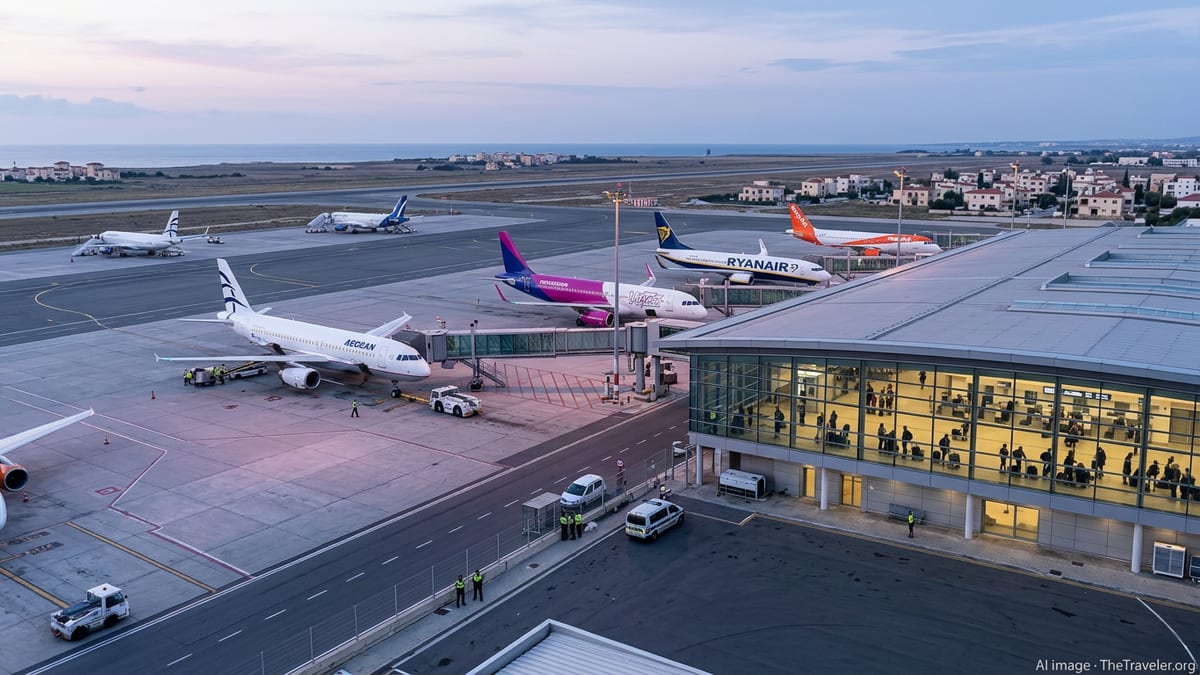
The ripple effects of the Middle East airspace closures and the Akrotiri strike have been most visible for passengers at Cyprus’s two main international gateways, Larnaca and Paphos. In recent days, Hermes Airports, the operator of both hubs, has reported dozens of cancellations and diversions as airlines re-route around conflict zones and adjust schedules.
Larnaca International Airport was temporarily evacuated earlier this week after the sighting of an unidentified object in Cypriot airspace, according to local reports. Operations were suspended for several hours while security teams conducted checks, before flights gradually resumed under tightened procedures. The episode came on top of widespread knock-on delays caused by the closure of Iranian and several Gulf states’ airspace.
British carriers including easyJet, British Airways and TUI have cancelled a number of flights between the UK and Cyprus over the past week. Affected departures have included services from London Gatwick and Heathrow, as well as some regional airports, forcing holidaymakers to rebook, reroute or in some cases abandon their trips.
Airlines are advising passengers to arrive earlier than usual for security screening and to check flight status repeatedly on the day of travel. Travel industry analysts warn that while Cypriot airspace itself remains open, disruption to onward connections to the Middle East and Asia is likely to continue as long as major regional hubs remain under strain.
What the Updated FCDO Guidance Means for Travellers
The refreshed FCDO text for Cyprus places new emphasis on crisis preparedness and personal security planning. Britons are urged to think in advance about how they would respond if the regional situation deteriorated, including keeping essential supplies, travel documents and emergency contact details readily accessible.
The advisory recommends following instructions from local authorities without delay, staying away from security or military facilities, and avoiding large gatherings or demonstrations that could quickly become volatile. Travellers are also encouraged to ensure mobile phones are charged, roaming is enabled, and key numbers are saved, including those for the nearest British consular services.
Importantly, the FCDO has not raised Cyprus to a “do not travel” or “all but essential travel” category. As a result, most package holidays, flights and hotel bookings remain subject to normal terms and conditions. Tourists who decide they no longer wish to travel due to security worries may find they are not automatically entitled to refunds or insurance payouts unless the advice changes further.
Consumer advocates say travellers should read their policies carefully and keep detailed records of any cancellations or disruptions. Those already on the island are advised to monitor their airline’s updates in case return flights are rescheduled or re-routed at short notice.
Balancing Popular Tourism With a Shifting Security Landscape
Cyprus, long marketed as a safe and sunny gateway to the Eastern Mediterranean, now finds itself navigating the delicate balance between reassuring visitors and acknowledging its proximity to an active war zone. Tourism remains a crucial pillar of the Cypriot economy, and local businesses are keen to stress that beaches, resorts and cultural sites are open and welcoming guests.
At the same time, the government in Nicosia is coordinating closely with British and European partners on airspace management, contingency planning and intelligence sharing. Officials insist that the country’s airports and critical infrastructure are operating with robust security measures and that the public should remain calm but vigilant.
Security experts note that Cyprus is far from alone in adapting its travel posture to the unfolding Iran war. Advisories from Australia and other EU states echo many of the same themes: elevated regional tension, potential for sudden airspace closures and a need for travellers to stay flexible and well informed.
For prospective visitors, the message from the latest FCDO update is nuanced rather than alarmist. Cyprus remains accessible and broadly safe for tourism, but the margin for complacency has narrowed. As the Middle East conflict continues to evolve, those heading to the island this spring and summer are being urged to treat official travel advice as a live document and to be prepared for plans to change with little warning.