

More news on this day
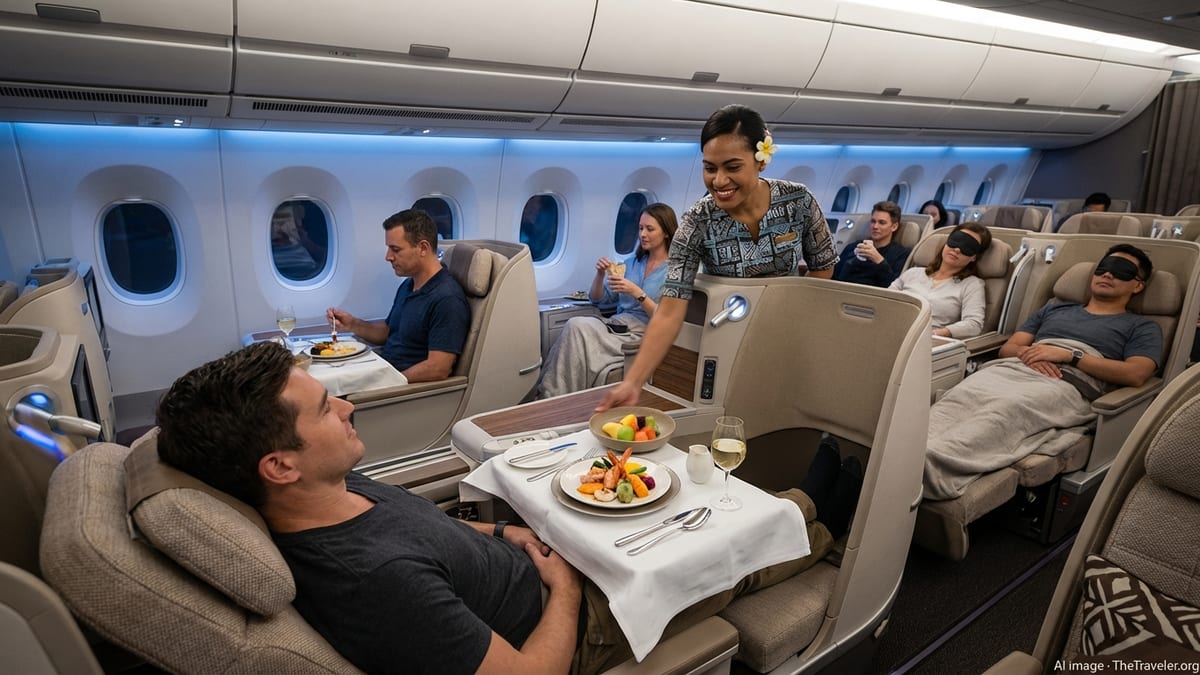
Fiji Airways is reshaping the in-flight dining experience for premium passengers, rolling out a true on-demand meal service in Business Class on flagship routes from Los Angeles, Vancouver, Singapore, New Zealand and other key gateways, giving travelers far more control over when and how they dine at 35,000 feet.
What Fiji Airways’ On-Demand Dining Actually Means
On-demand dining has become one of the most sought-after perks in premium cabins, and Fiji Airways is now firmly entering that space. Instead of rigid meal times, Business Class travelers can request dishes throughout much of the flight, choosing whether to eat shortly after takeoff, in the middle of the journey, or closer to landing. The move is designed to give passengers more control over their sleep, work and relaxation schedules on board.
According to the airline’s recent service updates, the on-demand concept is being paired with a refreshed Pacific Rim menu that places emphasis on restaurant-style plating and pacing rather than mass catering. While some structured elements remain, such as recommended service windows on overnight departures, the core promise is flexibility. For long-haul travelers used to a single, multi-course tray appearing at a set time, the change represents a significant step toward a more tailored experience.
Fiji Airways has framed the initiative as a response to evolving expectations among luxury travelers who increasingly compare in-flight experiences to boutique hotels rather than traditional airlines. Executives say guests want to dine when they are hungry, not when the cabin schedule dictates, and the airline is adjusting its onboard staffing and galley operations to reflect that shift.
Key Routes: From Los Angeles and Vancouver to Singapore and New Zealand
The new on-demand service is focused initially on long-haul and higher-yield regional routes where Business Class demand is strongest. This includes Fiji Airways’ growing North American network, with flights from Los Angeles and Vancouver to Nadi operating on widebody aircraft that already feature the carrier’s latest Business Class cabins. These routes are often overnight journeys where sleep timing is crucial, making flexible dining particularly valuable for travelers adjusting between North American and South Pacific time zones.
In the Asia-Pacific region, Singapore and major New Zealand cities such as Auckland and Wellington are also benefiting from the enhanced service model. These routes connect important corporate and leisure markets to Fiji and beyond, and they are key to the airline’s ambition to position itself as a competitive transit option between the Americas, Australasia and Southeast Asia. By standardizing the on-demand concept across these trunk routes, Fiji Airways aims to create a consistent premium experience regardless of origin.
The rollout is being phased, with different aircraft types and schedules coming online over several months. Industry reports indicate that by mid-2026, the on-demand dining framework will be embedded across Fiji Airways’ primary long-haul operations, subject to aircraft rotations and seasonal adjustments. Passengers booking in Business Class from the highlighted cities are increasingly likely to encounter the new service on flights to and from Nadi, though exact offerings may vary slightly by route and departure time.
Inside the New Pacific Rim Menu and Service Style
The dining upgrade is not just about when food is served, but what appears on the plate. Fiji Airways has introduced a Pacific Rim menu concept that blends flavors from Southeast Asia, Australia and the Pacific Islands, with a strong emphasis on Fijian ingredients. Dishes such as grilled mahi mahi with prawn chili oil, hamachi crudo with local sea grapes, and coconut-simmered Fijian chicken curry are among the highlights being showcased in Business Class.
The airline is also paying attention to presentation and finishing touches. Meals are being plated and finished in the galley rather than served fully preassembled, aiming to create a restaurant-style appearance despite the confines of an aircraft kitchen. Business Class tables are set with bone china, white linens and decorative elements inspired by Fijian crafts, underscoring the carrier’s effort to position dining as a centerpiece of its premium offering.
For drinks, the program leans into the airline’s South Pacific identity. Cold-pressed tropical juices and island-inspired cocktails join a wine list that draws on producers in New Zealand, Australia and California. Artisanal Fijian chocolate and other local treats appear alongside tea and coffee service, reinforcing the sense of place. Fiji Airways says special meals and dietary preferences continue to be available by request, although those need to be pre-ordered ahead of departure.
How the On-Demand System Works in Business Class
Operationally, Fiji Airways’ on-demand dining is built around a more flexible galley flow rather than a single, rigid service. Soon after boarding, Business Class travelers are typically presented with the full menu and can discuss their preferences with the cabin crew. Passengers may choose to have a substantial meal shortly after takeoff, delay service to maximize sleep, or opt for lighter dishes and snacks spread throughout the flight.
Once airborne, guests can request items by using the call button or speaking directly with flight attendants during their rounds. The kitchen operates in waves, balancing the need to accommodate individual requests with the constraints of oven space, food safety standards and crew workload. While this is not a full 24/7 restaurant-style model, Fiji Airways is targeting broad service windows during which main dishes and snacks can be prepared on demand, particularly on overnight segments between Los Angeles or Vancouver and Nadi.
Passengers should be aware that some time-sensitive items, such as elaborate desserts or hot breakfast components, may still be encouraged within specific windows to ensure quality and availability. Nonetheless, compared with traditional airline meal schedules that offer little flexibility, Fiji Airways’ system is designed to let travelers better align dining with their own body clocks and travel plans, whether they are connecting onward to New Zealand, Singapore or elsewhere in the network.
Aircraft, Cabins and Where You Will Experience It
The most complete version of Fiji Airways’ on-demand dining is tied closely to its flagship aircraft, particularly the Airbus A350 and A330 widebodies used on long-haul flights. These jets offer the space, galley capacity and crew complement needed to support a flexible service model without compromising safety or efficiency. On routes from Los Angeles and Vancouver, the Airbus A350 typically features lie-flat Business Class seats arranged in a modern configuration, providing the ideal setting for extended dining windows and rest.
On services linking Nadi with Singapore and New Zealand, a mix of A330 and Boeing 737 aircraft is in use, and the precise experience can vary slightly depending on the aircraft assigned to a particular flight. Widebody aircraft are generally better equipped for the full on-demand menu, while some narrowbody operations focus on a more compact yet still flexible offering tailored to shorter sectors. Fiji Airways has indicated that it is working to harmonize its soft product so that the dining expectations in Business Class remain broadly consistent, regardless of aircraft type.
For travelers, this means checking the aircraft scheduled for their flight can offer clues as to the extent of the on-demand service they are likely to receive. However, because airlines routinely adjust equipment for operational reasons, Fiji Airways is emphasizing a network-wide standard that prioritizes flexibility, even when aircraft substitutions occur close to departure.
Comparing Fiji Airways’ Approach With Global Competitors
The move toward on-demand dining places Fiji Airways in closer competition with established premium carriers in the long-haul market. Airlines in the Middle East and Asia have long used dine-anytime concepts to differentiate their Business and First Class products. By introducing its own version, Fiji Airways is signaling that it intends to be considered alongside those players, rather than simply as a leisure-focused airline to a beach destination.
Industry analysts note that Fiji Airways is leveraging a relatively small but growing long-haul network to deliver a boutique-style service, especially on routes from North America where passengers have alternative options through major hubs. The carrier’s emphasis on local cuisine, personal interaction with cabin crew and a less regimented service flow may appeal to travelers who value a more relaxed, resort-like atmosphere on board.
At the same time, expectations will be high. Previous reviews of Fiji Airways’ Business Class catering have been mixed, with some travelers praising service and comfort but criticizing the imagination and consistency of the food. The new menu and on-demand structure are intended to address those concerns, but the ultimate test will be whether execution remains reliable as the program expands across more flights.
What Economy Class Passengers Can Expect
While the headline changes focus on Business Class, Fiji Airways is also updating its Economy offering on long-haul flights from cities such as Los Angeles, Vancouver and Singapore. Economy passengers will not receive full restaurant-style on-demand dining, but they can expect refreshed menus, expanded beverage options and additional snacks that better reflect the airline’s South Pacific identity.
Updates include new mocktails and cocktails, hot chocolate service and a broader selection of meals that incorporate regional flavors within the constraints of high-density cabins. The airline is also highlighting improvements in special meals, including vegetarian and other dietary options that can be pre-arranged before departure. These adjustments acknowledge that overall satisfaction in Economy can be shaped significantly by food and beverage quality, particularly on overnight and ultra-long sectors.
For travelers connecting through Nadi from New Zealand or Southeast Asia to North America, the upgraded Economy service may make Fiji Airways a more attractive option, even without the full on-demand flexibility enjoyed in Business Class. The carrier is positioning the changes as part of a broader effort to raise its profile as a full-service airline rather than one catering solely to price-sensitive holidaymakers.
Tips for Travelers Booking Fiji Airways for On-Demand Dining
Passengers planning to take advantage of Fiji Airways’ new on-demand dining service should pay close attention to flight details when booking. Opting for long-haul sectors operated by Airbus A350 or A330 aircraft between Nadi and hubs such as Los Angeles, Vancouver, Singapore and major New Zealand cities will maximize the chances of experiencing the complete Business Class offering. Travel advisors suggest checking schedules close to departure, as aircraft assignments can shift.
Once on board, travelers looking to sleep early on overnight departures may want to request that their main meal be served promptly after takeoff or, in some cases, pre-select a lighter option that can be delivered quickly. Those preferring a more leisurely experience can space out courses or combine main dishes with snacks later in the flight. Communicating preferences clearly to cabin crew at the start of the journey can help them tailor the service to individual needs within the on-demand framework.
Finally, travelers with specific dietary requirements should continue to request special meals when booking, as many of these items must be loaded in advance and cannot be guaranteed on an impromptu basis. Fiji Airways’ new dining direction is built around flexibility and personalization, but it still operates within the practical limits of airline catering. Understanding those boundaries will allow passengers to make the most of the new system while enjoying the elevated flavors of the South Pacific en route.