

More news on this day
Fiji is rolling out one of the South Pacific’s most ambitious aviation and tourism overhauls, tying major airport upgrades to a push into remote island destinations as it seeks to cement its status as a regional hub and high‑value holiday playground.
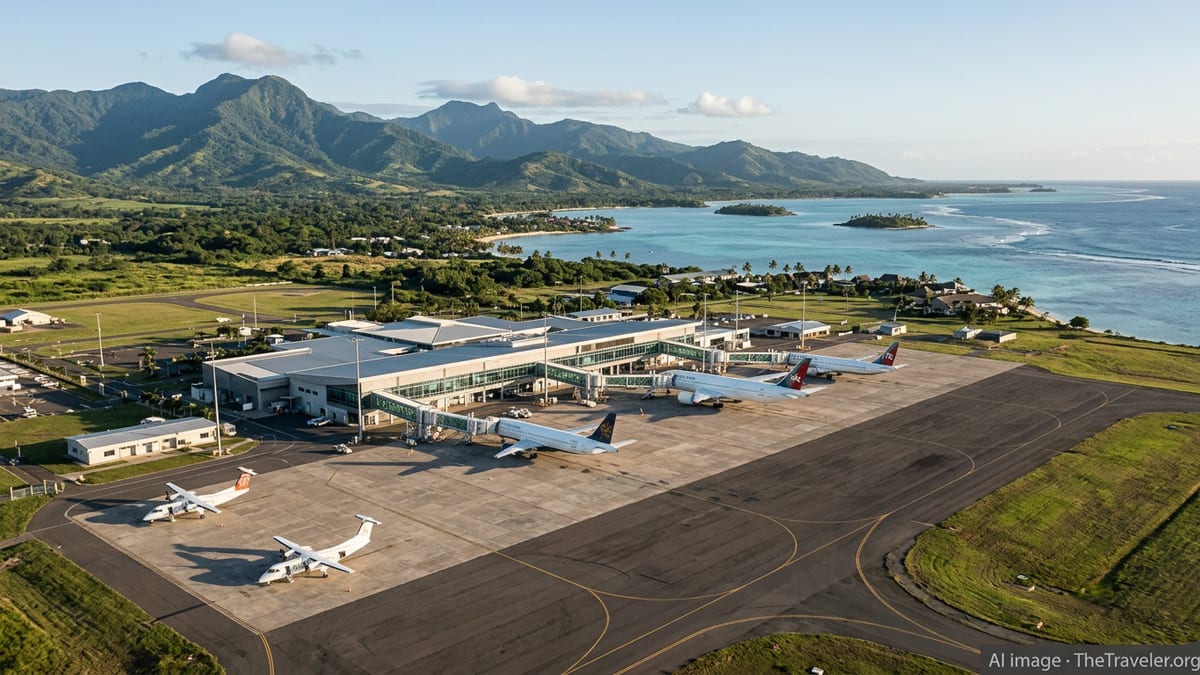
Nadi International Airport at the Heart of a Multi‑Billion Pivot
Nadi International Airport, Fiji’s primary gateway, sits at the center of the country’s aviation transformation. Fiji Airports has outlined a 2024–2033 master plan that would effectively rebuild much of the airport to handle long-term growth in visitors and aircraft movements. The operator has told local media and lawmakers it is seeking up to 2.3 billion Fijian dollars in financing to modernize ageing facilities, expand capacity and keep pace with rising regional competition.
Early work is already visible on the tarmac. A 10.4 million dollar contract with Australian engineering firm RATE is delivering six new passenger boarding aerobridges, replacing decades‑old equipment and allowing more efficient handling of wide‑body aircraft such as the Airbus A350. The first of these new bridges entered service in late 2025, part of a broader refresh that includes upgraded aprons, improved air traffic systems and expanded car parking to smooth peak‑hour flows.
Fiji’s government has linked the Nadi overhaul directly to its 10‑year National Development Plan, arguing that a fit‑for‑purpose hub is essential if the country is to keep attracting long‑haul carriers from North America, Asia and Europe. Officials say future phases will shift and add boarding gates, introduce biometric check‑in systems and install new baggage screening technology, with works staggered through the second half of the decade to limit disruption to current services.
Behind the airside engineering is a quieter effort to strengthen project governance. Fiji Airports has brought in international advisors to stress‑test financial models and funding strategies, hoping to reassure lenders that the long pipeline of capital works can be delivered on time and within budget. The operator has signaled that climate resilience and energy efficiency will be key design criteria, as Fiji positions Nadi as a modern, sustainable hub for the wider Pacific.
Secondary Airports and Outer Islands Get Long‑Awaited Attention
While Nadi dominates headlines, some of the most consequential changes for travelers and communities are unfolding at smaller airports scattered across Fiji’s archipelago. Under a program known as Na Vualiku, authorities have begun upgrades at Labasa and Savusavu in the north, with new terminal concepts and safety works designed to open the door to more reliable domestic services and, potentially, larger regional aircraft.
Parliamentary briefings in 2025 detailed plans for runway, lighting and terminal improvements that would allow these northern gateways to better serve both residents and international visitors bound for Vanua Levu’s dive sites and rainforest lodges. A feasibility study for an entirely new airport on the island is also under way, reflecting government confidence that tourism demand will stretch beyond traditional hubs in the west and central regions.
International backing has underpinned parts of this shift. The Australian Infrastructure Financing Facility for the Pacific has supported maintenance and capital works not only at Nadi but also at several outer‑island airports, with projects scheduled to run through at least 2027. These investments focus on basics that matter to pilots and passengers alike, from resilient pavements and safer navigation aids to power and communications systems able to withstand stronger storms.
For remote communities, the changes are about more than convenience. More frequent, reliable flights can shorten medical evacuations, stabilize freight links and provide new channels for local businesses to tap tourism dollars. For visitors, they unlock shorter transfer times and smoother connections between Fiji’s main entry points and its more secluded beaches and reefs.
Remote Tourism as Fiji’s Next Competitive Edge
The airport revamp dovetails with a deliberate strategy to push tourism deeper into Fiji’s outer islands, spreading economic benefits and differentiating the country in an increasingly crowded Pacific market. Tourism officials have signaled that future growth will rely less on adding beds in established resort corridors and more on carefully managed expansion in remote areas, supported by upgraded airstrips and small‑scale aviation services.
Resort developers and community‑based operators are watching closely as plans for better air access to islands in the Yasawa, Lau and Lomaiviti groups gather momentum. Although many of these destinations are currently served by a mix of small planes, helicopters and boats, more capable airfields and safety improvements could lengthen the viable tourist season and make travel options less weather‑dependent.
Industry leaders argue that Fiji’s advantage lies in pairing improved access with strict sustainability standards. Government policy documents emphasize low‑density developments, renewable energy and protection of marine ecosystems as conditions for new tourism projects, especially in outer islands where traditional landownership and village governance play a central role. The expectation is that stronger aviation links will bring in higher‑spending visitors, not mass tourism, helping to fund conservation and cultural programs.
For travelers, the result is likely to be a broader palette of experiences, from surf breaks and shark dives far from the main tourist strips to cultural stays in villages that have historically been several flight segments and a long boat ride away. Shorter legs in small aircraft, connected more seamlessly to long‑haul arrivals at Nadi or Nausori, could make once‑distant corners of Fiji feel within reach for a typical two‑week holiday.
Regional Connections and the Race to Be a Pacific Hub
Fiji’s aviation push is unfolding as airports across Asia and the Pacific race to add capacity and capture new routes. From Singapore’s multibillion‑dollar Terminal 5 project to expansion plans at major gateways in Australia and Southeast Asia, the regional benchmark for passenger experience and operational efficiency is rising quickly. Fijian officials are candid that standing still would risk losing traffic to better equipped hubs.
New and expanded services are already testing that proposition. Partnerships between Fiji Airways and carriers in Australia and North America have created additional one‑stop options linking the United States to Queensland via Nadi, supporting visitor flows in both directions. Fiji’s location roughly midway between the Americas and Australasia makes it a natural refueling and transfer point, but only if its flagship airport can match the reliability and comfort of larger competitors.
The strategy is not only about long‑haul flights. Improved runways, aprons and navigation systems at domestic fields give Fiji Airways and smaller operators more flexibility to schedule inter‑island services that bank smoothly with international arrivals. This sort of finely tuned connectivity is standard in larger markets but has been harder to achieve in the scattered geographies of the Pacific.
By bundling hub‑style upgrades at Nadi with targeted investments in secondary and outer‑island airports, Fiji is betting it can offer something distinctive: a modern, efficient entry point leading directly into some of the most remote and pristine tourism experiences in the region. How quickly funding is locked in and works are delivered over the next few years will determine whether that bet pays off.
Balancing Growth, Climate Risk and Community Priorities
Fiji’s aviation build‑out is taking place on the front lines of climate change, forcing planners to balance the demands of growth with the realities of rising seas and more intense storms. Government action plans filed with international aviation bodies highlight measures such as more efficient flight planning, modern air traffic procedures and upgraded ground infrastructure aimed at cutting emissions and improving resilience.
At the same time, communities near airports and along new tourism frontiers are pressing to ensure that benefits outweigh disruptions. Village leaders and landowners are involved in negotiations over airstrip extensions, noise impacts and the use of customary land for resort developments. The government has framed community consultation as central to the success of both aviation investments and remote tourism, a message likely to be tested as construction ramps up.
Environmental advocates are also watching closely. While air connectivity is essential for an island nation, they argue that growth must be accompanied by stronger protections for coral reefs, mangroves and coastal settlements that are both drawcards for visitors and buffers against storms. Fiji’s insistence on low‑rise, low‑density projects in many outer islands reflects a recognition that its natural assets are finite.
For now, the trajectory is clear: more capacity at Nadi, better links to secondary and remote airports, and a tourism offering that pushes beyond established resort belts. If executed well, Fiji’s aviation and tourism reset could provide a template for other Pacific nations seeking to harness the benefits of global air travel while safeguarding the fragile environments and cultures that make the region unique.