

More news on this day
Fiji is entering 2026 with record visitor numbers but a changing mood, as increasingly price-conscious travellers from Australia, New Zealand and North America reassess the cost of a Fijian getaway and look for more authentic, lower-impact escapes across the Pacific islands.
Get the latest news straight to your inbox!
Record Arrivals Meet Mounting Cost Concerns
Recent data indicates that Fiji closed 2025 with around 986,000 international arrivals by air, edging past its 2024 result and cementing tourism as the country’s dominant foreign-exchange earner. Visitor numbers in key months such as July reached historic highs, supported by strong demand from Australia, New Zealand and the United States.
Beneath the headline figures, however, momentum has begun to diverge by source market. Central bank and regional tourism updates show that overall arrivals in 2025 grew only marginally, with small year-on-year declines recorded from Australia and New Zealand, even as arrivals from the United States and Europe rose. Analysts describe this pattern as an early signal that traditional short-haul holidaymakers are reassessing value, while higher-spend long-haul visitors remain prepared to pay a premium.
Industry market reports suggest that accommodation costs are a key friction point. Benchmarking for resort-heavy destinations in Fiji highlights room rates that have climbed well above pre-pandemic levels, particularly in the four and five star segments clustered around Nadi, Denarau and the Coral Coast. Travel commentary across the region increasingly links softening demand from some families and groups to the combined effect of higher airfares, elevated nightly rates and surcharges such as card fees.
Local tourism bodies note that air-access capacity has largely recovered, but competition has intensified from other warm-weather destinations marketing sharply priced packages. Fiji’s reliance on a small number of core markets, especially Australia, leaves it vulnerable when those travellers decide that their money stretches further elsewhere.
From All-Inclusive Luxury To Village Stays And Nature Retreats
As budgets come under pressure, spending patterns within Fiji are also changing. Published commentary from hotel and tourism associations in late 2025 describes a clear tilt away from all-inclusive luxury stays toward smaller, more flexible products. Travellers are reportedly swapping week-long resort packages for shorter stays on Denarau combined with nights in guesthouses, eco-lodges or community-run bungalows in the islands.
Regional development reports tracking tourism investment in Fiji point to growing interest in experiences that centre on village life, traditional food and handicrafts, and outdoor activities such as hiking, diving and surfing. These offerings are typically priced below the big-brand resorts and appeal to visitors who prefer to allocate more of their budget to local tours and dining rather than premium room categories and imported amenities.
Market research from across the Pacific finds that younger travellers in particular associate value not only with price but with authenticity and connection. This cohort is more likely to book locally owned stays, use public or shared transport where available, and seek out lesser-known islands instead of the main resort corridors. Fiji’s outer islands, long overshadowed by flagship properties on Viti Levu, are beginning to benefit from this shift as travellers seek coral reefs, waterfalls and uncrowded beaches far from large-scale developments.
The trend aligns with broader experiential tourism patterns observed in other island destinations, where visitors increasingly select trips based on cultural depth and nature access instead of star ratings alone. For Fiji, the challenge is to support this move down-market and outward into rural areas without diluting standards, safety or environmental protections.
Pacific Neighbours Compete With Authentic, Low-Cost Alternatives
The changing profile of Fiji-bound travellers is playing out against a wider regional rebalancing. Tourism statistics from places such as Samoa, the Cook Islands and the Solomon Islands show steady if smaller-scale growth, as these destinations position themselves as less commercialised alternatives that offer direct community contact and relatively modest prices.
New Zealand travel data for 2025 indicates rising outbound flows to a spread of Pacific islands, with record numbers reported for some smaller destinations. Industry observers view this as evidence that value-focused travellers are shopping across the region, comparing total trip costs, inclusions and the perceived authenticity of experiences before committing to Fiji’s traditionally higher-priced package holidays.
Marketing campaigns from several Pacific tourism boards now feature themes of “unspoiled” nature, “untouched” reefs and village-based tourism, directly targeting visitors who may once have defaulted to Fiji. While Fiji still enjoys significant brand recognition and air connectivity, competing islands are leveraging their lower cost structures and smaller scale to appeal to backpackers, adventure travellers and families looking to avoid the resort premium.
Economic briefings from commercial banks and regional development agencies warn that if Fiji does not continue to diversify its tourism offer and control price inflation, a greater share of the high-growth, experience-driven market could migrate to neighbouring countries. That risk is amplified at times of currency weakness or slowing wage growth in Australia and New Zealand, when even loyal repeat visitors start to seek cheaper options.
Climate Pressures Push Demand Toward Lower-Impact Experiences
Climate vulnerability is another factor shaping Fiji’s tourism trajectory. International coverage has highlighted the country’s exposure to severe cyclones, coastal erosion and sea level rise, with tourism infrastructure and coastal communities often overlapping in high-risk zones. These realities are increasingly visible to visitors, who now commonly encounter flood mitigation works, relocated villages and coral restoration projects during their stays.
In response, Fiji has promoted itself as a champion of sustainable tourism, with policy frameworks encouraging renewable energy use, waste reduction and nature-based experiences that generate income for local communities. Eco-certification schemes and conservation levies have become more prominent, especially in marine tourism hubs where diving, snorkelling and surfing are central draws.
Consumer research across the Pacific suggests that environmentally aware travellers are not necessarily willing to pay unlimited premiums for green credentials, but they do favour operators that demonstrate genuine engagement with conservation and local livelihoods. This has encouraged a wave of smaller-scale ventures such as reef-safe dive operations, village-run hiking trails and agro-tourism visits that showcase traditional farming and food.
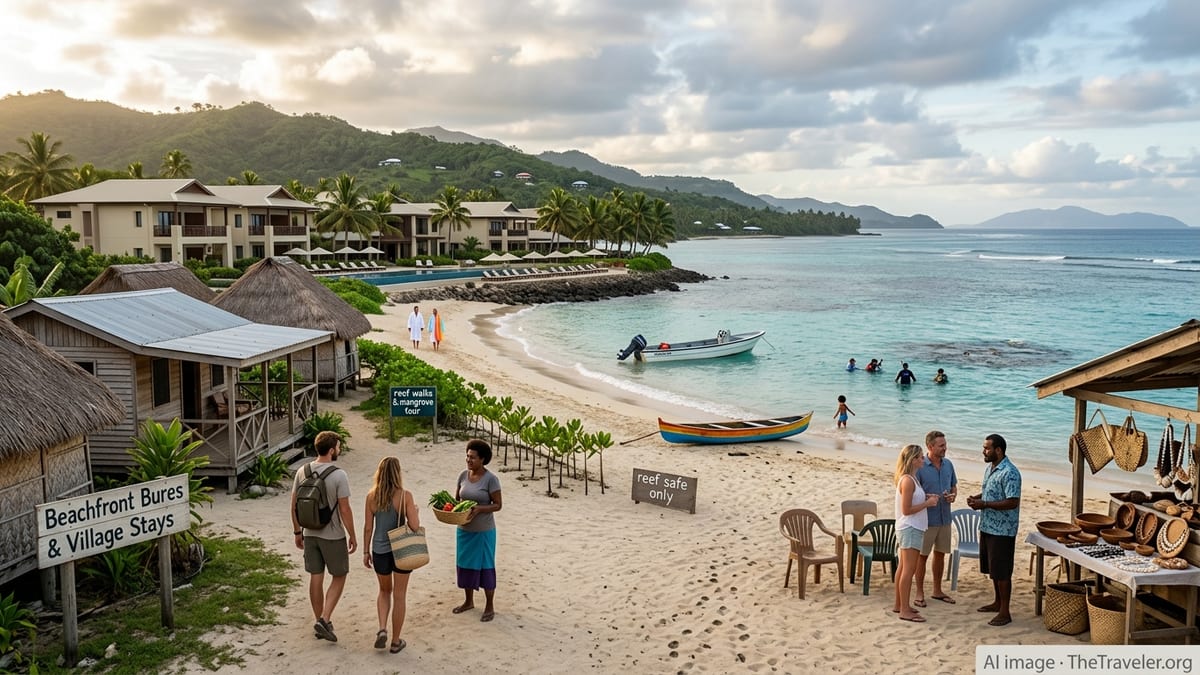
For Fiji, integrating climate resilience with value-conscious tourism offers a potential competitive edge. Packages that bundle simple beachfront bure accommodation with guided reef walks, cultural nights and volunteer programmes can be priced below luxury alternatives while aligning with visitors’ ethical expectations.
Policy And Industry Responses Aim To Rebalance The Market
Industry commentary through 2025 indicates that policymakers and private operators are beginning to adjust to these new dynamics. Tourism strategies emphasise dispersing visitors beyond the main corridors, encouraging investment in mid-range and budget accommodation, and supporting small and medium enterprises that deliver cultural and nature-based experiences.
Hoteliers and inbound operators are also experimenting with more flexible pricing, including dynamic offers for shoulder seasons, bundled air and land packages, and promotions targeting regional travellers who can travel at shorter notice. Some large resorts are partnering with nearby villages to offer half-day cultural visits or handicraft markets, attempting to bridge the gap between high-end facilities and the authentic experiences visitors increasingly request.
Economic forecasts for 2026 suggest that overall visitor numbers to Fiji are likely to remain robust, but revenue growth may slow unless the industry can capture higher volume in mid-market segments and maintain appeal for long-haul travellers who still favour full-service resorts. The balance between maximising yield and preserving Fiji’s image as an accessible, welcoming destination will be central to these efforts.
Across the Pacific, Fiji’s evolving tourism story is viewed as a bellwether. As price-sensitive travellers push back against the paradise premium and seek out cultural immersion and untouched nature, the country’s success in adapting could influence how island destinations throughout the region design and market their own post-pandemic tourism futures.