

More news on this day
Fiji is riding a wave of record airline traffic and expanding international routes, with aviation and tourism leaders forecasting that current momentum could crest into a historic tourism boom by 2026.
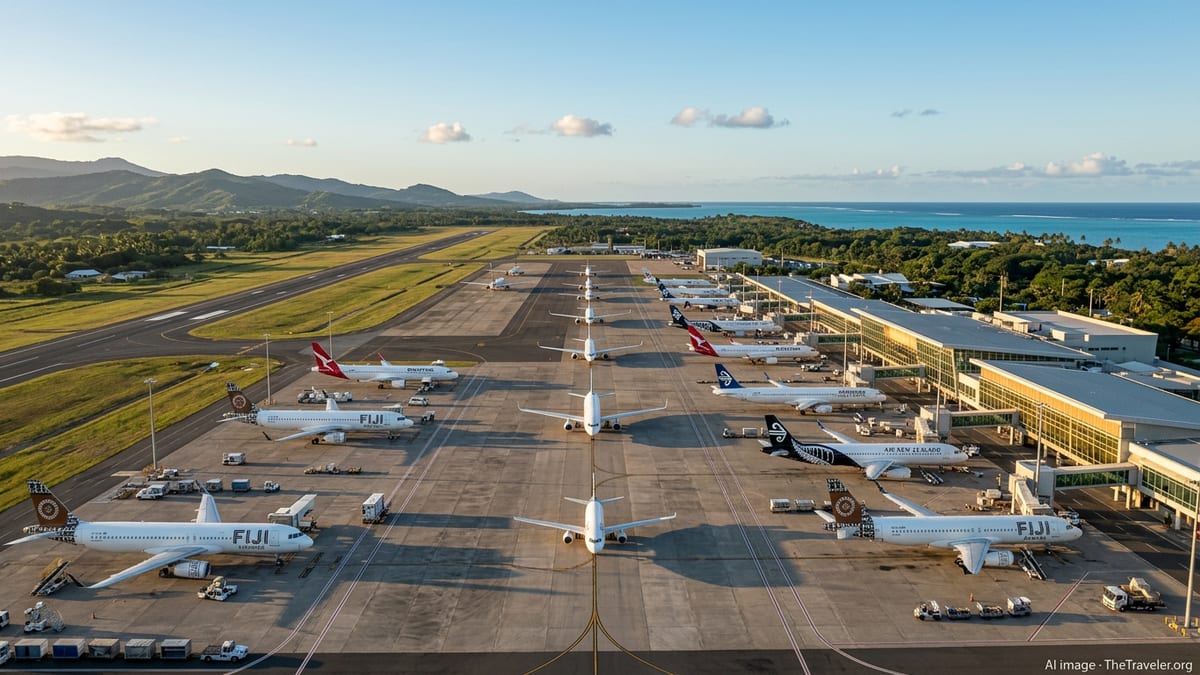
Record Passenger Numbers Lift Fiji’s Tourism Outlook
Fiji’s visitor economy has moved decisively beyond recovery and into expansion, with official figures showing back-to-back annual records for tourist arrivals. Provisional data from the Fiji Bureau of Statistics and recent economic briefings indicate that Fiji welcomed around 986,000 visitors in 2025, edging past a previous record set in 2024 and reinforcing tourism’s position as the country’s leading growth engine.
The latest tourism and economic assessments note that the strong 2025 result follows a landmark 2024, when Fiji crossed the one million mark for total visitors by air and sea for the first time. That year saw close to 983,000 tourists arriving by air and more than 80,000 by cruise ship, a performance that prompted the Reserve Bank of Fiji and regional analysts to upgrade growth forecasts and emphasise tourism’s spillover benefits across transport, retail and services.
This demand is being felt at Nadi International Airport, the country’s primary gateway. Airports Fiji has reported that the hub handled approximately 2.9 million passengers in 2024, with long term projections suggesting throughput could almost double to around 5.7 million annually by 2033. Industry observers say the capacity outlook, combined with continued growth in visitor arrivals, underpins expectations that Fiji is on track for another round of record-breaking tourism numbers heading into 2026.
New Long Haul Routes Drive Airline Traffic Surge
At the heart of the aviation upswing is a deliberate push to broaden Fiji’s international reach. Fiji Airways has added and expanded long haul services that link Nadi more directly with key tourism and trade partners, notably in North America. A flagship development was the launch of non-stop flights between Nadi and Dallas–Fort Worth in late 2024, creating a powerful new one-stop option into Fiji for travellers from the central and eastern United States and parts of Europe.
The Dallas route joins existing Fiji Airways services to markets such as Los Angeles, San Francisco and Vancouver, giving the airline a broader North American footprint than before the pandemic. Australian and New Zealand connectivity has also deepened, with strong frequencies from Sydney, Melbourne, Brisbane and Auckland feeding holidaymakers into Nadi and on to Fiji’s resort islands. Aviation filings and competition documents describe the Dallas launch as a pivotal step in lifting overall capacity and diversifying visitor flows beyond Fiji’s traditional core markets.
Airport and tourism officials say these new and expanded routes are already visible in traffic numbers. Sydney Airport, for example, has reported Nadi among its top international city pairs by passenger volume, reflecting heavy utilisation of trans-Tasman and South Pacific services. At Adelaide Airport, Nadi ranked among the fastest growing overseas destinations by percentage growth in 2025, highlighting Fiji’s rising profile in secondary Australian markets as well as major gateways.
Source Markets Broaden Beyond the Australia–New Zealand Core
Australia and New Zealand remain the pillars of Fiji’s tourism base, accounting for close to 70 per cent of total visitor arrivals in 2024 and 2025. Australian arrivals alone were estimated at around 450,000 in 2024, with New Zealand providing more than 200,000 visitors. Analysts say sustained growth from these short haul markets has provided the critical mass of demand that allows airlines to deploy larger aircraft and higher frequencies into Nadi.
The picture is changing, however, as longer haul markets accelerate. Data from mid-2025 show robust year-on-year growth from the United States, Canada, the United Kingdom and continental Europe, with North American arrivals in particular hitting record monthly highs during the June and July peak season. Tourism Fiji and regional travel trade publications have highlighted a seven per cent rise in American visitors in July 2025 compared with a year earlier, helped by the expanded route network and strong marketing campaigns positioning Fiji as a premium yet relaxed South Pacific escape.
The mix of visitors is also evolving by purpose of travel. While holidays still dominate, accounting for roughly four out of five arrivals, there are signs of increasing numbers of travellers visiting friends and relatives, particularly from Australia, New Zealand and Pacific diaspora communities. Business and conference travel, though a smaller share, is gaining traction as improved connectivity and upgraded facilities at Nadi and major resorts make Fiji more attractive for regional meetings and corporate incentive trips.
Nadi Airport Investments Prepare for the Next Tourism Wave
To sustain the current surge and accommodate anticipated growth into the 2030s, Fiji’s aviation infrastructure is undergoing a series of upgrades. Airports Fiji has been implementing terminal improvements and baggage system enhancements at Nadi, including a recent baggage handling upgrade designed to speed throughput and reduce congestion during peak arrival banks. The operator’s long term forecasts envisage passenger volumes almost doubling over the next decade, a scenario that has spurred planning for expanded terminal capacity and airside efficiency.
Industry reports describe Nadi as a rising hub in the South Pacific, with international passenger movements surpassing 2.6 million in 2023 and rising further in 2024 as airlines restored and expanded networks. Aviation analysts say the airport’s geography, sitting roughly midway between Australia and North America, places it well to capture connecting traffic alongside strong point-to-point flows. The combination of modernised facilities and an increasingly global route map is expected to be central to Fiji’s efforts to lift higher yielding long haul arrivals in the years ahead.
Domestic connectivity is part of the equation. Feeder services from Nadi to islands such as Vanua Levu and the Mamanuca and Yasawa groups allow visitors to disperse quickly across Fiji’s 333 islands, easing pressure on the main gateway while extending tourism’s economic benefits to outer island communities. Policymakers argue that this geographic spread will be crucial in managing visitor growth if Fiji is to lift arrivals significantly beyond current records without eroding the relaxed, uncrowded experience that is central to the country’s appeal.
Record Months Set the Stage for a 2026 High Point
Recent monthly data underscore just how strong the trajectory has become. July 2025 set an all time monthly record for Fiji, with around 99,300 visitor arrivals, while August 2025 came close behind, marking the first time the country has seen back-to-back months approaching or exceeding the 100,000 mark. Economic briefings from the Reserve Bank of Fiji and regional banks note that 2025’s full year visitor total of just under 1 million was up on 2024’s record performance, even as global economic conditions and airline cost pressures remained challenging.
Banks and multilaterals now project that overall visitor numbers could climb further in 2026 if new air capacity beds in as planned and demand from North America continues to firm. Westpac’s latest Pacific economic update, for example, highlights tourism as the primary driver of Fiji’s medium term growth outlook, noting that arrivals in 2025 slightly outpaced earlier forecasts and that the country is broadly back on its pre-pandemic growth path for tourism.
Tourism officials are cautious about declaring 2026 a guaranteed record breaker, pointing to risks ranging from global economic uncertainty to fuel prices and climate related disruptions. Even so, industry sentiment is positive. With airline traffic trending higher, new long haul routes opening crucial gateways and Nadi’s infrastructure being upgraded to handle greater volumes, Fiji enters 2026 with a rare alignment of factors that many in the sector believe could deliver its biggest tourism year yet.