

More news on this day
Commercial jets are tentatively returning to Middle Eastern skies this week after days of mass cancellations and airspace closures triggered by the escalating conflict between the United States, Israel and Iran, offering stranded travelers the first concrete signs that the region’s paralyzed aviation network may slowly be creaking back to life.
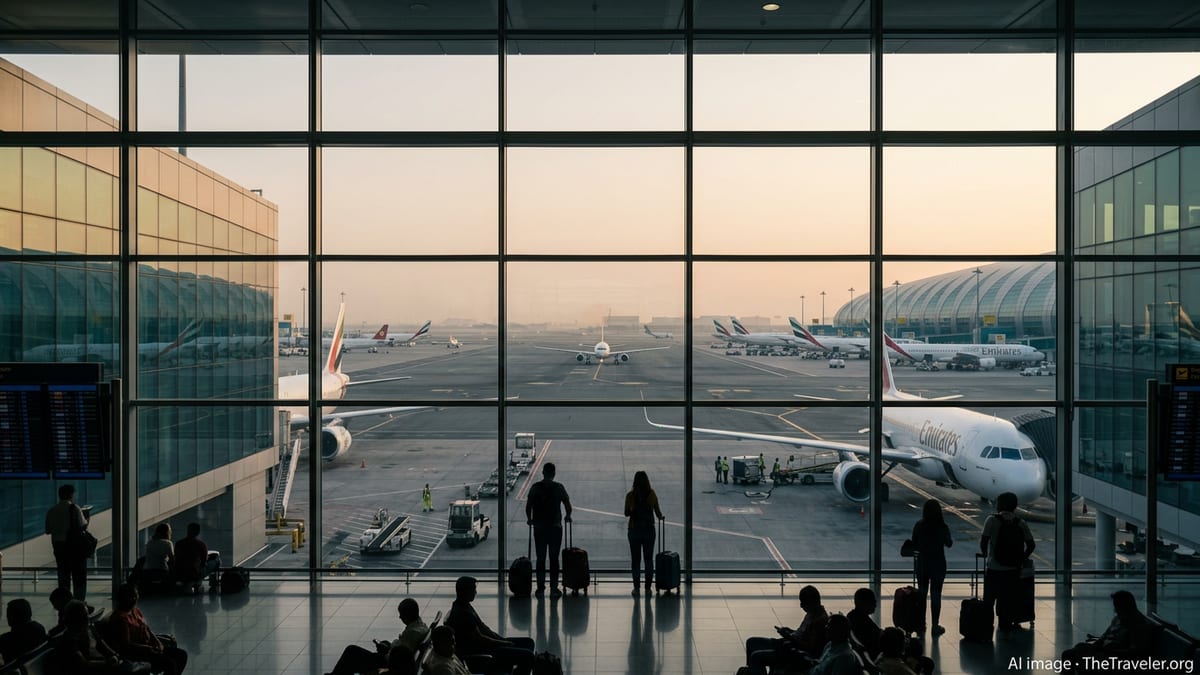
From Shutdown to Slow Restart at Gulf Mega Hubs
The first glimmers of recovery emerged late Monday and into Tuesday as Dubai International Airport and Abu Dhabi International Airport began operating a reduced schedule after near total shutdowns that started on February 28. Aviation data firms estimate more than 9,500 flights were cancelled across key regional hubs in the first four days alone, with total disruptions now exceeding 10,000 services as ripples spread across Asia, Europe and beyond.
Airport operators in the United Arab Emirates have framed the restart as a tightly controlled effort to restore essential connectivity rather than a full reopening. Dubai has permitted a limited number of Emirates and flydubai departures to cities including Mumbai, Chennai, Moscow, Warsaw and Belgrade, while prioritising aircraft and crews already positioned in the emirate for outbound journeys.
In Abu Dhabi, Etihad Airways has operated a small handful of flights, including repatriation services and at least one long haul to the United Kingdom, according to travel industry reports. However, the carrier’s main schedule remains suspended, with operations restricted to repositioning, cargo and specially approved passenger flights in coordination with UAE authorities.
Qatar, by contrast, remains effectively offline as a hub. Hamad International Airport in Doha is still largely shut to regular passenger traffic while Qatari airspace stays closed following Iranian missile and drone strikes that directly targeted aviation infrastructure. Qatar Airways has kept its fleet grounded on most routes through the region, highlighting the uneven and fragile nature of the broader recovery.
Passengers Stranded, Then Scrambling for Scarce Seats
For passengers, the gradual reopening has produced a confusing mix of relief and renewed uncertainty. In Dubai and Abu Dhabi, tens of thousands of travelers who spent days sleeping on terminal floors or in hastily arranged hotel rooms are now vying for scarce seats on outbound flights as airlines work through long rebooking backlogs.
Indian routes have become a particular flashpoint. Emirates resumed limited services to and from major Indian cities this week, but several Dubai bound flights from Delhi, Chennai and Bengaluru were forced to turn back shortly after take off as airspace restrictions shifted again, leaving passengers facing a second round of disruption after believing they were finally on their way home.
Indian low cost carrier IndiGo and other regional airlines have announced special relief services, including evacuation style flights from Jeddah and other Gulf gateways, subject to last minute regulatory clearances and the volatile security picture. Governments from Europe, Asia and Australia have also dispatched consular teams to Gulf airports and, in some cases, chartered aircraft to extract stranded nationals where commercial options remain unreliable.
Travel agents describe a chaotic booking environment in which schedules change hourly and available seats are snapped up within minutes. Fares on some Europe Gulf and Asia Gulf routes have spiked well above pre crisis levels as pent up demand collides with heavily constrained capacity and long detours around closed airspace.
Airlines Balance Safety, Politics and Mounting Costs
The phased resumption reflects the difficult calculus facing carriers that rely on Gulf hubs for global connectivity. Airlines must weigh pressure from governments and passengers to restore flights against dynamic risk assessments of missile and drone activity, as well as the readiness of air defense systems and the integrity of radar and navigation infrastructure.
Executives at major Middle Eastern carriers have repeatedly stressed that safety remains the overriding concern, noting that civilian aircraft are particularly vulnerable when military assets are active in shared air corridors. Industry analysts say the extensive closures echo protocols seen in previous conflicts, where the default response has been to divert or ground traffic at the first sign of credible threat to aircraft at cruising altitudes or during the critical phases of take off and landing.
At the same time, the financial toll of the shutdown is rapidly mounting. The loss of thousands of high yield long haul segments through Dubai, Abu Dhabi and Doha is eating into revenue at a time when airlines were counting on strong spring and early summer bookings. Extra fuel costs from circuitous routings that bypass swathes of the Middle East, Iran and parts of Iraq and the Gulf are adding further pressure to operating margins.
Airport operators are also facing a logistical and financial hangover. Vast numbers of aircraft and crews are out of position, ground handling operations are stretched and compensation, meal and accommodation bills for stranded passengers have surged. Even with limited flying resuming, insiders expect it will take days, if not weeks, to restore normal patterns of aircraft rotations and crew scheduling.
Global Flight Paths Redrawn as Conflict Reverberates
The shock to Middle Eastern aviation has cascaded across global networks, forcing airlines far beyond the region to redraw flight paths and in some cases suspend services altogether. Carriers in Europe and Asia have rerouted flights that typically transit Gulf airspace, lengthening sectors to destinations in India, Southeast Asia and Africa and compressing already tight turnaround times at crowded airports.
Major European and Asian airlines have temporarily suspended some routes to the Gulf and Israel, while others are operating only daylight services or limiting overflights of contested areas. Flight trackers show long haul jets arcing north over Turkey and the Caucasus or south over the Arabian Sea to avoid conflict hot spots, adding up to an hour or more to some journeys.
Industry groups warn that if hostilities expand or airspace closures persist, capacity between Europe and Asia could be significantly constrained in the months ahead, echoing some of the structural shocks seen after Russia’s invasion of Ukraine curtailed access to Siberian air corridors. That scenario would have knock on effects for cargo operations as well as passenger travel, potentially raising shipping costs for time sensitive goods that typically move through Gulf hubs.
For now, however, most carriers are treating the disruptions as acute rather than permanent. Schedules are being adjusted in rolling blocks of days rather than weeks, and many airlines continue to sell tickets for later in March and April in the hope that risk levels will ease enough to restore at least a skeleton version of their pre crisis networks.
Uncertain Outlook for Spring Travel
The timing of the crisis could hardly be worse for the travel industry. The disruption has arrived just as airlines and tour operators were finalising schedules and packages for Easter and early summer, crucial periods for leisure demand from Europe and Asia into the Middle East and onward to Indian Ocean and Southeast Asian destinations.
Travel companies report a surge in inquiries from holidaymakers asking whether to cancel or reroute upcoming trips involving transits through Gulf hubs. Some are shifting bookings to itineraries that avoid the region altogether, while others are pursuing a wait and see approach in the hope that conflict de escalations or more stable airspace corridors will emerge in the coming days.
Travel insurers are updating advisories and policy wording in near real time as governments revise their own guidance for travel to and through affected countries. In many cases, coverage decisions now hinge on whether official warnings advise against all travel or only non essential trips, leaving some passengers exposed if they choose to press ahead with journeys through the region.
Despite the uncertainty, the partial return of flights from Dubai, Abu Dhabi and a handful of secondary gateways underlines the aviation sector’s determination to keep at least a thin line of connectivity open across the Middle East. For travelers who have spent the past week grounded by events far beyond their control, the sight of aircraft once again lifting off into the region’s skies is a small but significant step toward normality, even if clear skies in a political sense remain a distant prospect.