

Detroit rewards the curious visitor. This is a city where jazz clubs share blocks with cutting-edge art spaces, where riverfront parks overlook international waters, and where a humble house on West Grand Boulevard reshaped the sound of popular music. For first-time visitors, the challenge is not finding things to do, but choosing where to begin.
This guide focuses on the essential experiences that capture Detroit’s history, culture, food, and evolving creative energy so you can leave feeling like you have really met the city.
Explore Detroit’s Cultural Core in Midtown
Midtown is Detroit’s cultural heart, home to major museums, historic architecture, and a growing mix of cafes and bars that make the neighborhood an easy all-day base. Compact and walkable by Detroit standards, it is the best place for first-time visitors to get oriented while taking in world-class art, history, and design.
Detroit Institute of Arts
The Detroit Institute of Arts is one of the United States’ premier art museums and an essential stop on any first visit. Its collection ranges from ancient objects to contemporary works, but it is most famous for Diego Rivera’s Detroit Industry Murals, a sweeping fresco cycle that turns the walls of the central court into an immersive meditation on labor, technology, and the city’s auto legacy.
General admission is currently free for residents of Wayne, Oakland, and Macomb counties, thanks to a public millage, while out-of-town visitors pay a modest admission compared with many big-city museums. The museum is open Tuesday through Sunday, with extended evening hours on Fridays, and periodically hosts major temporary exhibitions and community events, from film screenings to family art-making sessions.
Plan on at least two to three hours, more if you enjoy lingering. Do not rush past Rivera Court, and leave time for the American galleries and African American art collections, which together offer a nuanced sense of Detroit’s place in national cultural history.
Charles H. Wright Museum of African American History
Just a short walk from the Detroit Institute of Arts, the Charles H. Wright Museum of African American History traces Black experiences from African civilizations through the Middle Passage, the Civil Rights era, and contemporary life. Its core exhibition uses immersive displays, archival photographs, and oral histories to connect global history to Detroit’s local story.
The museum also functions as a community hub, with rotating exhibitions and frequent public programs that highlight Black creativity and activism. For visitors new to the city, it offers context for Detroit’s demographics, political movements, and influential role in music and industry across the twentieth century.
Museum of Contemporary Art Detroit (MOCAD)
Housed in a former auto dealership, the Museum of Contemporary Art Detroit presents changing exhibitions of experimental and often provocative contemporary work. There is no permanent collection, which means repeat visits can look entirely different from one another and reflect the latest in Detroit’s creative scene alongside national and international artists.
MOCAD is especially good for travelers interested in how Detroit’s post-industrial landscape has inspired new forms of art and design. The museum’s program often spills into performance, music events, and talks, so it is worth checking current exhibitions and event listings when planning your Midtown day.
Walk the Waterfront and Discover Downtown Landmarks
Detroit’s riverfront has been transformed into a long stretch of public space that is both scenic and symbolic of the city’s recent revival. Combined with downtown landmarks and restored skyscrapers, this area offers a mix of architecture, public art, and people-watching that can easily fill an afternoon or evening.
Detroit Riverwalk
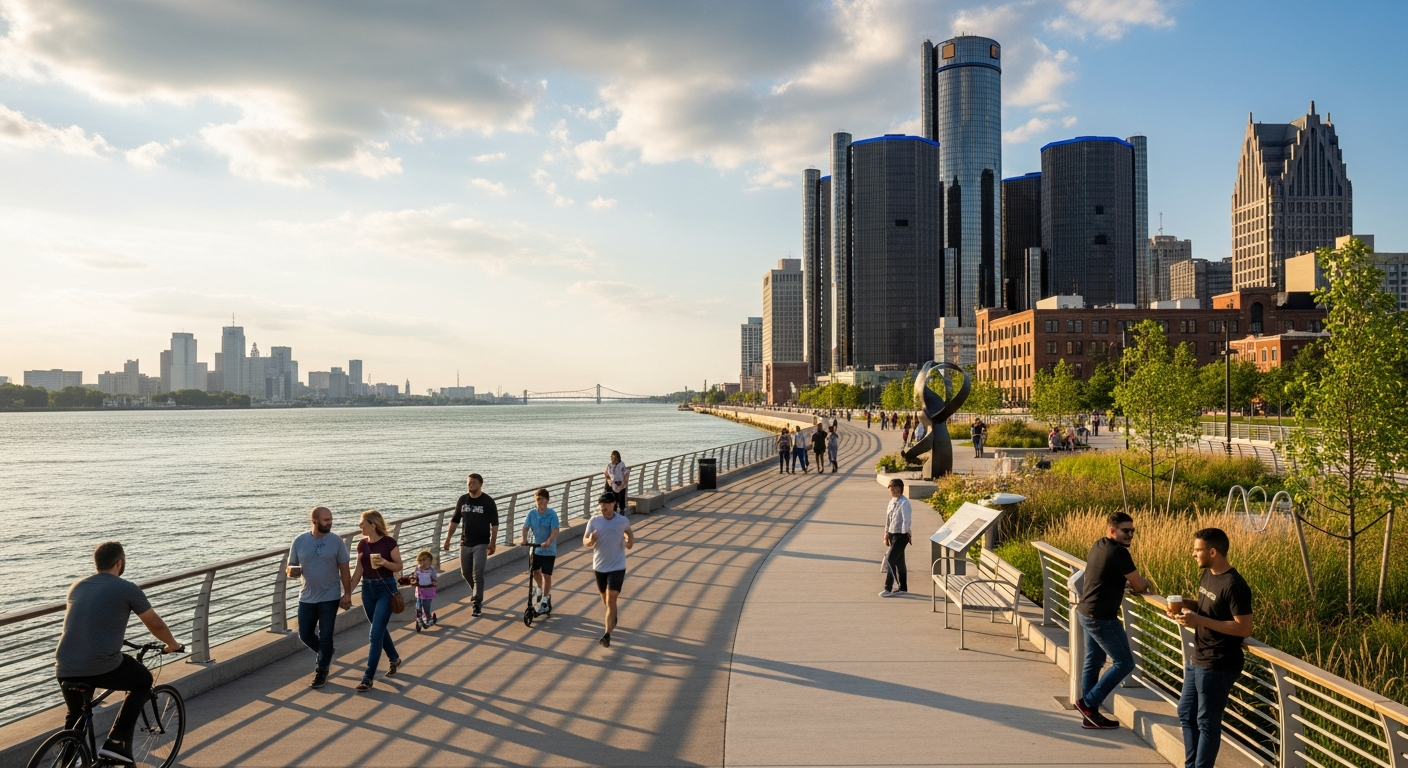
The Detroit Riverwalk is a multi-mile promenade that traces the city’s edge along the Detroit River, with Canada visible just across the water. Repeatedly recognized as one of the best riverfronts in the country, it offers a safe, attractive place for walking, jogging, and cycling, along with parks, gardens, and playgrounds.
Key sections include the stretch near the Renaissance Center, with dramatic views of the skyline, and the parks closer to the east side, where you will find fishing piers, public art installations, and seasonal food vendors. Summer and early fall bring outdoor concerts, festivals, and fitness classes, while winter can still be atmospheric on clear days if you are dressed for the cold.
Campus Martius Park and Downtown Squares
Campus Martius Park, often described as Detroit’s “living room,” is a compact but lively public square ringed by office towers, restaurants, and retail. Depending on the season, you might find a beach complete with sand and lounge chairs, a skating rink, holiday markets, or outdoor concerts.
Nearby, Cadillac Square and other small plazas host food trucks, farmers’ markets, and pop-up events that make downtown feel animated at nearly all times of year. First-time visitors should plan to pass through Campus Martius at least once, whether for a coffee break, a quick snack, or simply to get a sense of how locals use public space in the city center.
Guardian Building and Architectural Highlights
Known as the “Cathedral of Finance,” the Guardian Building is an Art Deco gem and a must-see for architecture enthusiasts. Its exterior is impressive enough, but the real spectacle is inside, where a soaring lobby displays bold, colorful tile work, ornate ceilings, and intricate stone detailing that reflects Detroit’s early twentieth-century prosperity.
Guided architectural tours of downtown frequently include the Guardian Building, along with other landmarks such as the Fisher Building, the Fox Theatre, and a selection of restored office and industrial buildings now converted into hotels, apartments, and creative spaces. If you prefer to explore independently, you can still walk into many lobbies during business hours and appreciate the craftsmanship up close.
Trace the Soundtrack of the City
Detroit’s global reputation rests heavily on its music, from Motown and jazz to techno and rock. Experiencing that heritage in person is one of the most rewarding parts of any first trip. Several key sites preserve the city’s musical legacy while the contemporary scene keeps it very much alive.
Motown Museum (Hitsville U.S.A.)
The Motown Museum, located in the modest house that once served as Hitsville U.S.A., is one of Detroit’s most evocative attractions. This is where Berry Gordy built Motown Records into a musical powerhouse that launched the careers of artists such as Stevie Wonder, Diana Ross and the Supremes, Marvin Gaye, and the Temptations.
Today, guided tours lead small groups through Gordy’s apartment, original offices, and the legendary Studio A, where many of those hits were recorded. The museum has been undergoing a major multi-million-dollar expansion to create a larger campus with new exhibition and performance spaces, but the original house remains the emotional centerpiece.
Advance tickets are strongly recommended, especially on weekends and during peak travel seasons, as tours frequently sell out. For music fans, the experience of standing in Studio A and hearing the stories behind the songs is often a highlight of the entire trip.
Live Music and Historic Venues
Beyond Motown, Detroit’s live music scene spans intimate jazz bars, ornate theaters, and repurposed industrial spaces. Many visitors begin with the larger venues, such as the Fox Theatre or the Fillmore, where touring acts appear alongside local performers, but it is worth seeking out smaller clubs as well.
Neighborhood spots in areas like Midtown, Corktown, and Eastern Market host everything from jazz and soul to techno and experimental electronic music, in keeping with Detroit’s status as the birthplace of techno. Checking local listings shortly before your visit will help you catch a show that matches your tastes and gives you a window into the city’s creative life after dark.
Dive into Neighborhoods and Local Flavor
Detroit is a city of strong neighborhoods, each with its own character and evolving mix of food, nightlife, and street life. Spending time outside the downtown-Midtown axis is essential to understanding what day-to-day life looks like and where many of the most interesting new businesses are emerging.
Eastern Market
Eastern Market is one of the oldest and largest public markets in the United States, and it remains a working food hub and community gathering point. On Saturdays, especially from late spring through fall, the district fills with farmers, food producers, florists, and thousands of shoppers who come for fresh produce, baked goods, meat, cheese, and ready-to-eat meals.
The surrounding streets have become an open-air gallery of large-scale murals painted by local and international artists, giving visitors a striking visual backdrop as they move from shed to shed. During the week, a growing number of restaurants, cafes, and specialty shops keep the area lively even when the market is not operating at full capacity.
Arrive early on busy Saturdays to avoid the biggest crowds, and consider pairing your visit with a walking or biking tour that highlights both the food culture and the street art that now define the neighborhood.
Corktown
Corktown, Detroit’s oldest surviving neighborhood, blends historic brick houses and corner bars with new restaurants, cocktail spots, and creative businesses. Long associated with Irish immigrants, the area has recently gained national attention as the site of a major redevelopment of Michigan Central Station into a tech and mobility campus.
For visitors, Corktown is particularly appealing in the evening, when its restaurants and bars draw a mix of residents and out-of-towners. Menus often spotlight regional ingredients and updated takes on comfort food, while neighborhood pubs preserve a sense of the area’s working-class roots.
Mexicantown and Southwest Detroit
Southwest Detroit, often referred to as Mexicantown in its most concentrated stretch, is a vital center for Latino culture and cuisine. Taquerias, panaderías, and family-run restaurants line the main corridors, serving dishes that reflect both Mexican traditions and a fusion with Midwestern tastes.
Visitors can explore by simply walking and stopping where the smells are most tempting, or they can seek out beloved local institutions known for their tamales, enchiladas, or baked goods. Daytime visits are ideal for families and food-focused travelers, and the area is often at its most vibrant around major holidays and community events.
Experience Detroit’s Automotive Heritage
No first-time trip to Detroit is complete without engaging with the story of the automobile. From early assembly lines to concept cars and modern manufacturing, the region’s history with the auto industry has shaped not only its economy but also its identity in the national imagination.
The Henry Ford Museum of American Innovation and Greenfield Village
Located in the nearby city of Dearborn, The Henry Ford is a vast complex that includes the Henry Ford Museum of American Innovation and Greenfield Village. The museum houses iconic vehicles, from early Ford models and presidential limousines to race cars and experimental designs, alongside exhibits on industrial history, aviation, and everyday American life.
Greenfield Village, an outdoor living-history museum, gathers historic structures from across the United States, including the workshop where Thomas Edison developed the light bulb and other notable buildings moved or replicated on site. Costumed interpreters, working farms, vintage rides, and demonstrations make it particularly engaging for families and anyone interested in hands-on history.
A full day is often needed to do both the indoor museum and the village justice, so first-time visitors should plan accordingly and consider this as a dedicated day trip from central Detroit.
Ford Rouge Factory Tour
Also based in Dearborn, the Ford Rouge Factory Tour offers a rare look at a working auto plant combined with exhibitions on the evolution of manufacturing. Visitors can observe parts of the assembly process from designated viewing areas, supplemented by multimedia displays that explain how the Rouge complex has transformed over the decades.
Recent updates emphasize sustainability and modern production processes, including how contemporary vehicles incorporate new materials and technologies. For travelers fascinated by industry and engineering, this tour helps translate abstract ideas about Detroit’s manufacturing legacy into a tangible, modern experience.
Relax in Detroit’s Parks and Green Spaces
Detroit’s reputation as a hard-edged industrial city can obscure how much green space it offers, from major parks designed by celebrated landscape architects to riverfront lawns and neighborhood gardens. Taking time in these spaces helps balance museum and nightlife-heavy itineraries and reveals another side of local life.
Belle Isle Park
Belle Isle is a 982-acre island park in the Detroit River, accessible by bridge and managed as a state park. With views of both the Detroit and Windsor skylines, it offers a mix of waterfront lawns, wooded trails, historic buildings, and family attractions.
Notable sites on the island include a century-old conservatory with lush plant collections, a small aquarium, and architectural remnants that speak to the park’s long history as an urban getaway. Walking, cycling, picnicking, and simply sitting by the water to watch freighters pass by are all popular activities.
On summer weekends, Belle Isle is especially lively with local families and gatherings, making it a good place for visitors to observe how Detroiters use their public spaces for relaxation and celebration.
Dequindre Cut Greenway and Urban Trails
The Dequindre Cut is a below-grade former rail corridor converted into a pedestrian and cycling trail that connects the riverfront with Eastern Market and nearby neighborhoods. Lined with graffiti, murals, and occasional public art installations, it provides a safe, car-free route for moving between key districts.
First-time visitors who enjoy walking or biking can use the Dequindre Cut to link a morning at the Riverwalk with an afternoon in Eastern Market, observing how old industrial infrastructure is being repurposed as part of Detroit’s broader revitalization.
Eat and Drink Your Way Through the City
Detroit’s dining scene has expanded rapidly in recent years, combining long-standing institutions with new restaurants that highlight both local ingredients and global influences. For first-time visitors, exploring the food and drink landscape is not just about meals, but also about understanding the city’s diverse communities.
Classic Coney Islands and Detroit Specialties
No introductory trip is complete without a stop at a coney island, the local term for diners specializing in hot dogs topped with meat chili, onions, and mustard. Rival institutions in downtown and around the city each claim superiority, but the core experience is the same: a quick, affordable meal in a setting that feels deeply Detroit.
Beyond coneys, visitors should seek out other regional staples such as Detroit-style pizza, known for its thick, airy crust, caramelized edges, and generous toppings baked in rectangular pans. Many pizzerias around the metro area offer their own versions, and sampling at least one pan is practically a rite of passage.
New Restaurants, Breweries, and Cocktail Bars
The last decade has seen a wave of chef-driven restaurants, craft breweries, and inventive cocktail bars open in neighborhoods across the city. Many champion Michigan ingredients, from Great Lakes fish and seasonal produce to local beers and spirits.
Neighborhoods such as Midtown, Corktown, Eastern Market, and New Center are good hunting grounds for these newer spots, which range from casual brewpubs to refined dining rooms. Reservations are recommended for popular restaurants, particularly on weekends, while walk-in bars and breweries often provide a more spontaneous, flexible option after a day of sightseeing.
The Takeaway
For first-time visitors, Detroit can feel both familiar, thanks to its outsize role in American culture, and surprisingly new, given the scale of ongoing revitalization and creativity on the ground.
A well-balanced itinerary might start with the big anchors like the Detroit Institute of Arts, Motown Museum, and The Henry Ford, then weave in time on the Riverwalk, in neighborhoods like Eastern Market and Corktown, and on Belle Isle or the Dequindre Cut.
What emerges from these experiences is a nuanced picture of a city that is far more than its headlines, defined by resilient communities, innovative artists, and a deep pride in its history and future. Whether you are drawn by music, architecture, food, or the story of American industry, Detroit offers enough substance to fill several trips and plenty of reasons to start planning the next one before you even leave.
FAQ
Q1. How many days should a first-time visitor spend in Detroit?
Most first-time visitors find that three full days is enough to see major highlights such as the Detroit Institute of Arts, Motown Museum, Riverwalk, and a day at The Henry Ford complex in Dearborn. With four or five days, you can explore more neighborhoods, take in live music, and add relaxed time in parks like Belle Isle.
Q2. Is Detroit safe for tourists?
Like any large city, Detroit has areas that are safer and busier than others. Visitors who stay in established districts such as downtown, Midtown, Corktown, and the area around Eastern Market, use common urban sense, and rely on licensed transportation generally find the city welcoming and comfortable. It is wise to stay aware of your surroundings, avoid isolated areas at night, and keep valuables out of sight.
Q3. Do I need a car to get around Detroit?
Having a car makes it easier to reach attractions that are spread across the region, such as The Henry Ford in Dearborn or certain neighborhood restaurants. However, first-time visitors who focus on downtown, Midtown, and the Riverwalk can rely on a mix of walking, rideshare services, the QLINE streetcar, and buses. Many guided tours also provide transportation to key sites.
Q4. When is the best time of year to visit Detroit?
Late spring through early fall, roughly May through October, offers the most comfortable weather and the fullest calendar of outdoor events, markets, and festivals. Summer is particularly lively along the Riverwalk and on Belle Isle. Winter visits can still be rewarding, especially for indoor attractions like museums and live music, but require warm clothing and more flexible plans in case of snow.
Q5. Can I visit Detroit and Windsor, Canada, in the same trip?
Yes. Detroit sits directly across the river from Windsor, Ontario, and many visitors choose to cross for a few hours or a day. You will need appropriate identification, such as a passport, to cross the border by bridge or tunnel. Travel times vary with traffic and customs, so plan extra time if you have tickets for specific events.
Q6. Is the Motown Museum suitable for children?
The Motown Museum can be very engaging for older children and teenagers, especially those who love music. Tours involve standing and walking through a small historic house, with guides sharing stories and playing song excerpts. Younger children may enjoy the music but could find some of the historical context less accessible and the tours a bit long.
Q7. How do I visit The Henry Ford and Greenfield Village without a car?
The Henry Ford is in Dearborn, just outside Detroit, and is easiest to reach by car or rideshare. Some tour operators offer package trips that include transportation, admission, and guided orientation, which can be a good option if you do not want to drive. Public transit options exist but typically require transfers and extra travel time.
Q8. What should I wear when visiting Detroit in winter?
Winter temperatures in Detroit can be below freezing, with wind off the river making it feel colder downtown and along the Riverwalk. Pack a warm coat, hat, gloves, scarf, and waterproof or insulated shoes with good traction. Layering is key, since indoor spaces like museums and restaurants are heated and you will want to be able to adjust throughout the day.
Q9. Are the main Detroit museums accessible?
Major institutions including the Detroit Institute of Arts, Charles H. Wright Museum of African American History, and The Henry Ford complex are designed with accessibility in mind, offering ramps, elevators, accessible restrooms, and options for visitors with mobility or sensory needs. It is still a good idea to check each museum’s current accessibility information in advance and contact them directly if you have specific requirements.
Q10. What local dishes or drinks should I try besides coney dogs?
In addition to coney dogs, first-time visitors should seek out Detroit-style pizza, Middle Eastern cuisine from the broader metro area, Mexican specialties in Southwest Detroit, and locally roasted coffee or Michigan craft beer. Many restaurants highlight seasonal produce from the region, and bakeries and diners often put their own spin on classic comfort foods, making it easy to eat well at a range of price points.