

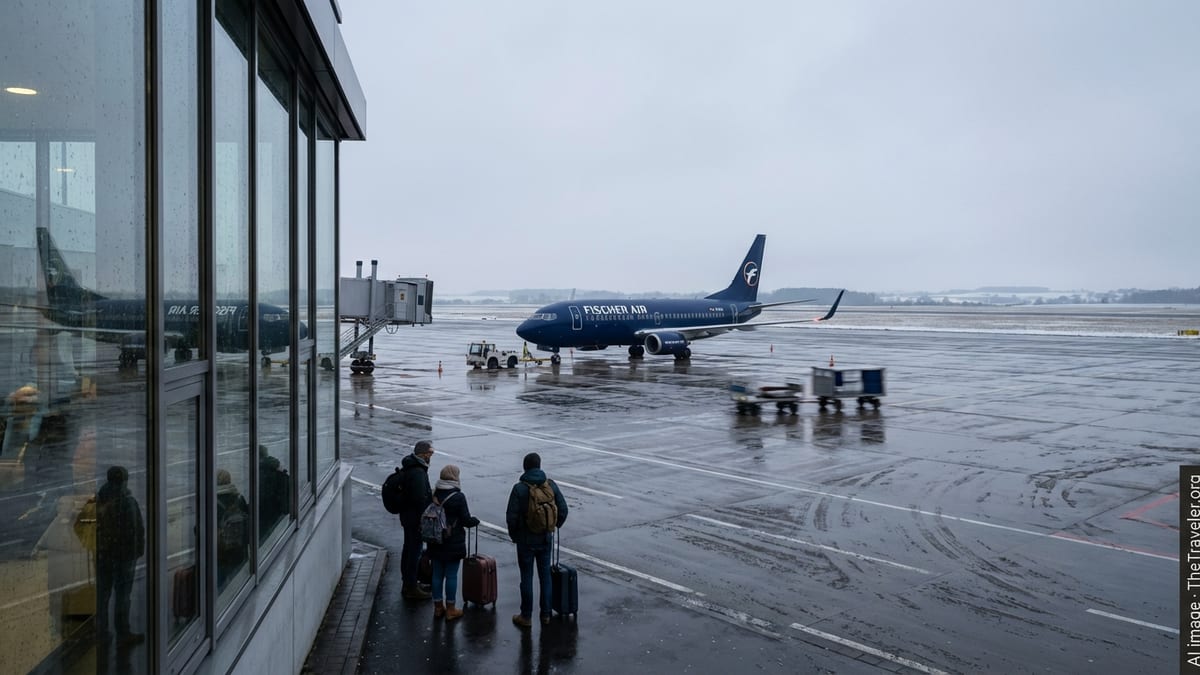
Fischer Air has once again postponed the start of its Kassel–Gran Canaria service, pushing back the long-promised holiday route and disrupting travel plans for German tourists who had already booked winter sun escapes to the Canary Islands.
Launch Date Slips From Winter to Late Spring
The latest schedule change means that Fischer Air’s charter flights between Kassel Airport and Gran Canaria, originally marketed as a key new winter connection, will now begin no earlier than mid May. The airline had most recently been advertising a mid February start for the route, after abandoning earlier launch targets around Christmas and early January.
According to statements given to aviation trade media, the company attributes the new delay to its ongoing certification process with the Slovak aviation authority. Fischer Air, which is being relaunched by tourism entrepreneur Vaclav Fischer, is registered in Slovakia and needs a full operating certificate there before it can deploy its own Boeing 737 aircraft. Until that is secured, the carrier has attempted to rely on chartered capacity, but even these flights have repeatedly failed to materialize from Kassel.
The new postponement is particularly sensitive for Kassel Airport, where the Kassel–Gran Canaria rotation had been presented as a flagship route for the winter and early spring season. Holidaymakers from northern Hesse looking for direct access to Gran Canaria’s beaches and hiking trails now face another gap in the regional flight schedule, with many forced to rebook from larger hubs such as Frankfurt or Hanover.
Fischer Air has not issued a detailed public timetable for replacement departures or a clear mid May start date for all affected departures, adding to uncertainty among passengers and travel retailers. Tour operators in the region say they are relying on case-by-case communication and improvised rebookings rather than a structured rescue plan from the airline.
Confusion After Months of Shifting Promises
The latest delay caps several months of shifting announcements around Fischer Air’s plans from Kassel. When the carrier first promoted its comeback last year, it promised a Christmas-time launch, with the inaugural flight from Kassel to Gran Canaria set for December 20. That date slipped to early January, then to late January, and later to a start sometime in February.
Even as Kassel Airport updated its public information to show a February launch at the earliest, Fischer Air’s own booking system continued at times to display scattered departures in December and January, sowing confusion among customers. Local press reports documented how flights that appeared bookable on the airline’s website later disappeared from airport timetables without clear explanation.
Each revision in the planned start date has translated into a new wave of disruption for travelers. Some passengers were informed that their flights were simply not operating and were left to seek alternatives on short notice. Others reported receiving schedule changes or cancellations only after they inquired with travel agencies or the airport, rather than through proactive messaging by the airline.
The disconnect between public promises and operational reality has damaged confidence in the Fischer Air project, particularly in a region where direct holiday flights are limited and residents have grown wary of ambitious but short lived ventures at Kassel Airport. A route that was promoted as a symbol of renewed optimism has instead become a case study in how fragile such plans can be.
Tourism Businesses Count the Cost
For many local tourism players, the repeated delays are more than an inconvenience. Travel agencies in and around Kassel say they are spending increasing amounts of time unwinding or reconfiguring itineraries that depended on a direct Kassel–Gran Canaria link. Some agencies report that customers have been rebooked from Frankfurt, Paderborn or Hanover, often at higher prices or with less convenient schedules.
One agency based at Kassel Airport has described a “chicken-and-egg” situation, in which travelers hesitate to book seats on a new, untested route, while the airline in turn struggles to reach the occupancy levels needed to operate economically. Low initial bookings, combined with regulatory uncertainties, have apparently made it harder for Fischer Air to commit firmly to operating specific flights.
Hotel partners and destination management companies in Gran Canaria are also affected. Winter and spring are key periods for northern European visitors seeking mild temperatures, and tour operators had hoped that direct capacity from Kassel would open access to a new catchment area in central Germany. Instead, partners report short term cancellations and a shift of business back to existing feeder markets linked to major airports.
While the volume of passengers from Kassel alone is relatively modest in the context of total arrivals to the Canary Islands, such regional links often support niche products, including specialist hiking, cycling and rural tourism packages. The lack of reliable airlift from Kassel this season makes it harder for those products to gain traction with new customer segments.
Passenger Frustration and Consumer Watchdogs
The turbulence around the route is increasingly catching the eye of consumer advocates. In Germany, regional consumer protection bodies have begun looking into complaints from travelers who booked Fischer Air services, then saw their flights cancelled or indefinitely postponed without timely refunds. Some customers describe weeks of uncertainty while waiting for responses or reimbursements.
Legal experts note that once a flight is cancelled, passengers within the European Union are generally entitled to refunds within a defined period, regardless of whether the operating airline is fully certified or is using chartered capacity. Where significant delays in repayment occur, or where marketing continues for services that show little sign of materializing, authorities can examine whether advertising has become misleading.
In Hesse, consumer organizations are now openly assessing whether Fischer Air’s communications and sales practices around Kassel departures cross that line. Although no formal enforcement action has been announced, the fact that watchdogs are examining the case adds pressure on the airline to demonstrate that its revised mid May schedule is realistic and that it can meet its obligations to ticket holders.
For affected passengers, the experience has been bruising. Some had planned long awaited family holidays to Gran Canaria timed around school breaks, only to find themselves searching for last minute alternatives. Others had coordinated time off work around the originally advertised Christmas or January flights and now face rearranging those plans for a second or third time.
Strategic Stakes for Kassel Airport
The disruption is particularly awkward for Kassel Airport, which has long fought criticism over its low traffic volumes and financial losses. Local and regional authorities have defended the airport as a strategic investment, arguing that it supports thousands of direct and indirect jobs and provides important connectivity for the wider region despite persistent operating deficits.
In that context, the Fischer Air project had been held up as a potential turning point. The airline’s plan to base an aircraft at Kassel and serve multiple leisure destinations including Gran Canaria, Fuerteventura, Lanzarote, Tenerife, Hurghada, Mallorca and Crete was touted as a way to strengthen the airport’s role as a holiday gateway for central Germany. The reality to date, however, has fallen far short of those expectations.
Even before the latest postponement, critics questioned whether it was wise for Kassel Airport to lean so heavily on a single, newly revived carrier that still lacked an operating certificate. The airport maintains that it merely provides infrastructure and that decisions on flight schedules and customer communication rest with the airline and its tour operator partners.
Nonetheless, each missed start date reinforces the perception that Kassel struggles to attract and retain sustainable air services. The gap now left by Fischer Air’s postponed Kassel–Gran Canaria connection will likely be cited in debates over the airport’s future strategy and the balance between public investment and realistic market demand.
Gran Canaria Demand Remains Strong Despite Setbacks
Demand for travel from Germany to Gran Canaria itself shows few signs of weakening, which makes the situation in Kassel all the more striking. The island remains one of the most popular winter sun destinations in the Spanish archipelago, drawing visitors with its year round mild climate, diverse landscapes and extensive resort infrastructure.
On a national level, German tour operators report solid bookings to the Canary Islands, with capacity from major airports in western and southern Germany largely restored to or exceeding pre pandemic levels. Airlines and package providers have long viewed Gran Canaria as a relatively low risk market, benefiting from strong repeat business and a wide range of accommodation options.
The problem for travelers in northern Hesse is access. Without a direct Kassel–Gran Canaria route, they must generally route through other German or European hubs, adding time, cost and complexity to their journeys. For families, senior travelers and those in smaller towns around Kassel, that can be a decisive factor in choosing whether to book at all.
Some airlines have in the past experimented with seasonal or charter operations linking smaller German airports to Gran Canaria and other Canary Islands, with mixed results. Industry analysts note that such routes require careful coordination between airlines, tour operators and local partners to ensure sufficiently high load factors across the season. If confidence in a particular operator is undermined, as critics say has happened with Fischer Air, rebuilding that trust can take years.
Regulatory and Operational Hurdles for Fischer Air
Behind the scenes, Fischer Air’s regulatory and operational challenges are central to the unfolding story. As a new Slovak based airline trying to revive a legacy brand, it must complete a complex certification process before it can independently operate its own aircraft. Industry specialists describe this as a time consuming and resource intensive undertaking that typically requires detailed demonstrations of safety management, maintenance oversight and crew training.
While airlines can use chartered aircraft from already certified partners in the interim, coordinating such capacity is itself a logistical and commercial hurdle. Charter providers may hesitate to commit aircraft and crews to a newcomer whose forward bookings and financial backing are still being tested. Any gap between public announcements and internal readiness magnifies the risk that high profile inaugural routes like Kassel–Gran Canaria will be postponed yet again.
The airline has spoken of plans to expand beyond Gran Canaria to a broader network of leisure destinations from Kassel, Hamburg, Friedrichshafen and Bratislava. However, the continuing delays and scrutiny in Kassel raise questions about how quickly those ambitions can be realized in practice. The mid May target for the first Kassel departures will now be viewed as a crucial test of Fischer Air’s credibility.
If the airline manages to complete its certification, secure stable aircraft capacity and operate consistently through the summer season, some of the current skepticism could subside. If not, the Kassel–Gran Canaria route risks becoming a cautionary tale of how over optimistic timelines and opaque communication can erode support for regional air connectivity projects.
Uncertain Summer for Travelers and the Region
As of mid February, the atmosphere around the postponed route is one of cautious wait and see among travelers, agencies and local officials. Many holidaymakers with flexible plans are choosing to hold off on new bookings from Kassel until they see firm evidence that planes are actually departing for Gran Canaria. Others are deliberately shifting to established carriers from larger airports, even if that means longer drives or connecting flights.
For Kassel Airport and the wider tourism sector in northern Hesse, the coming months will be crucial. If Fischer Air delivers on its mid May promise, the region could still benefit from a shortened but meaningful run of direct flights to Gran Canaria and potentially other sun destinations into the autumn. Should further postponements occur, however, it will be harder to persuade skeptical residents and business partners to support future ventures of this kind.
In the meantime, the story of the delayed Kassel–Gran Canaria service serves as a reminder that building sustainable regional air links requires more than eye catching announcements. Reliable operations, transparent communication and robust consumer protection are all essential to ensure that the promise of new routes translates into real benefits for travelers and tourism economies on both ends of the line.