

More news on this day
A wave of cancellations and redeployments has left a tighter but still significant group of five cruise brands planning Arabian Gulf itineraries in the 2026-27 seasons, reshaping how travelers will sail between Dubai, Abu Dhabi, Doha and neighboring ports after a turbulent period for regional cruise tourism.
Get the latest news straight to your inbox!
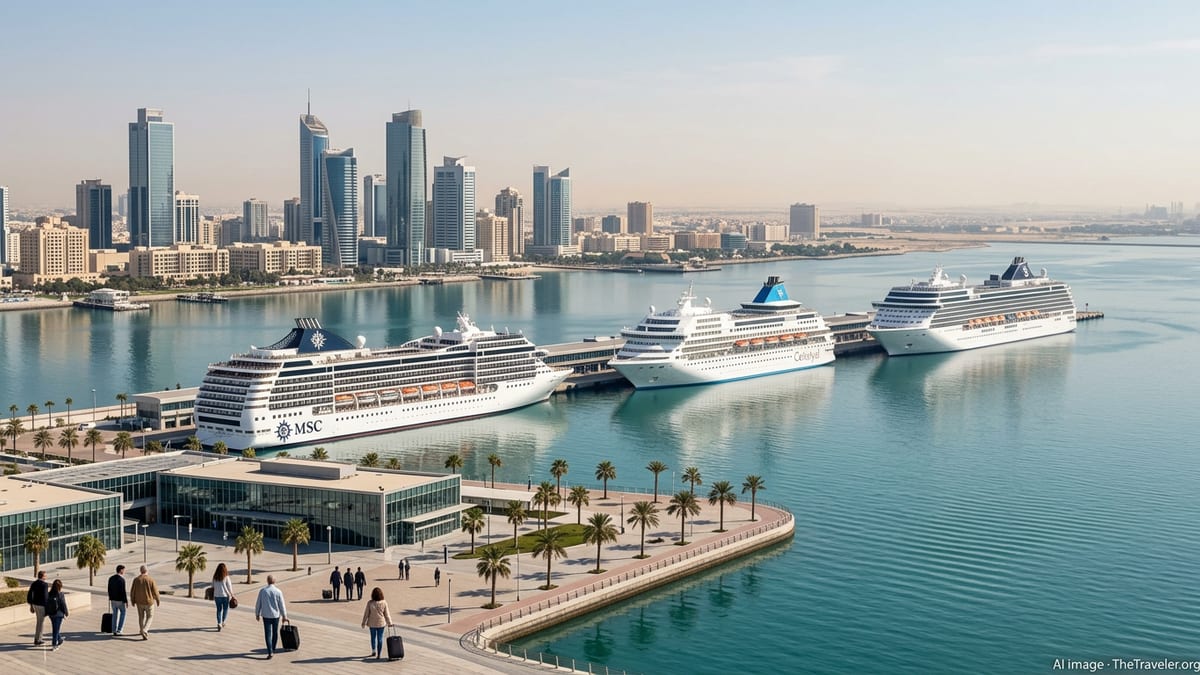
From Rapid Growth To Reset In The Arabian Gulf
In the years leading into the mid-2020s, the Arabian Gulf emerged as a key winter playground for mainstream European and international cruise lines, with Dubai, Abu Dhabi and Doha serving as major homeports. Industry coverage showed more than 300 sailings planned for the 2025-26 season, supported by expanding air links and new terminals in the United Arab Emirates and Qatar.
That trajectory changed sharply in late 2025 and early 2026 as security concerns and route disruptions prompted multiple operators to curtail or cancel Gulf deployments. Published advisories and trade reports indicate that brands such as MSC Cruises, AIDA Cruises, TUI Cruises and Saudi-backed Aroya Cruises either scaled back or withdrew scheduled programs for the 2025-26 winter, rerouting ships to the Mediterranean, Red Sea or other regions.
Despite the shake-up, forward schedules and deployment guides still point to at least five distinct cruise brands planning Arabian Gulf or Gulf-linked operations that touch the region in the 2026-27 window. While the mix of lines and the length of the season look different from earlier projections, the remaining programs suggest a more concentrated, potentially higher-yield model focused on itineraries that can be adjusted quickly if conditions change.
For travelers, this reset means fewer choices than during the peak expansion years, but also a clearer picture of which companies are maintaining a stake in the Gulf, and how those itineraries connect with the broader cruise networks of Europe, Asia and the Red Sea.
Key Players: The Five Brands Still Betting On The Gulf
Planning tools, brochures and cruise search aggregators for 2026-27 highlight five brands with scheduled or promoted Arabian Gulf sailings: MSC Cruises, Celestyal, Aroya Cruises, plus a smaller set of premium and luxury operators using the Gulf on longer repositioning or collection voyages. The exact mix of hardware and dates remains subject to change, but these lines are the ones most consistently appearing in forward-looking deployment material for the region.
MSC Cruises continues to position its Gulf program as part of a global winter strategy, pairing Emirates itineraries with Caribbean and Mediterranean offerings. Its promotional materials reference Dubai, Abu Dhabi, Qatar and Bahrain as core ports, with calls at Sir Bani Yas Island and Oman on selected sailings. Several departures in late 2026 and early 2027 are already loaded into online schedules, typically in the seven-night range roundtrip from Doha or Dubai.
Celestyal stands out for committing two ships to the broader 2025-26 and 2026-27 Gulf seasons, with Celestyal Journey and Celestyal Discovery operating three to seven-night itineraries built around Doha, Abu Dhabi, Dubai, Bahrain and Sir Bani Yas Island. Trade documentation for the 2026 and early 2027 seasons lists a dense pattern of departures, indicating that the line continues to see the region as a cornerstone of its winter portfolio.
Aroya Cruises, backed by Saudi interests, is in a different position. Initial announcements focused on the Red Sea and Eastern Mediterranean, followed by plans to enter the Arabian Gulf from 2026 with sailings between Dubai, Dammam, Doha and Khasab. Subsequent security developments have disrupted the early phases of this rollout, but official fleet descriptions and tourism strategy briefings still describe the Gulf as part of the company’s long-term map once conditions allow.
How 2026-27 Itineraries Are Shaping Up
Looking across the various brochures and booking engines now live for late 2026 and early 2027, several common itinerary patterns emerge. Seven-night circuits remain the backbone of most mainstream Gulf programs, typically linking Dubai or Doha with a loop that includes Sir Bani Yas Island, Abu Dhabi, Bahrain and at least one Omani port such as Muscat or Khasab.
Celestyal’s upcoming seasons illustrate the trend toward flexibility. The line has promoted short three and four-night “taster” cruises alongside classic seven-night routes, often allowing guests to combine back-to-back sailings into longer voyages. Sail dates listed for early 2026 and into the first quarter of 2027 show repeated Friday or Saturday departures, optimized to connect with overnight flights from Europe and key regional gateways.
MSC Cruises positions its Gulf voyages within broader winter portfolios marketed as “Dubai, Abu Dhabi and Qatar” or “Emirates cruises.” The itineraries highlighted for the 2026-27 window pair major cities with at least one beach or nature stop, such as Sir Bani Yas Island, and often include extended evenings in Dubai or Abu Dhabi to tap into dining and entertainment demand.
In addition to dedicated Gulf programs, several higher-end and luxury lines continue to schedule longer collection or repositioning voyages that either begin or end in Dubai, Abu Dhabi or Doha, tying the Gulf to the Red Sea, Indian Ocean or Mediterranean. These sailings are fewer in number but provide options for travelers seeking more port-intensive itineraries or one-off voyages connecting the Gulf with broader regional explorations.
Practical Implications For Travelers Considering Gulf Cruises
The recent volatility in Arabian Gulf cruise deployment has practical implications for anyone eyeing a 2026-27 voyage. One key consideration is the potential for late changes to routes, including port substitutions or wholesale redeployments if risk assessments shift. Booking conditions, particularly around cancellation, air add-ons and travel insurance, are likely to play a larger role than during earlier, more predictable seasons.
Publicly available advisory notices from several cruise lines and travel agents already urge caution on nonrefundable flight and hotel bookings related to early 2026 departures. Travelers looking ahead to the later part of the 2026-27 window may face fewer disruptions, but many companies still highlight that itineraries remain subject to short-notice adjustment.
Another implication is capacity. With fewer large brands operating full seasonal schedules, cabins on remaining Gulf sailings may prove more limited, especially on dates that coincide with European school holidays, winter festivals and major sporting events in the region. Early booking can help secure preferred cabins, but monitoring payment deadlines and fare conditions is equally important given the possibility of change.
Travelers should also consider how Gulf cruises fit into wider itineraries. Many programs encourage combining a cruise with pre- or post-stays in Dubai, Abu Dhabi or Doha, or with overland extensions into Saudi Arabia, Oman or further afield. In an environment of evolving cruise deployment, these add-ons may offer a degree of flexibility, allowing trips to proceed in a modified form even if a specific voyage is altered or rescheduled.
What To Watch As The 2026-27 Seasons Approach
As the 2026-27 cruise seasons draw closer, several developments will help clarify the real shape of Arabian Gulf cruising. Updated deployment announcements from MSC Cruises, Celestyal and Aroya will signal how much capacity ultimately returns, and whether additional brands step back into the market once security assessments stabilize.
Port investment is another indicator. Dubai, Abu Dhabi and Doha have spent heavily on terminals and supporting tourism infrastructure, and further enhancements or promotional campaigns aimed at cruise guests would suggest continued confidence in the sector. Any slowdown in port calls, on the other hand, could prompt authorities to focus more on land-based tourism growth until conditions for cruising improve.
Travelers and agents will also be watching pricing. Early promotional offers for Gulf sailings in 2026 and early 2027 position the region as a value-oriented winter alternative to the Caribbean or Western Mediterranean. If supply remains constrained while demand from Europe and Asia recovers, fares could harden, particularly on peak dates and for balcony or suite categories.
For now, the picture that emerges for 2026-27 is one of consolidation rather than collapse. A smaller group of committed operators is set to shape the next chapter of Arabian Gulf cruising, offering a more focused range of itineraries that still link some of the world’s most modern skylines and desert landscapes. Travelers prepared to monitor developments closely, read fare rules carefully and remain flexible on dates and routes are likely to be best positioned to take advantage of what the region can offer in the coming seasons.