

More news on this day
Rail passengers traveling through the Cologne–Bonn region face five months of disruption in 2026 as Deutsche Bahn’s intensive renovation of a key corridor forces wide-ranging timetable changes, longer journey times and extensive replacement services across one of Germany’s busiest rail hubs.
Get the latest news straight to your inbox!
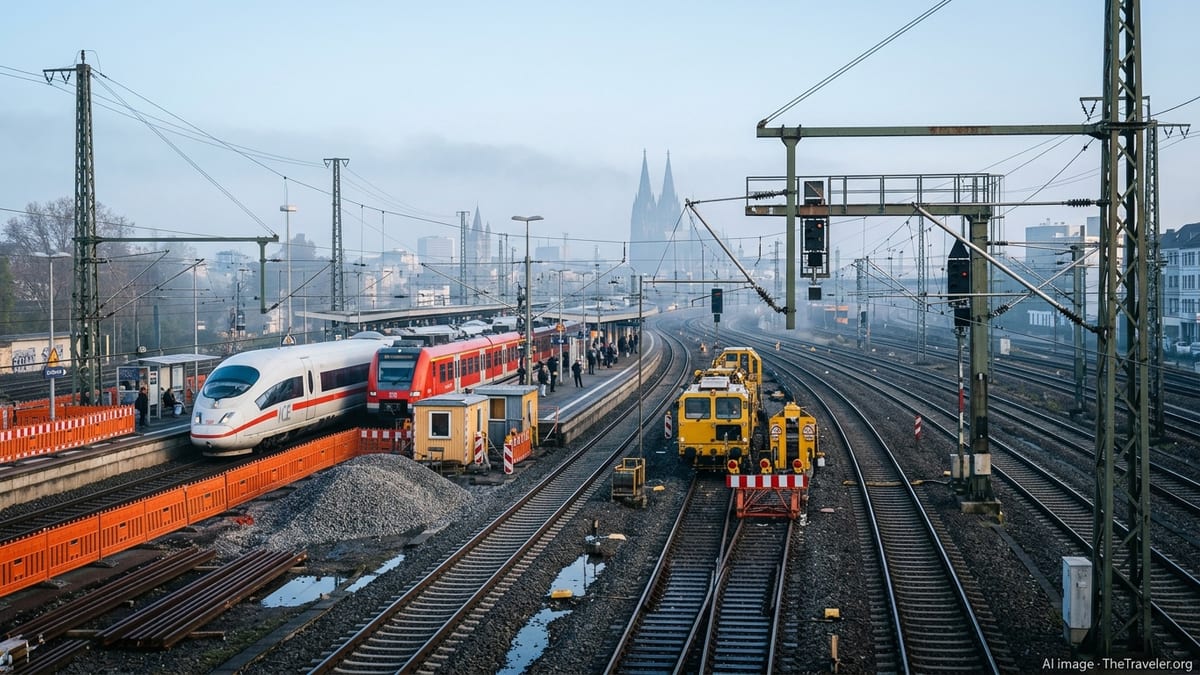
Major Upgrade Closes Hagen–Wuppertal–Cologne Route
Publicly available project information shows that the main line linking Hagen, Wuppertal and Cologne is undergoing a comprehensive general refurbishment in 2026, with work concentrated over a period of about five months. The corridor is a core artery for both regional and long distance services in North Rhine-Westphalia, carrying commuter flows into Cologne as well as intercity trains toward Bonn, Koblenz and Berlin.
According to published coverage of the programme, the closure runs from early February until July 2026, following a shorter preparatory shutdown over the previous winter used to stage machinery and materials. During the intensive phase, much of the 65 kilometre route is closed to regular traffic, allowing engineers to renew tracks, switches, overhead lines and station infrastructure in one concentrated campaign instead of years of weekend and overnight work.
Reports indicate that the project forms part of a wider national push to overhaul ageing German rail infrastructure. Deutsche Bahn’s infrastructure subsidiary has outlined plans to invest tens of billions of euros over several years in heavily used corridors, with the Hagen–Cologne line and the parallel work between Nuremberg and Regensburg among the first to undergo this kind of bundled refurbishment approach.
Ripple Effects for Cologne–Bonn Commuters and Long Distance Travel
The Hagen–Wuppertal–Cologne shutdown has direct implications for the busy Cologne–Bonn axis, where rail lines and long distance services interconnect. Cologne is the dominant junction in western Germany, and Bonn Hauptbahnhof relies on frequent regional express and long distance trains that route through Cologne before continuing along the Rhine. Any prolonged closure feeding into Cologne inevitably reshapes patterns for commuters, business travellers and visitors using Bonn as a base.
Published timetables and route maps for the renovation period show that several long distance connections are diverted away from their usual paths, with some trains skipping Cologne altogether or using alternative approaches via Siegburg/Bonn and the high speed line. Earlier short term works in the region have already demonstrated the likely impact for travellers, with reports of fully cancelled high speed services on the Bonn–Cologne–Berlin route and reduced frequencies for regional lines when key tracks were taken out of service.
For regular commuters between Cologne and Bonn, the five month disruption will compound an already strained corridor. Commentaries on the state of the local network frequently point to chronic congestion and recurring signal and overhead line faults on the left bank Rhine route, which carries a mix of dense passenger traffic and heavy freight. Even when works are not directly on the Cologne–Bonn stretch, diversions and altered train paths elsewhere in the node tend to reduce reliability and capacity for the daily flow between the two cities.
Replacement Buses, Diversions and Longer Journey Times
Planning documents for the general refurbishment outline a broad package of replacement and diversion measures designed to keep passengers moving during the five month period. Substitute bus services are being arranged for sections without usable rail alternatives, particularly between intermediate towns where parallel lines do not exist. On other stretches, trains are expected to use longer detours, with additional stops at secondary stations that can handle redirected traffic.
Experience from recent construction phases in the Cologne–Bonn area suggests travellers should prepare for noticeably longer journey times and more complex connections. During earlier week long and multi week shutdowns, regional passengers faced extended travel via circuitous routes along the right bank of the Rhine or through smaller junctions, while local trams and light rail lines absorbed some of the displaced demand.
Reports also highlight that capacity on alternative routes will be tight. The Rhine valley already ranks among Germany’s most intensively used freight corridors, and the need to fit diverted passenger trains into existing freight paths leaves limited room for extra services. As a result, some long distance trains will run less frequently, and certain regional patterns will be thinned out or temporarily merged, an arrangement likely to increase crowding on the services that do operate.
Cologne Rail Hub Faces Overlapping Construction Campaigns
The five month corridor closure comes on top of a series of construction schemes that have already tested the resilience of the Cologne–Bonn rail hub. In late 2025, a ten day closure of Cologne Central Station for signalling upgrades caused extensive rerouting and cancellations across western Germany, and publicly available coverage notes that a second station shutdown is likely to coincide with the Hagen–Cologne corridor works.
At the same time, additional projects are moving forward on neighbouring lines. Modernisation of Rhine bridges and motorway crossings has required adjustments to overhead lines and pylons, temporarily cutting rail connections between Cologne and Bonn during earlier phases. Further south, general renovation is planned on the right bank Rhine line from Troisdorf toward Wiesbaden, a development that will reshape long distance traffic along the river later in the decade.
For travellers, this pattern means that disruption around Cologne and Bonn is evolving from a series of isolated weekend blockades into a multi year sequence of overlapping construction windows. Transport commentators note that while this approach concentrates inconvenience into defined periods, it challenges passengers who rely on predictable schedules, especially those commuting daily between the region’s major cities or connecting at Cologne for flights via the nearby airport.
What Travellers Should Expect in 2026
For many passengers, the most visible effect of the five month disruption will be reduced direct options and a greater need to change trains. Published projections for the renovation period show that some fast intercity links between Bonn and northern or eastern Germany will either be temporarily withdrawn or rerouted via alternative junctions, with fewer direct services to cities such as Berlin and Hamburg. Regional express routes that normally offer straightforward hops between Bonn, Cologne and Wuppertal are expected to see altered stopping patterns and, in some cases, partial replacement by buses.
Rail users can also anticipate increased crowding on trains that continue to operate through Cologne during the works. Previous closure periods around Cologne Hauptbahnhof led to sharply higher passenger volumes on unaffected services, particularly at peak times. With a full corridor out of action for several months, the pressure on remaining long distance and regional trains is likely to intensify, making advance journey planning and flexible travel times more important for those who can adjust their schedules.
Despite the short term disruption, transport analysts argue that the renovation offers long term benefits for travellers in the Cologne–Bonn region. By renewing worn infrastructure in one concerted effort, the project aims to reduce the signal and track failures that currently cause frequent delays, while upgraded stations and modern signalling should enable more reliable operations and, in time, additional capacity. For now, however, the five month construction window in 2026 signals a challenging season for anyone moving through this pivotal stretch of western Germany’s rail network.