

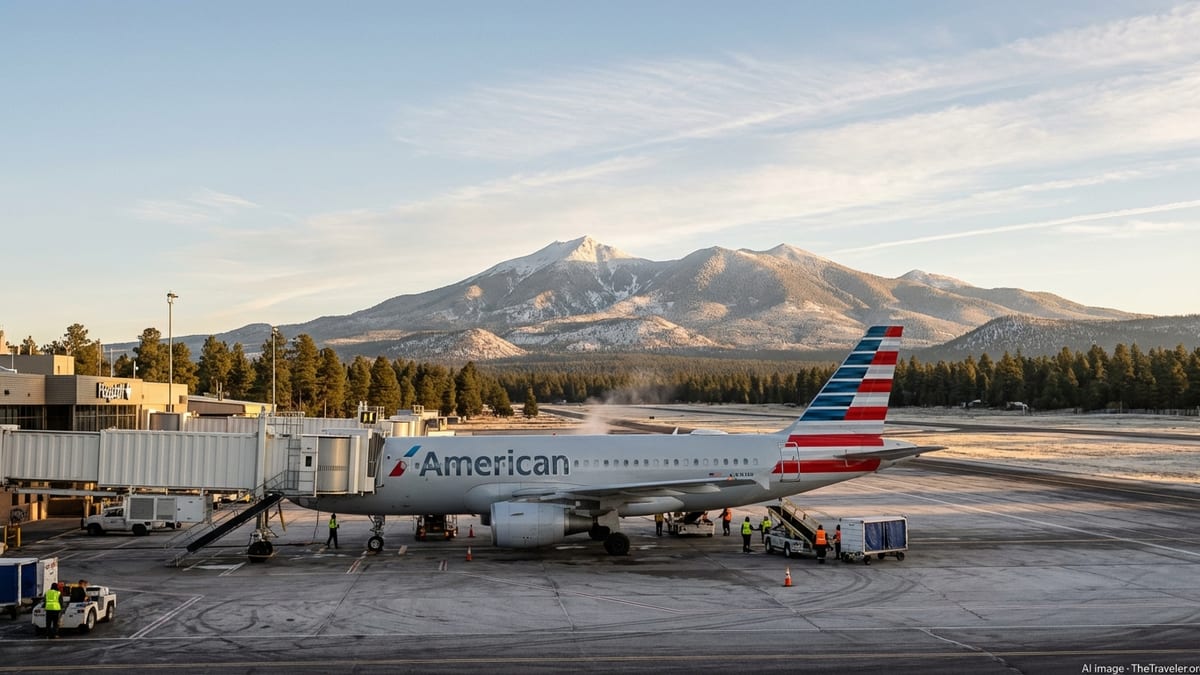
Flagstaff Pulliam Airport is set to receive a significant boost in connectivity this spring, as American Airlines upgrades its Dallas Fort Worth service to a larger Airbus A319 aircraft, expanding capacity and improving comfort on one of northern Arizona’s most important air routes.
A Mainline Milestone for Flagstaff Pulliam Airport
The aircraft upgrade, announced in a recent statement from Flagstaff Airport officials, will take effect on May 21. On that date, American Airlines will replace its current Bombardier CRJ700 regional jets on the Flagstaff–Dallas Fort Worth route with 128 seat Airbus A319 aircraft, introducing mainline service to the airport for the first time. The move more than doubles the number of available seats on each flight and signals growing demand for travel to and from the high country gateway.
Flagstaff Pulliam Airport, which currently offers American Airlines service to Phoenix, Dallas Fort Worth, and Los Angeles, has been working to expand its role as a regional air hub. The introduction of a mainline narrowbody jet is viewed by city and airport leaders as a key milestone in that strategy, reflecting confidence from the carrier in the strength of the local market.
Airport officials say the larger aircraft will give residents, business travelers, and visitors greater flexibility when planning trips, while strengthening Flagstaff’s connections to one of the nation’s busiest airline hubs. With Dallas Fort Worth serving as a major national and international gateway, the upgraded service is expected to open up easier one stop links to hundreds of onward destinations.
More Seats, More Comfort, and Three Classes of Service
The Airbus A319 replacing the regional jets brings a different onboard experience for travelers on the Flagstaff to Dallas Fort Worth corridor. The aircraft will be configured with three cabins, including First Class, Main Cabin Extra, and Main Cabin, providing a level of product differentiation that was not available on the smaller CRJ700.
According to airport and airline information, the A319 will offer a total of 128 seats. This is more than double the capacity of the outgoing regional jets, which typically seat around 65 to 70 passengers. For travelers, that translates into significantly more opportunities to secure a seat on peak travel days, particularly during holiday periods, university move in and graduation seasons, and the busy summer tourism months when northern Arizona draws visitors from across the country.
The mainline Airbus cabin also offers more spacious overhead bins, a wider fuselage, and a quieter ride compared with the regional jets it replaces. Business travelers are likely to welcome the expanded premium seating, while leisure passengers may see improved availability of Main Cabin Extra seats, which provide additional legroom on the roughly two and a half hour flight between Flagstaff and Dallas Fort Worth.
Strengthening Flagstaff’s Role as a Northern Arizona Gateway
The decision by American Airlines to upgauge the aircraft on the Flagstaff to Dallas Fort Worth route underscores the city’s growing importance as a gateway to northern Arizona and the Colorado Plateau. Flagstaff sits within easy reach of the Grand Canyon, Sedona, Meteor Crater, and numerous national monuments, drawing both domestic and international visitors year round.
Local tourism and economic development officials have long emphasized the importance of strong air links in attracting more visitors, conferences, and meetings to the region. With Dallas Fort Worth offering connections across the United States, Europe, Latin America, and Asia, the upgraded service has the potential to make itineraries to Flagstaff more attractive for international travelers who might previously have connected through Phoenix alone.
The move also reflects broader trends in the airline industry, where carriers are increasingly deploying larger, more efficient narrowbody aircraft on routes that demonstrate sustained demand. For Flagstaff, securing a mainline aircraft represents a vote of confidence that could support future route development and additional capacity if passenger numbers continue to grow.
Improved Connectivity for Business, Education, and Tourism
Flagstaff’s economy relies on a mix of education, research, tourism, and professional services, and airport officials say the upgraded Dallas Fort Worth service will support all of these sectors. The city is home to Northern Arizona University, the United States Geological Survey, and Lowell Observatory, institutions that maintain extensive ties across the country and overseas.
For business travelers, the enhanced service to Dallas Fort Worth means more reliable access to a global hub with extensive same day connection options. Early afternoon departures from Flagstaff, coupled with mid afternoon arrivals in Texas, are expected to align well with evening banks of onward flights, reducing overall travel time to key business centers on the East Coast and in the Midwest.
Tourism operators, meanwhile, anticipate that the larger aircraft will make it easier for group tours, meeting planners, and international wholesalers to include Flagstaff in their itineraries. More seats on a single flight can simplify logistics for ski groups bound for Arizona Snowbowl in winter, hiking and rafting outfitters in spring and summer, and fall foliage visitors drawn to the area’s high elevation forests.
Operational Changes and What Travelers Should Expect
While the schedule between Flagstaff and Dallas Fort Worth will remain broadly similar, the shift to the Airbus A319 will bring some operational changes that passengers should be aware of. The larger aircraft will require updated boarding procedures and may use different parking positions on the airfield compared with the regional jets currently serving the route.
Airport authorities continue to advise passengers to arrive at least 90 minutes before departure to allow time for ticketing, baggage drop, and security screening. With a greater number of seats to fill and potentially higher passenger loads at peak times, travelers may wish to allow additional time during busy holiday periods and on Mondays and Fridays, when business demand typically peaks.
The flight time between Flagstaff and Dallas Fort Worth is expected to remain close to the current schedule of around two hours and thirty minutes, covering a distance of approximately 856 miles. The upgraded aircraft may offer modest improvements in performance and ride quality, but officials emphasize that the main benefit will be capacity and comfort rather than speed.
Competitive Landscape in Arizona Air Service
The Flagstaff upgrade comes at a time when Arizona’s air service landscape is evolving, with airlines adjusting capacity and routes across the state. Larger airports in Phoenix and Tucson continue to add domestic and international destinations, but smaller regional airports like Flagstaff have been working to secure incremental improvements that can have an outsized impact on local connectivity.
In recent months, carriers have announced new or expanded service from other Arizona cities to Dallas Fort Worth, reflecting strong demand for links to the Texas hub. Against that backdrop, Flagstaff’s move to mainline A319 service positions the city to better compete for travelers who might otherwise drive to Phoenix or another airport to access a wider range of flights.
For American Airlines, consolidating capacity on a single, larger daily flight from Flagstaff rather than multiple regional departures can also yield operational efficiencies. A mainline aircraft offers greater cargo capacity, which can support local businesses that rely on air freight for time sensitive shipments, from medical supplies to specialty outdoor gear.
Community Response and Future Growth Prospects
The announcement has been welcomed by local officials, business leaders, and tourism stakeholders, who see the aircraft upgrade as a tangible sign of recovery and growth in the wake of recent years’ travel disruptions. Many have pointed to the community’s strong support for existing routes as a key factor in convincing American Airlines to invest additional capacity in the market.
Airport leaders say they will closely monitor passenger demand once the Airbus A319 begins operating in May, using booking trends and load factors to make the case for further enhancements. Potential future developments could include additional daily frequencies, seasonal adjustments to better match tourism peaks, or new nonstop destinations if demand and airline fleet plans align.
For now, the focus remains on ensuring a smooth transition to the larger aircraft and communicating the benefits to travelers. Officials are encouraging residents and visitors alike to consider using the upgraded Dallas Fort Worth service when planning trips, emphasizing that consistently strong passenger numbers are essential to sustaining and expanding air service in Flagstaff.