

More news on this day
Unusually severe rains have triggered flash floods across Tanzania’s Serengeti National Park, stranding safari vehicles, damaging key roads and river crossings, and prompting rare emergency safety warnings from tour operators as the peak travel season continues.
Get the latest news straight to your inbox!
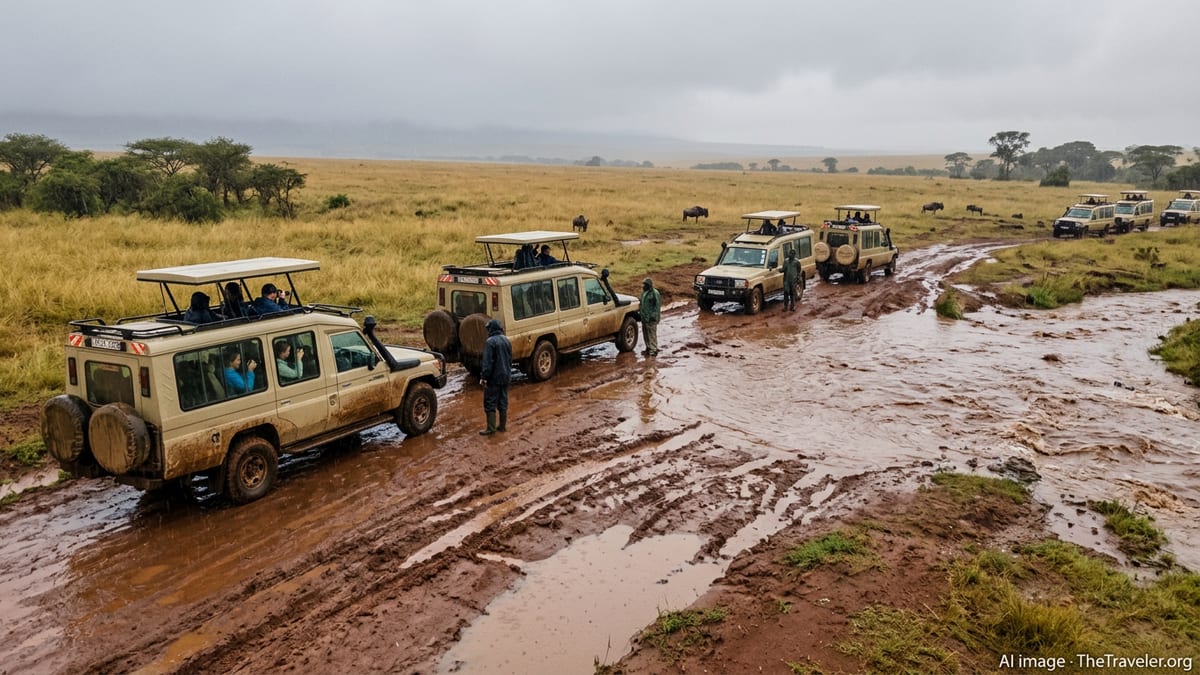
Flooding Turns Iconic Safari Landscape Into Hazard Zone
In recent days, prolonged heavy rainfall has transformed sections of the Serengeti’s vast savannah into fast-moving waterways, inundating dirt tracks that are the park’s main arteries for safari vehicles. Authorities report that several river crossings and low-lying culverts have been overwhelmed, leaving some tourists and guides cut off for hours while emergency teams work to reach them.
The Tanzania National Parks Authority has confirmed that roads and bridges have suffered significant damage, particularly at known flood-prone spots where seasonal rivers swell rapidly after storms. While park officials stress that core tourism activities remain open, they acknowledge that access to some areas is currently limited and that conditions can deteriorate quickly during downpours.
Local media and industry groups have reported instances of vehicles being swept off damaged tracks or becoming stuck between flooded drifts. In response, the government has announced millions of dollars in emergency funding to repair washed out roads and key bridges inside the park, underscoring the seriousness of the disruption during one of East Africa’s most important tourism periods.
Aerial surveys have been deployed to locate stranded vehicles and to map the extent of the flooding, with aircraft guiding ground rescue convoys to tourists cut off by rising waters. Temporary diversions and makeshift repairs have allowed many visitors to continue their journeys, but officials warn that the situation remains fluid as further rainfall is expected.
Tour Operators Issue Rare Safety Alert
The Tanzania Association of Tour Operators has taken the unusual step of issuing a sector wide flooding alert, urging its members to prioritize safety over tight itineraries. The association’s leadership has warned that some safari companies have continued to push through hazardous crossings, exposing clients and staff to unnecessary risk as flash floods surge across unpaved roads.
Operators are being advised to avoid driving through any running water, to halt game drives when storm clouds build over key river systems, and to strictly follow instructions from park wardens and rescue teams stationed at strategic points. Companies are also revising their daily briefings to clients, adding clearer explanations of weather related risks and the possibility of sudden route changes or delays.
Industry insiders say the flooding is testing long established safari routines. Guides accustomed to reading the bush are now being asked to exercise extra caution, sometimes cancelling sunrise or sunset drives in areas where roads are known to wash out. Several lodges have begun adjusting check in and check out times, allowing extra hours for vehicles to navigate safer, alternative routes during daylight.
Despite the disruption, tour operators emphasize that most visitors are still able to enjoy wildlife viewing, particularly in less affected sections of the central and southern Serengeti. However, they acknowledge that flexibility is essential, and that some marquee experiences, such as dramatic river crossings, may be off limits when water levels are dangerously high.
What Travelers on Safari Now Should Expect
Tourists currently in the Serengeti or due to arrive in the coming days are being advised to prepare for slower, more cautious journeys between camps and lodges. Road transfers that normally take a few hours can stretch far longer if convoys are rerouted around flooded drifts or forced to wait while water levels subside.
Many camps are coordinating closely with park authorities to stagger departures, reducing congestion at vulnerable crossings and ensuring that vehicles move in radio contact with one another. Guests may be asked to stay an extra night if conditions make onward travel unsafe, with some operators waiving penalties or providing alternative arrangements in nearby accommodations.
Inside the park, visitors can expect more frequent weather and safety briefings, along with restrictions on night driving in affected zones. Guides are likely to keep closer to all weather gravel or graded roads and away from remote black cotton soil tracks that cling to vehicles when wet. That may change the feel of some game drives, but it is intended to reduce the risk of vehicles becoming stranded far from help.
Officials also note that the flooding has not driven wildlife out of the park, and that in some areas animals may be easier to spot as they congregate on higher ground and along newly formed channels. However, rangers caution against leaving vehicles at viewpoints or attempting to approach wildlife on foot near swollen rivers, where banks can crumble without warning.
Planning a Trip: Safety, Insurance and Timing
For travelers with safaris booked in the coming weeks, the flooding has sharpened the focus on pre departure planning. Tour companies and travel advisers are urging clients to confirm that their itineraries allow for weather related changes and that their insurance policies cover delays, additional accommodation, or rearranged flights caused by natural events.
Prospective visitors are being encouraged to stay in close contact with their operator or lodge in the days before departure, rather than relying solely on generalized weather forecasts. Because conditions vary across different parts of the park, local on the ground updates from camp managers and guides remain the best indicator of what to expect on arrival.
Travel safety agencies continue to remind visitors that March and April are traditionally part of the long rain season in northern Tanzania, and that heavy downpours are not unusual during this period. What has changed this year, officials say, is the intensity and timing of storms, which appear linked to broader regional patterns of extreme weather and climate variability across East Africa.
Some operators are quietly steering more risk averse clients toward alternative dates later in the dry season, when road networks are typically more reliable. Others are emphasizing that traveling during the rains, while less predictable, can still offer rewarding wildlife experiences at lower crowd levels, provided guests are fully briefed on the risks and willing to adapt plans day by day.
How Authorities Are Responding on the Ground
In response to the crisis, Tanzanian authorities have mobilized a multi agency operation combining park rangers, engineers, local government officials, and private sector partners. Emergency teams equipped with heavy machinery are working to reinforce embankments, rebuild washed out road sections, and stabilize temporary crossings at the most critical points.
The government has earmarked substantial funds for medium term repairs to roads and bridges inside the Serengeti, recognizing that tourism is a vital source of revenue and employment. Plans already announced before the latest floods to construct new, more resilient bridges in historically vulnerable parts of the park are now being treated as a higher priority.
Park managers say they are also reviewing their early warning systems, exploring ways to combine satellite rainfall monitoring, river gauge data, and real time field reports from guides to trigger faster closures of dangerous crossings. The goal, according to officials, is to reduce reliance on improvised on the day decisions and to give operators clearer advance guidance when storms are moving into key safari areas.
While authorities insist that there is no immediate plan to close the Serengeti to visitors, they acknowledge that short term access restrictions to particular sectors or roads will continue whenever safety is in question. For now, tourists are being told that the park remains open, but that their experience may look different, with a stronger emphasis on risk awareness and cooperation between guides, operators, and rangers as the unusually wet season unfolds.