

More news on this day
Passengers across China faced mounting frustration as widespread flight cancellations and delays involving Xiamen Airlines, China Southern Airlines, and China United Airlines disrupted travel through Beijing, Wenzhou, Hangzhou, and several other major hubs, stranding travelers and rippling through already busy domestic air corridors.
Get the latest news straight to your inbox!
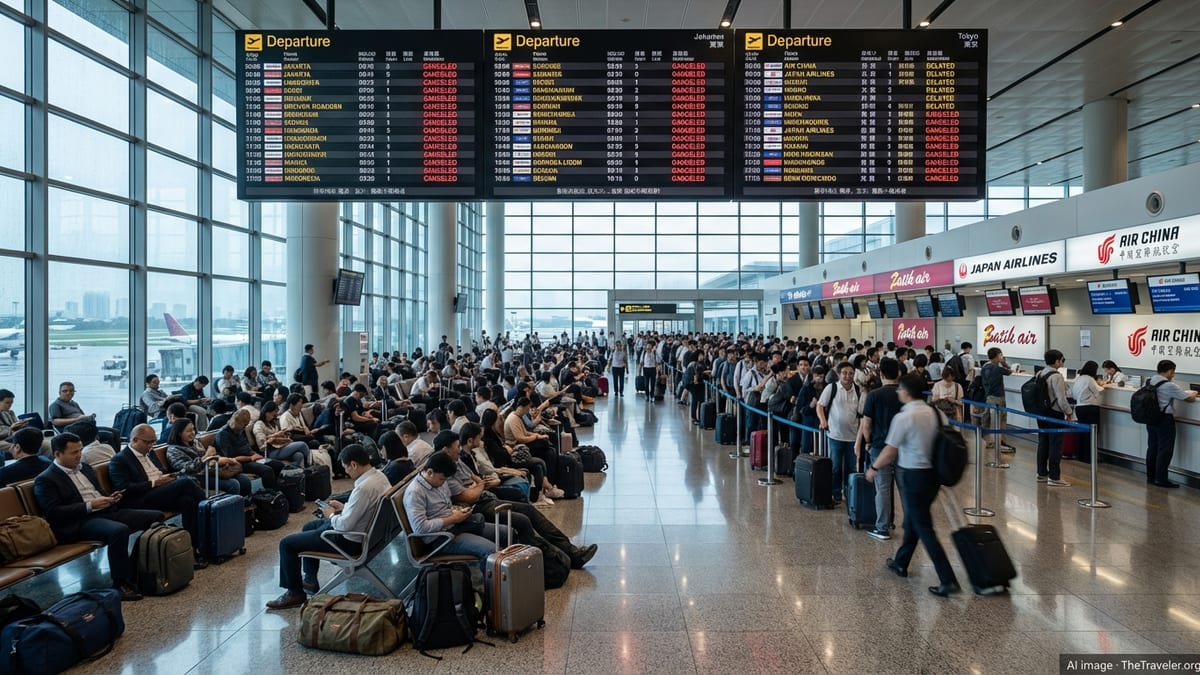
Widespread Disruptions Hit Major Chinese Hubs
Publicly available flight-tracking data and industry reports indicate that at least 40 flights operated by Xiamen Airlines, China Southern Airlines, and China United Airlines were canceled, with a further 342 experiencing delays across China. The disruption was concentrated on key routes feeding into Beijing, Wenzhou, and Hangzhou, but it also affected secondary cities linked to these hubs.
The scale of the disruption left many passengers stranded at airports or forced into lengthy rebookings and overland journeys. China’s densely scheduled domestic network meant that even a wave of cancellations affecting a relatively small share of daily flights had cascading effects, pushing later departures off schedule and tightening capacity for last minute rebooking.
Travel industry monitoring shows that Beijing’s airports, together with coastal hubs such as Hangzhou Xiaoshan International Airport and Wenzhou Longwan International Airport, were among the most affected. Delays on trunk routes linking these cities to other major centers in eastern and southern China added further pressure to an already congested system.
The latest disruption follows a broader pattern of operational challenges reported across China’s aviation network in recent months, where clusters of delays and cancellations at busy hubs have periodically stranded thousands of passengers and complicated domestic itineraries.
Impact on Xiamen Airlines, China Southern and China United
Among the hardest hit in the latest wave were Xiamen Airlines, China Southern Airlines, and China United Airlines, all of which operate extensive domestic networks connecting tier one cities with fast growing regional destinations. Published route and schedule information highlights how strongly these carriers are embedded in the country’s east coast and northern markets, including Beijing, Hangzhou, and Wenzhou.
Xiamen Airlines, which maintains a significant presence in Beijing and multiple eastern cities, saw several services linking interior cities to coastal hubs impacted. Delays and cancellations on routes feeding into Hangzhou and Wenzhou contributed to local congestion, with missed connections and limited spare capacity on later flights compounding the strain for travelers.
China Southern Airlines, one of China’s largest carriers by fleet and passenger numbers, was also heavily involved in the disruption. With the airline’s extensive network connecting Beijing and major eastern hubs to cities further south, schedule irregularities in one region translated quickly into knock-on delays elsewhere, illustrating the sensitivity of tightly timed domestic operations.
China United Airlines, which has a strong focus on Beijing Daxing International Airport and other domestic routes, likewise experienced cancellations and delays that reverberated across its network. Services linking Hangzhou to the capital, for example, have been highlighted in public tracking data as particularly vulnerable to schedule changes when broader system disruptions occur.
Travelers Confront Long Queues and Uncertain Itineraries
The immediate effects for passengers were felt in crowded terminals, long check in and customer service queues, and rapidly changing departure boards. Reports from Chinese and international travel outlets describe travelers waiting hours for updated information, with many forced to adjust hotel bookings, ground transport, and onward connections at short notice.
Families traveling for work and school holidays faced particular challenges, as a canceled or heavily delayed flight often meant missing connections in Beijing or Hangzhou, where options for same day rebooking were limited by high demand. In some cases, travelers opted to switch to high speed rail services, which link many of the affected cities and can provide a more predictable, if not always immediate, alternative.
Observers note that while China’s domestic aviation market has recovered strongly in terms of passenger numbers, the infrastructure strain is increasingly visible on peak days. When weather, congestion, or operational issues affect multiple carriers at once, the margin for accommodating disrupted travelers shrinks quickly, leaving passengers with few easy options.
Travel planners in the region have been advising clients to build in additional buffers between flights, particularly when passing through Beijing and eastern coastal hubs. The latest disruption is expected to reinforce this trend, as both leisure and business travelers reassess the risks of tight connections in a system that has shown periodic volatility.
Operational Strains, Weather and Network Complexity
Publicly accessible aviation data and recent coverage of Chinese air travel trends suggest several overlapping factors behind the pattern of cancellations and delays. Weather remains a frequent contributor, particularly when storms or low visibility affect multiple major airports at once, but analysts also point to congestion, crew scheduling constraints, and aircraft rotations across large networks.
Airlines such as China Southern and Xiamen Airlines manage complex webs of short haul routes that turn aircraft around quickly at busy airports. When an early flight into a hub is delayed or canceled, it can destabilize the day’s entire rotation for that aircraft and crew, with each missed slot contributing to a growing backlog of late departures.
At the same time, Chinese carriers are adjusting to evolving cost pressures and regulatory conditions. Recent announcements on domestic fuel surcharges and shifts in international capacity have influenced how airlines allocate aircraft and schedule domestic versus overseas services. Industry observers suggest that these broader strategic changes can amplify short term disruptions when operational challenges arise.
Infrastructure at major hubs has expanded significantly in recent years, but demand growth has often matched or exceeded new capacity. This leaves airports and airlines operating close to their limits during peak travel periods, increasing the likelihood that a cluster of cancellations and delays will escalate into a large scale disruption across multiple cities.
What the Disruption Means for Future Travel in China
The latest wave of cancellations and delays across Beijing, Wenzhou, Hangzhou and other cities is prompting renewed scrutiny of the resilience of China’s domestic air travel network. Travel industry commentators note that repeated episodes of large scale disruption risk eroding passenger confidence if they are not matched with visible improvements in communication, contingency planning, and schedule reliability.
Some carriers have expanded their digital tools, allowing travelers to rebook or request assistance through mobile apps rather than waiting in line at airport counters. However, when multiple airlines face disruptions simultaneously, even improved digital channels can become congested, and available seat inventory for alternative flights is quickly exhausted.
The interconnectedness of air, rail, and road transport in China is also coming into sharper focus. High speed rail has often acted as a pressure valve when flight operations are unstable, and travel experts expect that more passengers will consider rail first for routes under a certain distance, especially between major eastern cities.
For now, the disturbance involving Xiamen Airlines, China Southern Airlines, and China United Airlines serves as another reminder of the fragility of crowded air corridors in one of the world’s busiest domestic aviation markets. As schedules normalize, attention is likely to shift to how carriers and airport operators can reduce the risk that a similar mix of cancellations and delays will again leave large numbers of passengers stranded across China.