

More news on this day
Thousands of air travelers across China are facing major disruptions after a wave of cancellations and delays involving Xiamen Airlines, China Southern Airlines and China United Airlines left passengers stranded from Beijing to coastal cities such as Wenzhou and Hangzhou.
Get the latest news straight to your inbox!
Wide-Ranging Disruptions Hit Major Chinese Hubs
Publicly available operational data and industry monitoring reports indicate that at least 40 flights involving Xiamen Airlines, China Southern Airlines and China United Airlines have been cancelled across the country, with a further 342 departures delayed. The disruption has rippled through major hubs in northern and eastern China, affecting Beijing’s airports as well as important coastal gateways including Hangzhou and Wenzhou.
The pattern emerging from recent reports mirrors earlier disruption events in which Chinese hubs such as Beijing Daxing, Guangzhou Baiyun, Chengdu Tianfu and Shanghai Hongqiao have seen clusters of cancellations and extensive delay backlogs. Observers note that even a relatively small number of outright cancellations can trigger much larger waves of delays when aircraft and crews are rotated across multiple domestic routes in a tightly scheduled network.
In Beijing, the impact has been particularly visible at the newer Daxing hub, where Xiamen Airlines and China Southern both maintain important operations. Similar pressure has been reported at Hangzhou Xiaoshan International Airport and at Wenzhou Longwan International Airport, which serve as key links between eastern China’s coastal cities and inland centers.
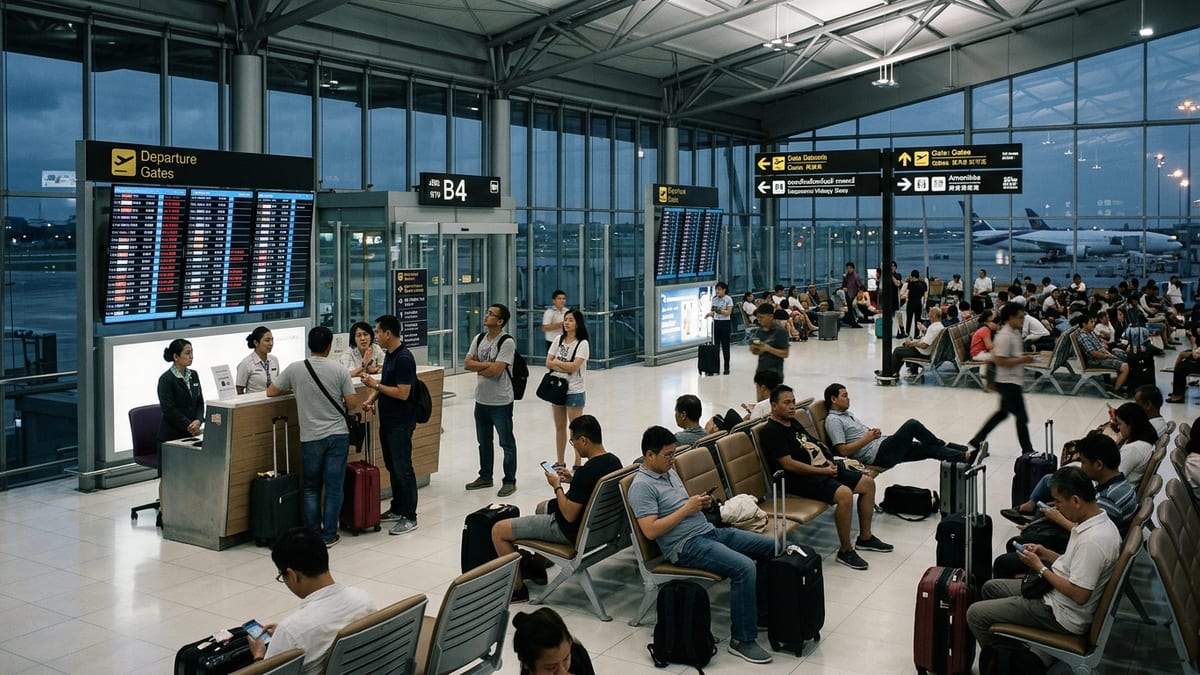
Travel and aviation trackers describe a delay-heavy operational environment, with many flights departing late rather than being scrubbed entirely. While this limits the headline number of cancellations, it has resulted in long queues at check-in and customer service counters, and extended waits on the tarmac and in terminal seating areas.
Operational Strain, Weather and Network Complexity
Reports point to a mix of factors behind the latest wave of disruption, including adverse weather, heavy air traffic and broader regional instability affecting airline scheduling. Earlier incidents in March showed how a combination of weather systems and geopolitical tensions could ripple through Asia-Pacific aviation, forcing hundreds of cancellations and thousands of delays across multiple countries as carriers rebalanced aircraft and crew availability.
In China’s domestic system, the knock-on effects are especially pronounced because major carriers such as China Southern Airlines and Xiamen Airlines operate dense webs of short-haul routes connecting tier-one hubs with regional cities. When a single aircraft rotation is disrupted in Beijing, for example, it can immediately affect later departures to secondary cities and then onward flights from those airports, turning a localized issue into a nationwide network challenge.
Industry data aggregators underline that Chinese airports already operate near capacity during peak travel periods, with relatively little slack built into schedules. When delays accumulate through the day at large hubs like Beijing, Hangzhou and Guangzhou, it becomes increasingly difficult for airlines to recover, leading to late-evening cancellations as crew duty limits are reached and aircraft miss their allocated slots.
Aviation analysts observing the current situation note that similar disruption patterns have appeared repeatedly over recent weeks, suggesting that the system remains highly sensitive to external shocks. While each episode may be triggered by specific local conditions, the overall picture is one of a network operating with limited resilience.
Impact on Passengers Across Beijing, Wenzhou, Hangzhou and Beyond
For passengers, the statistics translate into missed connections, abandoned itineraries and long waits at crowded terminals. Beijing’s dual-airport system, together with coastal airports such as Wenzhou and Hangzhou, handles heavy volumes of business and leisure traffic, so even a modest rise in cancellations can leave thousands of travelers scrambling to rebook or secure accommodation.
Travel-focused outlets tracking disruption across Asia report scenes of congested departure halls and long queues at information desks when clusters of cancellations occur. Passengers on affected services operated by Xiamen Airlines, China Southern Airlines and China United Airlines have faced uncertainty over revised departure times and the availability of alternative routes, particularly on busy trunk sectors where remaining seats are quickly taken.
Secondary effects are also being reported at connecting airports as delayed inbound flights miss scheduled onward departures. Travelers heading from Beijing or eastern China to other parts of Asia have encountered additional disruption at transfer points, as delayed arrivals force last-minute rebooking and luggage handling complications.
Some recent analyses of past disruption events in China have highlighted the particular frustration caused when passengers receive limited or inconsistent information about the status of delayed flights. While digital tools and airline apps have improved transparency in many cases, uneven communication practices can still leave travelers uncertain about whether to wait at the gate or seek alternative options.
How Airlines and Airports Are Managing the Backlog
Publicly available coverage of the current disruption indicates that airlines are relying heavily on same-day rebooking, rolling delay announcements and limited aircraft swaps in an effort to restore schedules. On routes where multiple daily frequencies are available, some passengers are being shifted to later flights, while others are being routed through alternative hubs when capacity allows.
Ground operations teams at Beijing, Wenzhou, Hangzhou and other affected airports have been tasked with managing large volumes of displaced passengers while simultaneously keeping security screening and boarding procedures flowing. In several recent disruption episodes across China, airport operators have emphasized measures such as dynamic gate reassignment and priority handling of severely delayed flights in order to reduce congestion on taxiways and at jet bridges.
Aviation data from recent days suggests that, in many cases, carriers prefer to maintain as many services as possible, even with multi-hour delays, rather than cancel entire rotations. This approach is intended to preserve connectivity for travelers who may have no near-term alternative options, although it can also result in late-night arrivals and further strain on crews and airport staff.
Observers note that the current situation may prompt renewed discussion within China’s aviation sector about schedule robustness, airspace management and investment in infrastructure at rapidly growing airports. Repeated patterns of multi-airport disruption have already fueled debate over how to add resilience to one of the world’s busiest domestic air networks.
What Travelers Can Do During Ongoing Disruptions
Travel industry guidance compiled in response to recent waves of cancellations across Asia suggests a number of practical steps for passengers caught up in similar events. Monitoring flight status closely on official airline channels, confirming any schedule changes before heading to the airport and arriving earlier than usual for check-in are consistently recommended.
Where cancellations occur, passengers are often offered rebooking on the next available flight operated by the same carrier or, in some cases, on partner airlines. Because high-demand routes can sell out quickly after disruption begins, travelers are advised in many public guides to act promptly once alternative options are presented, while carefully checking any change fees or fare differences that might apply.
Consumer advocates focused on air travel also emphasize the importance of retaining boarding passes and confirmation emails, documenting delays and keeping receipts for any accommodation or meal expenses incurred during extended disruptions. While compensation rules vary significantly by jurisdiction and route, such documentation can support later claims or formal complaints where applicable.
With Chinese domestic and regional traffic expected to remain strong, analysts suggest that passengers planning trips involving Beijing, Wenzhou, Hangzhou or other major Chinese hubs may wish to build additional buffer time into their itineraries. Recent disruption patterns indicate that tightly timed connections leave little margin when severe delays strike, particularly on days when multiple airlines experience concurrent operational challenges.