

More news on this day
Air travelers across Egypt faced mounting disruption this week as more than two dozen flights operated by EgyptAir, Emirates, Gulf Air and other carriers were cancelled from Cairo, Hurghada, Luxor and additional gateways, severing or reducing links to major Gulf hubs including Dubai, Doha, Riyadh, Abu Dhabi and Kuwait, as well as European cities such as Berlin.
Get the latest news straight to your inbox!
Regional Airspace Turmoil Ripples Into Egyptian Airports
Published coverage on Middle East aviation conditions in March 2026 indicates that widespread airspace restrictions and operational suspensions across the region are continuing to reverberate through Egyptian airports. While Egyptian airspace remains technically open, multiple reports describe extensive schedule changes and targeted route suspensions by regional and international airlines as carriers navigate evolving security assessments.
The latest wave of cancellations affecting travelers in Egypt appears closely tied to these broader disruptions. Services linking Cairo, Hurghada and Luxor with Gulf hubs such as Dubai, Abu Dhabi, Doha, Riyadh and Kuwait City are among the most affected, alongside certain services to European destinations, including Berlin. For many carriers, the challenge is not limited to a single country’s airspace, but rather to the cumulative impact of closures and restrictions across adjacent flight corridors that are essential for east–west connectivity.
Publicly available information shows that this instability has prompted airlines to repeatedly adjust schedules at short notice, creating a fast-changing picture for passengers. As a result, a flight that appears confirmed one day may be removed from the departure board the next, leaving travelers in Egypt unsure whether their journeys will proceed as planned.
EgyptAir, Emirates, Gulf Air and Others Trim Schedules
EgyptAir has already reduced its network to several Middle Eastern destinations in response to the regional situation, with published corporate updates describing temporary suspensions on a range of Gulf and Levant routes. Flights from Cairo and secondary Egyptian cities to Doha, Riyadh, Abu Dhabi, Kuwait and other points have been particularly exposed, directly affecting both point-to-point travelers and those using Cairo as a connecting hub.
Emirates services between Dubai and Cairo have also been subject to cancellation windows and phased resumptions in recent weeks, according to airline advisories and airport updates. Travelers report that certain rotations are reinstated on a limited basis while others remain withdrawn, contributing to a patchwork of availability that changes by the day. Similar patterns have been noted on links between Dubai and Red Sea gateways such as Hurghada, with some departures cancelled even as others continue to operate.
Gulf Air and additional Gulf-based carriers have likewise adjusted their operations in and out of Egypt amid ongoing airspace and operational uncertainties. Reports from regional media and passenger forums reference cancellations on services connecting Egyptian cities with hubs in Bahrain, Qatar and Saudi Arabia, as airlines consolidate traffic onto fewer flights and reroute aircraft to corridors deemed more predictable.
Passengers Scramble for Alternatives as Seats Vanish
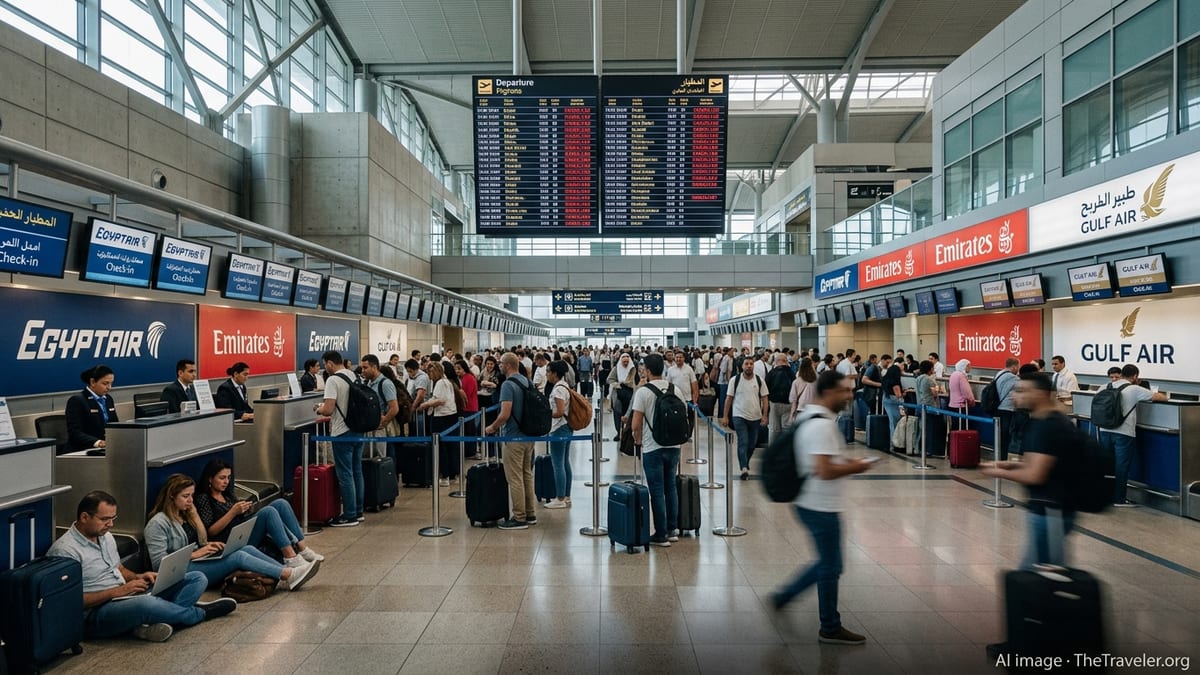
For travelers on the ground in Egypt, the practical effect of more than 25 cancellations across multiple airports in a short period has been a scramble for alternatives. Accounts shared on public travel and aviation forums describe passengers in Cairo, Hurghada and Luxor queuing at airline counters, attempting to secure space on remaining departures to Dubai, Doha, Riyadh, Abu Dhabi and Kuwait after their original flights were removed from schedules.
With capacity constrained, particularly on the most in-demand Gulf routes, many travelers report rebooking delays spanning several days. Some describe being shifted from cancelled services to special or repatriation-style flights, often with altered routings and departure times. Others have opted to reroute entirely via less affected hubs, accepting longer itineraries through Europe or different parts of the Middle East in order to reach final destinations such as Berlin, Riyadh or Doha.
Published airline guidance generally encourages passengers to monitor booking portals and flight status tools closely, as same-day changes remain possible. However, travelers stranded at airports have noted that online tools sometimes lag behind operational decisions, further complicating efforts to secure timely alternative arrangements.
Tourism and Business Travel Face New Uncertainty
The latest cancellations arrive at a sensitive moment for Egypt’s tourism sector, particularly in Red Sea and Upper Egypt destinations that rely heavily on air links to the Gulf and Europe. Hurghada and Luxor, both popular with leisure visitors and regional travelers, have seen selected departures cut or combined, creating uncertainty for tour operators, hotel partners and independent travelers with time-sensitive itineraries.
Business and expatriate travel between Egypt and Gulf cities has also been disrupted. Regular shuttles between Cairo and hubs such as Dubai, Abu Dhabi and Doha are a key artery for multinational companies, contract workers and government-related travel. Each additional round of schedule changes increases the risk of missed meetings, delayed project starts and interruptions to rotational work patterns that depend on predictable flight options.
Industry observers note that airlines are attempting to balance operational safety and regulatory compliance with the commercial imperative to maintain key routes. In practice, that has led to a strategy of operating a reduced but still meaningful schedule, which can provide a lifeline for essential travel but leaves many discretionary or lower-priority trips vulnerable to late-notice cancellation.
What Travelers Through Egypt Should Expect Next
Looking ahead, regional aviation analysts quoted in recent coverage suggest that further short-notice adjustments remain likely as long as airspace restrictions and security assessments continue to evolve. Flight timetables to and from Egypt may show gradual increases in frequencies on certain routes, but these improvements can be reversed quickly if conditions worsen along key corridors.
Prospective travelers through Cairo, Hurghada, Luxor and other Egyptian airports are being advised in public guidance to build additional flexibility into their plans. That can include allowing longer connection windows, preparing backup routings through alternative hubs, and ensuring that accommodation bookings are refundable or changeable in case onward flights are cancelled.
Consumer information from airlines and airports stresses the importance of monitoring flight status up to the time of departure and remaining reachable via updated contact details. Given the scale of the recent cancellations, travelers heading to destinations such as Dubai, Doha, Riyadh, Abu Dhabi, Kuwait and Berlin from Egypt in the coming days are likely to face a more fluid environment than usual, with operational decisions continuing to be shaped by developments well beyond Egypt’s borders.