

More news on this day
Travelers across Italy are facing mounting disruption as a combination of airline suspensions, strike threats and severe winter weather has led to at least 14 flight cancellations and widespread delays at major gateways in Milan, Florence and Rome, affecting services operated by easyJet, Iberia, CityJet, Air France, KLM and other carriers.
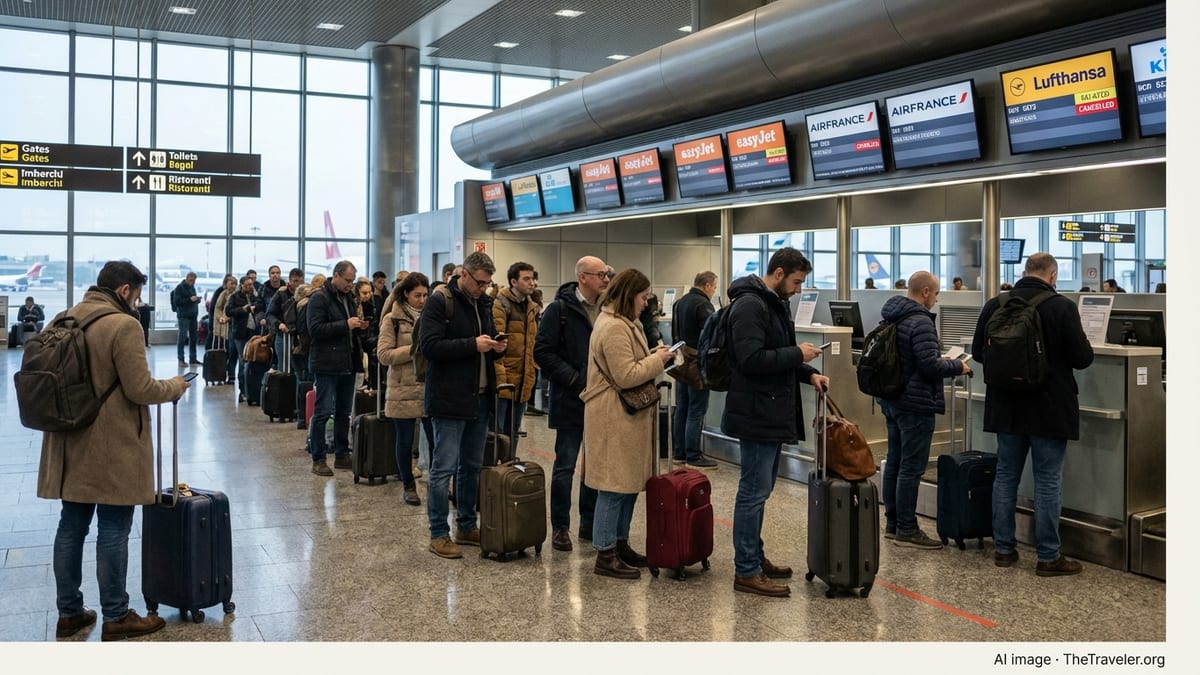
Airline Cancellations Ripple Across Italian Hubs
Italian airports already under seasonal pressure are contending with a fresh wave of disruption as multiple European carriers pull flights and thin their schedules. According to airport and airline advisories, at least 14 flights involving easyJet, Iberia, CityJet, Air France, KLM and partner airlines have been suspended across key routes touching Milan, Florence and Rome, leaving passengers scrambling for alternatives. While some cancellations are concentrated on short-haul European sectors, knock-on effects are being felt across connecting networks.
The immediate impact is most visible at Milan’s Linate and Malpensa airports, Rome Fiumicino and Florence’s Amerigo Vespucci Airport, where boards have periodically filled with “cancelled” and “delayed” notices. Airline operations teams are working to consolidate lightly booked services, protect longer-haul connections and reposition aircraft and crews, a delicate balancing act made harder by a tight winter timetable and brittle staffing levels.
For affected passengers, the disruption is playing out in long queues at service desks and crowded departure areas. With multiple airlines adjusting their programs at the same time, rebooking options have become more limited by the hour, and some travelers have been forced to overnight in airport hotels or detour through secondary hubs to reach their destinations.
Despite the relatively small number of outright cancellations so far, the combination of delays, missed connections and aircraft rotations has amplified the sense of uncertainty. Travel agents and airline call centers report a surge in inquiries from customers anxious to confirm that their upcoming flights will still operate.
Strikes and Industrial Tensions Add to Operational Strain
The latest flight suspensions come against a backdrop of renewed industrial tension in Italy’s aviation sector. Unions representing airline crews, ground handlers and air traffic control staff have announced and, in some cases, rescheduled nationwide and carrier-specific strikes stretching from late February into early March. Recent government intervention has postponed a 24-hour general aviation strike that was originally slated for mid-February, pushing it to later in the month to avoid coinciding with major events and peak traffic periods.
Although that action has been delayed, unions representing employees at ITA Airways, Vueling and easyJet have signaled that further walkouts remain possible if contract disputes over working hours, pay progression and staffing levels are not resolved. Previous coordinated stoppages have explicitly named foreign carriers operating in Italy, including Air France and KLM, as being affected through ground handling slowdowns and support staff shortages at key hubs such as Rome Fiumicino and Milan Malpensa.
Industrial unrest has a cascading effect: even when only a portion of staff participate, airlines may preemptively trim schedules to preserve safety margins and avoid last-minute operational breakdowns. Short targeted strikes, sometimes lasting only a few hours, can still disrupt the day’s program, particularly in tightly banked morning and evening waves when European point-to-point flights connect with long-haul services.
With labor negotiations ongoing, both airlines and airport coordinators are drawing up contingency plans that may include further selective cancellations, especially on domestic and regional routes where alternative transport options by rail or road are more readily available. Passengers planning to travel over the next two weeks are being urged to monitor updates from their carriers closely, even if their specific flight has not yet been flagged as at risk.
Severe Winter Weather Compounds Disruption
At the same time, Italy is feeling the effects of a powerful winter storm system sweeping across parts of Europe. Meteorological services have reported high winds, low cloud and periods of heavy rain at low altitudes, along with snow in the northern Apennines and the Alps. These conditions have strained airport operations in northern and central Italy, with Milan and Florence particularly exposed to crosswinds and visibility issues that can quickly force air traffic control to slow or temporarily halt arrivals and departures.
Florence’s compact city airport, hemmed in by surrounding hills and subject to strict wind and visibility limits, is especially vulnerable. Over the past 24 hours, crews operating regional services on behalf of larger carriers, including CityJet and other partners flying for Air France and KLM, have faced diversions, extended holding patterns and last-minute returns to departure airports when conditions have fallen below safety thresholds. Even when flights ultimately land, delays cascade through the rest of the day’s roster.
In Milan, operations at both Malpensa and Linate have been intermittently disrupted by gusty winds and heavy precipitation associated with the broader European storm pattern. Ground handling teams have had to work more slowly when lightning or strong gusts are present, and de-icing operations have added time to morning turnarounds. While such measures are routine for winter operations, their impact is magnified when airlines are already thinning their schedules due to staffing constraints and industrial uncertainty.
Rome Fiumicino, though less directly affected by the worst of the storm, has nonetheless seen delays as en route traffic diverts around congested airspace and as connecting passengers miss onward services arriving from northern cities. As a major transfer hub for both ITA Airways and joint ventures involving Air France and KLM, any slowdown in Rome reverberates through their broader international networks.
How Major Carriers Are Responding
Airlines named in the latest wave of cancellations are adopting a mix of schedule adjustments and customer-care measures to manage the disruption. Low-cost carrier easyJet, which maintains a dense short-haul network linking Milan and other Italian cities with northern Europe, has consolidated a number of frequencies where demand can be accommodated on remaining flights, and is using flexible rebooking policies to move travelers to alternate departures on the same day or later in the week.
Legacy carriers such as Iberia, Air France and KLM, which rely heavily on Italian feeder traffic into their respective hubs in Madrid, Paris and Amsterdam, have selectively suspended some rotations that are most exposed to weather or staffing constraints. These airlines are prioritizing long-haul connections and higher-volume business routes, while offering affected customers the choice of rerouting via other European gateways or postponing travel to a later date. Passengers holding through-tickets are being rebooked, subject to seat availability, without additional fare collection in many cases.
For regional operators including CityJet and other franchise or wet-lease partners, the challenge is to maintain aircraft and crew positioning so that disruptions on one or two Italian sectors do not cascade into their broader network obligations. Industry sources indicate that some of the 14 suspended flights involve these smaller carriers operating on behalf of larger brands, which can complicate communication for passengers who booked through a major airline but are actually flying with a partner carrier.
Across the board, airlines are encouraging customers to use digital self-service tools rather than queue at airport desks. Mobile apps and websites are being updated throughout the day as operational decisions are made, and most carriers are sending proactive notifications via email and text message when flights are changed or cancelled. Nonetheless, the volume of affected travelers is putting noticeable strain on call centers and social media support teams.
Impact on Milan: Fashion, Business and Olympic Traffic
Milan remains at the epicenter of the current disruption, with both Malpensa and Linate handling a mix of business traffic, inbound tourism and event-related flows tied to the city’s high-profile calendar. Airlines and tourism officials had already flagged February as a sensitive month, with winter sports crowds, trade fairs and cultural events drawing elevated visitor numbers into northern Italy. The suspended flights and rolling delays are now cutting into that capacity just as hotels and venues report strong bookings.
Businesses that rely on same-day or overnight travel between Milan and other European financial centers are reporting missed meetings and hastily rescheduled itineraries. On certain routes, particularly those linking Milan with Paris, Amsterdam, Madrid and London, the loss of specific frequencies and unpredictable departure times have made it harder for companies to plan one-day trips, pushing some toward videoconferencing or rescheduling to later in the season.
Tourism stakeholders in Lombardy also worry about the reputational impact of repeated transport disruptions. While most visitors understand that severe weather and industrial disputes can affect air travel, a sequence of strikes and storm-related cancellations risks reinforcing perceptions of Italy as a challenging destination to navigate during the winter months. Local authorities have urged travelers to allow extra time for airport transfers and to consider flexible booking options where possible.
Rail services on key corridors linking Milan with Rome, Florence and Venice are absorbing some of the displaced demand, but these networks have limits, particularly at peak hours. Trenitalia and Italo high-speed trains on popular routes are already busy, and last-minute seats can be scarce and expensive when multiple flights are cancelled on short notice.
Florence and Rome Feel the Knock-On Effects
In Florence, where the city’s airport has a history of weather-related operational constraints, the latest disruptions are amplifying long-standing debates about capacity and resilience. With several flights diverted to or from nearby airports in recent days, passengers have reported unplanned coach transfers to Pisa or Bologna and extended waits for baggage and ground transport. Airlines affected by these reroutings, including Iberia and regional partners operating for Air France and KLM, have had to juggle bus arrangements, hotel rooms and meal vouchers for stranded travelers.
Local tourism operators say cancellations and delays are hitting short-stay city-break visitors particularly hard. Many travelers to Florence plan tightly packed weekend itineraries built around museum visits and restaurant reservations, leaving little room to absorb a lost half-day due to a late arrival or missed connection. Hoteliers and tour guides are working to rearrange bookings where possible, but some businesses report last-minute no-shows and shortened stays.
Rome Fiumicino, Italy’s primary international gateway, is meanwhile functioning as both a pressure valve and a bottleneck. Some airlines have rerouted traffic through Rome to avoid weather or slot constraints at northern airports, but the additional load is stretching terminal facilities and security checkpoints during certain peaks. Passengers arriving from disrupted flights in Milan and Florence have occasionally missed onward long-haul departures, adding to rebooking queues and straining lounge capacity.
City transport in Rome has also faced intermittent industrial action and heavy congestion due to poor weather, complicating journeys between the city center and the airport. Local authorities are advising travelers to set out earlier than usual, particularly for morning flights when road traffic is densest and any accident or downpour can quickly cause tailbacks on the ring road.
What Passengers Can Do If Their Flight Is Affected
Consumer advocates and travel advisors are urging passengers to take a proactive approach if they are scheduled to fly to or from Milan, Florence or Rome in the coming days. The first step, they say, is to verify the status of flights directly through airline apps or official channels on the day of travel, and again a few hours before leaving for the airport. Even when departures appear on time, sudden shifts in weather patterns or last-minute staffing issues can trigger schedule changes.
Experts recommend that travelers whose flights are cancelled or significantly delayed contact their airline as soon as possible to discuss rebooking or refunds. Depending on the carrier, route and cause of disruption, passengers may have rights to alternative transport, accommodation or financial compensation under European air passenger regulations. In practice, these entitlements can vary case by case, and documentation such as boarding passes, booking confirmations and receipts for extra expenses should be kept safely for any future claim.
Passengers with tight connections, particularly those linking short European hops with long-haul journeys, are advised to allow greater buffer times or, where feasible, consolidate separate tickets into a single booking with one airline group. This can make it easier to secure protection on later flights if the first leg is delayed. Travel insurance that includes disruption coverage may also help offset costs linked to hotel nights, meals and nonrefundable tour reservations.
Finally, travelers are being encouraged to remain flexible in their plans. In some cases, shifting to rail on domestic routes, flying into an alternative Italian airport, or adjusting travel dates by a day or two can significantly reduce the risk of being caught up in the worst of the disruption. While the current wave of cancellations has been relatively contained in numerical terms, the combination of strikes, weather and tight winter schedules means that conditions at Italian airports may remain unpredictable in the short term.