

More news on this day
Hundreds of travelers were left stranded at Baghdad International Airport after multiple outbound flights to Doha, Amman and other key regional hubs were abruptly canceled, disrupting connections across the Gulf as airlines including Qatar Airways, Gulf Air and Royal Jordanian continued to navigate a volatile regional airspace situation.
Get the latest news straight to your inbox!
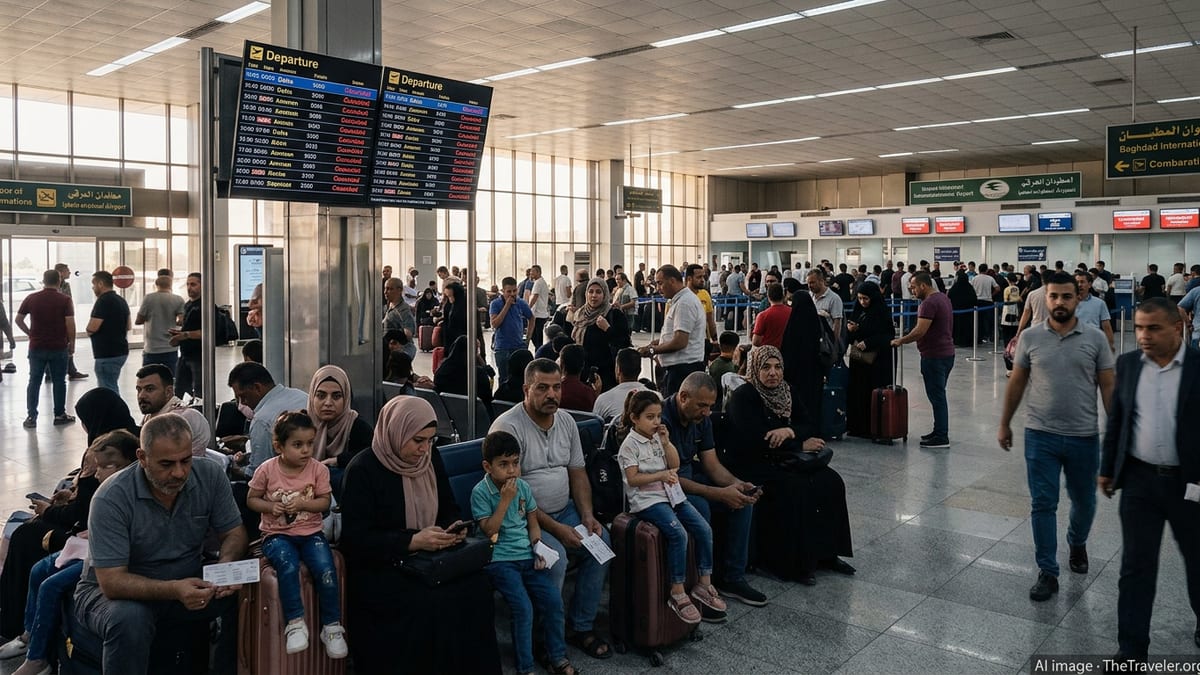
Wave of Cancellations Hits Key Regional Routes
Reports from Baghdad on March 17 indicate that at least seven flights scheduled to depart from Baghdad International Airport were canceled in quick succession, affecting services to Doha, Amman and other Middle Eastern destinations that function as critical transit gateways for onward long haul travel. Passengers preparing to check in for evening departures found their flights either marked as canceled on terminal display boards or removed entirely from schedules.
The cancellations reportedly involved services operated by or codeshared with Qatar Airways, Gulf Air and Royal Jordanian, three carriers that connect Iraq to major hubs in Qatar, Bahrain and Jordan. These routes are commonly used by travelers heading to Europe, North America and Southeast Asia, making the disruption especially impactful for those with tight onward itineraries.
Airport staff were seen directing affected passengers toward carrier service desks, where long lines quickly formed as travelers sought rebooking options, refunds or temporary accommodation while they waited for clarity on the evolving situation. Many faced the added complication of expired visas, missed medical appointments and disrupted work travel as the cancellations rippled through their plans.
While Baghdad International Airport itself remained operational, publicly available flight-tracking data and regional aviation updates suggested that the primary driver of the disruption was not a local technical issue inside Iraq, but wider uncertainties in surrounding airspace that continued to force last minute adjustments to airline schedules.
Regional Airspace Constraints Intensify Disruption
The latest disruption in Baghdad comes against the backdrop of an already fragile aviation environment across the Gulf and wider Middle East in March 2026. Regional security developments and a series of Iranian missile strikes, including reported targets around Doha, have led to rolling airspace closures and restrictions in several Gulf states, prompting airlines to cancel, reroute or consolidate flights with little advance notice.
Publicly available bulletins from regional transport and maritime advisories in early March described a patchwork of airspace constraints, with some Gulf countries closing their skies entirely and others imposing time limited restrictions. These measures have forced airlines to alter standard flight corridors, extend flight times and, in many cases, suspend passenger operations on certain routes while limited emergency or repatriation services continue.
Qatar in particular has seen significant disruption since late February following strikes that affected the area around Hamad International Airport and triggered a temporary closure of national airspace. Subsequent updates from the Qatar Civil Aviation Authority outlined a cautious partial reopening under emergency conditions, prioritizing evacuation and cargo movements over regular commercial schedules, leaving many passenger flights to and from Doha suspended or subject to sudden changes.
The cumulative effect of these measures has been felt well beyond the immediate conflict zones. Iraq, Jordan, Kuwait and other states that sit along common east west transit corridors have experienced delays, detours and cancellations as airlines attempt to avoid sensitive airspace while still maintaining skeletal connectivity for stranded travelers.
Qatar Airways, Gulf Air and Royal Jordanian Under Pressure
The three airlines most directly associated with the canceled departures in Baghdad all play outsized roles in regional connectivity, and each has been reshaping its operations in response to the shifting risk landscape. Qatar Airways, which normally operates dense waves of flights through Doha linking Europe, Asia, Africa and the Americas, has issued a series of travel advisories in recent weeks reflecting extensive cancellations and schedule reductions as its primary hub grapples with constrained airspace and limited traffic volumes.
Publicly available guidance circulated through airline trade portals and passenger updates describes flexible policies for travelers booked on Qatar Airways services over a defined disruption window, including options for refunds, date changes and, in some cases, rebooking on alternative carriers. Online forums and traveler reports suggest that many passengers have already experienced multiple rounds of cancellations and rebookings as the carrier adapts day by day to changing operational clearances.
Gulf Air and Royal Jordanian have also adjusted their networks amid the broader regional turbulence. Published coverage of Jordan’s aviation sector has noted temporary suspensions of flights to certain high risk destinations, including parts of the Gulf, driven by airspace closures in neighboring states. Royal Jordanian continues to use Amman’s Queen Alia International Airport as a key bridge between Iraq and long haul destinations, but some flights have been curtailed or rescheduled at short notice, complicating connection planning for passengers transiting from Baghdad.
For Gulf Air, which relies on Bahrain International Airport as a transit hub, regional restrictions have required tighter coordination of departure banks and a focus on routes that can safely operate within approved corridors. Any disruption touching Doha, Amman or Bahrain tends to have knock on effects across their networks, amplifying the impact on travelers departing from secondary cities such as Baghdad.
Travelers Confront Uncertainty and Limited Alternatives
For passengers in Baghdad caught up in the latest cancellations, the disruption has translated into hours of uncertainty in crowded terminals, with many unsure when or how they will reach their final destinations. With several neighboring airspace zones either closed or heavily restricted, rerouting options are constrained, and alternative itineraries can involve lengthy detours via more distant hubs, often at higher cost.
Travel discussion boards and social media posts from recent days describe travelers stranded not only in Gulf hubs such as Doha, but also in connecting airports in Europe and Asia after flights onward to the Middle East were canceled mid journey. In some cases, passengers have reported being rebooked several days later on different airlines, while others have opted to accept refunds and abandon trips entirely amid concerns that the situation could persist or escalate.
In Baghdad, standard passenger protections and rebooking obligations continue to apply according to airline specific policies and the rules of the ticketing country, but the extraordinary nature of the regional disruption limits what carriers can offer in practice. Hotel capacity near the airport and in central Baghdad is being tested by the influx of stranded travelers seeking short term stays while they await new flight arrangements.
Travel agents and online booking platforms are advising customers with upcoming itineraries involving Baghdad, Doha, Amman or other Gulf and Levantine hubs to monitor their reservations closely, ensure contact details are up to date in airline systems and consider building in additional buffer time for onward connections. Many are also encouraging travelers to review the terms of their travel insurance, particularly clauses related to war, conflict and airspace closures, which may affect eligibility for compensation.
What Passengers Can Expect in the Coming Days
As of March 17, the aviation outlook across the Gulf and surrounding region remains fluid. While some states have signaled a willingness to gradually reopen portions of their airspace under strict safety conditions, publicly available flight data suggests that airlines are continuing to operate with extreme caution, restoring only a limited number of routes and frequencies where they can be confident of consistent access to safe corridors.
Industry analysts note that a sustained return to regular schedules from Baghdad to Doha, Amman and other key hubs will depend not only on local airport conditions, but also on coordinated decisions by regional governments, civil aviation authorities and air navigation providers. Any renewed tensions or additional strikes affecting major hubs or airways could prompt new rounds of cancellations, potentially prolonging the disruption for weeks.
In the short term, passengers departing from Baghdad International Airport are likely to see more conservative scheduling, with airlines favoring fewer, more reliably operable flights over pre disruption frequencies. Travelers may find that alternative routings through non Gulf hubs in Turkey, Europe or South Asia become more prominent options, though these too are subject to change as airlines reassess risk and demand.
For now, the scenes at Baghdad International Airport, where hundreds of passengers have been left in limbo by a cluster of canceled flights, reflect the broader uncertainty facing air travel across the region. Until airspace restrictions ease and carriers regain confidence in their ability to operate stable schedules, travelers can expect continued volatility in flight operations, even on routes that have historically been considered routine.