

More news on this day
Passengers at Singapore Changi Airport faced fresh disruption this week as Qatar Airways, Gulf Air, Etihad Airways, Turkish Airlines and other regional carriers cancelled nearly a dozen flights, abruptly severing key links to Doha, Jakarta, Abu Dhabi, Istanbul, Kuala Lumpur and several other hubs.
Get the latest news straight to your inbox!
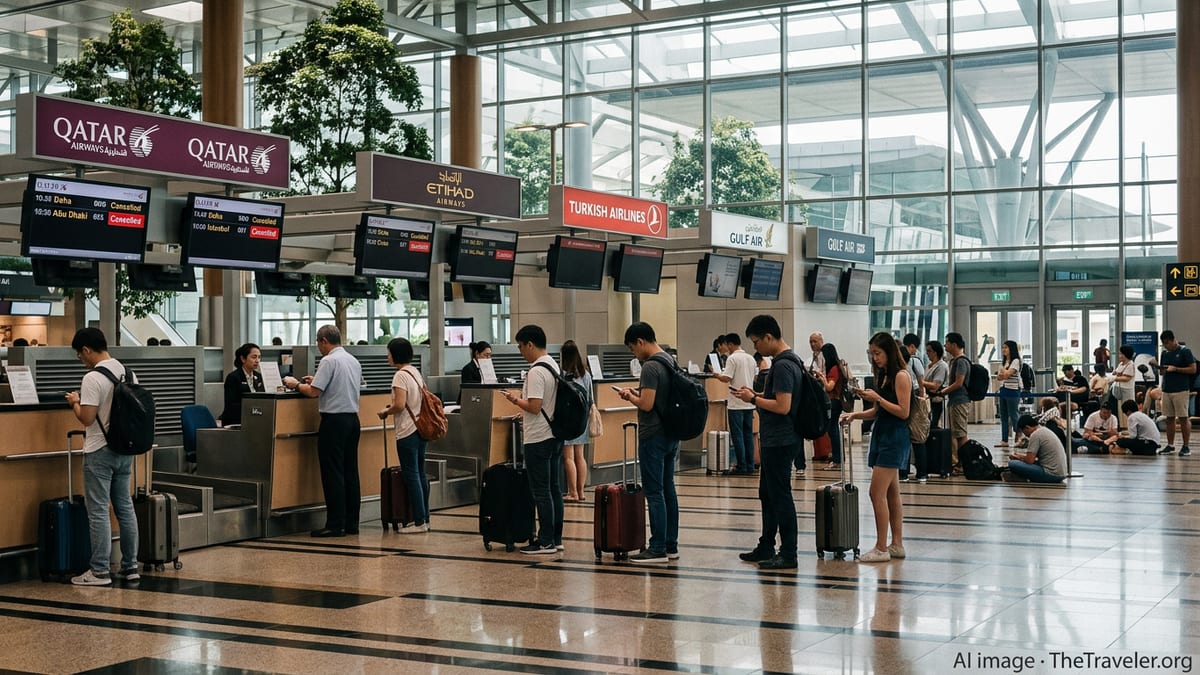
Multiple Gulf and Turkish Flights Scrubbed From Departure Boards
At Singapore Changi, one of Asia’s busiest transit airports, departure screens showed a cluster of cancellations affecting services operated by Qatar Airways, Gulf Air, Etihad Airways and Turkish Airlines, along with a handful of codeshare partners. The affected flights were primarily bound for Doha, Abu Dhabi and Istanbul, with knock-on impacts for passengers continuing to destinations across Europe, the Middle East and Africa.
Airport staff reported that the cancellations began appearing in the early hours of the morning local time, with some passengers only learning of the disruption upon arrival at the terminal. Others received overnight notifications prompting them to rebook or contact their airline for assistance, but many still turned up at the airport seeking clarification and alternative routes.
While the total number of flights involved remains relatively small compared with Changi’s overall schedule, the impact has been magnified by the strategic importance of these carriers for long haul connectivity. Qatar Airways, Etihad Airways and Turkish Airlines in particular are widely used by Southeast Asia based travelers for one stop itineraries to Europe, the United Kingdom and North America.
For travelers heading to regional cities such as Jakarta and Kuala Lumpur, the cancellations also disrupted shorter hops operated under interline and codeshare agreements, further complicating rebooking efforts for those relying on tight connections through Changi.
Operational And Regional Factors Behind The Latest Disruption
The latest wave of cancellations appears tied to a mix of operational constraints and ongoing regional security concerns that have weighed on Gulf carriers in recent weeks. Airlines serving Doha and Abu Dhabi have already been adjusting schedules in response to changing airspace restrictions and evolving risk assessments on certain routings across the Middle East.
Industry sources indicate that several carriers have opted to consolidate lightly loaded services or temporarily suspend specific rotations from Singapore in order to free aircraft and crews for routes with higher demand or more stable operating conditions. In practice, that has meant selectively cancelling flights where alternative routing options exist for affected passengers, rather than cutting capacity across entire networks.
Weather and air traffic control congestion along key corridors have also contributed, with airlines increasingly using preemptive cancellations to avoid last minute diversions and crew duty time overruns. This approach can improve overall network reliability, but it often leaves individual passengers facing abrupt changes to carefully planned itineraries.
Carriers have stressed that safety remains the overriding priority and that any decision to cancel or reroute a flight is taken only after internal risk teams and regulators have reviewed the latest information. For travelers, however, the distinction between strategic scheduling decisions and short notice operational cancellations can be academic when trips are disrupted at the departure gate.
Where Travelers Are Most Affected Right Now
The cancellations at Changi have been most keenly felt by passengers bound for Doha, Abu Dhabi, Istanbul and onward European destinations who were relying on same day or overnight connections. Many itineraries built around Middle Eastern hubs involve relatively tight transfer windows, leaving limited flexibility when an initial segment is removed from the schedule.
Travelers connecting to Jakarta and Kuala Lumpur have also faced complications, particularly those booked on multi carrier tickets where a Gulf or Turkish airline operated long haul sector is paired with a regional feeder flight. When the long haul flight disappears, the short haul segment can be left orphaned, triggering a cascade of changes that must be manually handled by airline or travel agency staff.
Premium cabin customers and frequent flyers have generally found it easier to secure alternative routings, either via other Asian hubs such as Bangkok and Hong Kong or by switching to partner airlines within a similar time window. Economy passengers, especially those on heavily discounted or restricted fares, have reported longer waits at service desks and fewer immediate options, reflecting tighter seat availability across the region at short notice.
Families and leisure travelers heading into school holiday periods have been particularly exposed, as popular departure days are already close to fully booked. In some cases, passengers have had to accept overnight layovers or departures several days later than originally planned in order to stay on the same ticket and avoid out of pocket costs.
What Airlines Are Offering: Rebooking, Reroutes And Refunds
In response to the latest disruption, Qatar Airways, Gulf Air, Etihad Airways and Turkish Airlines have activated irregular operations policies that allow for free rebooking in most cases where the airline cancels or significantly changes a flight. Passengers are typically permitted to move to the next available service in the same cabin or to adjust travel dates within a defined window, subject to seat availability.
Where direct alternatives from Singapore are unavailable, airlines have been offering reroutes via other hubs in their networks or through partner carriers under existing interline agreements. This has included rebooking affected travelers onto flights connecting through secondary gateways in the Middle East, Asia or Europe, occasionally adding an extra stop but preserving the overall journey.
For travelers whose trips are no longer viable, or who face delays that undermine the purpose of travel, refund options are being made available under standard conditions for involuntary cancellations. Some carriers have quietly expanded eligibility periods or eased restrictions on non refundable tickets in recognition of the wider regional situation, although such concessions may vary by route and fare type.
Airport agents and call center staff have urged passengers not to make independent changes before speaking with the airline, warning that self initiated cancellations or no shows can reduce the options available. Instead, they recommend contacting the carrier as soon as a cancellation notice appears, documenting all communications and asking specifically about reroutes on partner airlines if direct replacements are full.
Practical Advice For Passengers Flying Through Changi
For travelers with upcoming flights through Singapore on Qatar Airways, Gulf Air, Etihad Airways, Turkish Airlines or related codeshare services, the most important step is to monitor bookings closely in the days and hours before departure. Checking both the airline’s manage booking portal and the live departures board for Changi can provide early warning of schedule changes.
Passengers are advised to ensure their contact details are up to date with the airline so that text message and email alerts reach them quickly. Those already in transit or staying in airport hotels should allow extra time to resolve any issues at check in, where lines may be longer than usual as staff handle rebookings alongside standard departures.
Travelers with critical connections, such as onward cruises, group tours or events with fixed start times, may wish to discuss backup plans with their travel agent, including alternative routings on other carriers that avoid the most affected hubs. While purchasing duplicate tickets can be costly, some travelers have opted for refundable backup itineraries to hedge against ongoing uncertainty.
For now, Singapore Changi itself continues to operate smoothly, with the disruption concentrated on a limited set of flights rather than a systemic breakdown. Even so, the recent cancellations underline how quickly wider regional tensions and operational pressures can ripple through global networks, affecting passengers far beyond the immediate conflict zones and forcing travelers to remain flexible, informed and prepared for last minute changes.